July 24, 2013
Kevin Kelly (b. 1952) is the founding executive editor of ‘Wired’ magazine, and a former editor/publisher of the ‘Whole Earth Catalog.’ He has also been a writer, photographer, conservationist, and student of Asian and digital culture. Kelly was born in Pennsylvania and graduated from Westfield High School in New Jersey in 1970. He dropped out of University of Rhode Island after only one year. He currently lives in Pacifica, California, a small coastal town just south of San Francisco. He is a devout Christian. He is married and has three children; Tywen, Ting, and Kaileen.
Among Kelly’s personal involvements is a campaign to make a full inventory of all living species on earth, an effort also known as the Linnaean enterprise. The goal is to make an attempt at an ‘all species’ web-based catalog in one generation (25 years). He is also sequencing his genome and co-organizes the Bay Area Quantified Self Meetup Group (a lifelogging organization).
read more »
Posted in Language, Technology |
Leave a Comment »
July 24, 2013

‘What Technology Wants‘ is a 2010 nonfiction book by ‘Wired’ magazine co-founder Kevin Kelly focused on technology as an extension of life. In his young adulthood Kelly spent many years traveling remote parts of the developing world, an experience which helped inform his perspective on what he has coined the ‘technium.’ The opening chapter, entitled ‘My Question,’ chronicles this period in Kelly’s life and gives the reader a sense of how Kelly went from being a nomadic traveler with few possessions to a tech guru.
Kelly focuses on human-technology relations and argues for the existence of technology as the emerging seventh kingdom of life on earth. He offers the anthropomorphic conception that technology is one giant force – the technium, ‘…a word to designate the greater, global, massively interconnected system of technology vibrating around us.’
Posted in Language, Technology |
Leave a Comment »
July 23, 2013

The term ‘media ecology‘ was formally introduced in 1968 by cultural critic Neil Postman (who would later become well known for his 1985 book about television, ‘Amusing Ourselves to Death’), but the concept was originally proposed four years earlier by Canadian philosopher of communication theory Marshall McLuhan. Media ecology theory centers on the principles that technology not only profoundly influences society, it also controls virtually all walks of life. It is a study of how media and communication processes affect human perception and understanding.
To strengthen this theory, McLuhan and graphic designer Quentin Fiore claim that it is the media of the epoch that defines the essence of the society by presenting four epochs, inclusive of Tribal Era, Literate Era, Print Era, and Electronic Era, which corresponds to the dominant mode of communication of the time respectively. McLuhan argues that media act as extensions of the human senses in each era, and communication technology is the primary cause of social change.
read more »
Posted in Language, Science, Technology |
Leave a Comment »
July 16, 2013

‘Testament‘ was an American comic book series written by media theorist Douglas Rushkoff with art and covers by Liam Sharp. It was published from February 2006 to March 2008 under DC Comics’ Vertigo imprint.
The story takes place simultaneously in the near future and the biblical past to illustrate the most prominent theme: that history repeats itself. This is done by juxtaposing the two timelines, the purpose of which seems to be to illustrate that religion is a continually evolving, living story that is being written by how people, and specifically the protagonists, live their daily lives. Other themes include increasing numbers of fascist governments, human rights, technology, and information economics in the form of a global currency, manna.
read more »
Posted in Art, Language, Philosophy |
Leave a Comment »
July 16, 2013

Douglas Rushkoff (b. 1961) is an American media theorist, graphic novelist, and documentarian. He is best known for his association with the early cyberpunk culture, and his advocacy of open source solutions to social problems. Rushkoff coined the terms: viral media (or media virus), digital native, and social currency. He has written ten books on media, technology, and culture.
He wrote the first syndicated column on cyberculture for ‘The New York Times Syndicate,’ as well as a regular column for ‘The Guardian of London.’ Rushkoff currently teaches in the Media Studies department at The New School University in Manhattan. He has previously lectured at the ITP at New York University’s Tisch School of the Arts and taught a class called ‘Narrative Lab.’
read more »
Posted in Language, Money, Technology |
Leave a Comment »
July 14, 2013

Hypermasculinity [hahy-per-mas-kyuh-lin-i-tee] is a psychological term for the exaggeration of male stereotypical behavior, such as an emphasis on physical strength, aggression, and sexuality . This term can be pejorative, though it is also used when examining the behavior (as adaptive or maladaptive) dispassionately.
One of the first studies of hypermasculinity was conducted by pyschologists Donald L. Mosher and Mark Sirkin in 1984. Mosher and Sirkin have operationally defined hypermasculinity or the ‘macho personality’ as consisting of the following three variables: a) ‘callous sexual attitudes toward women,’ b) ‘the belief that violence is manly,’ and c) ‘the experience of danger as exciting.’ They developed the Hypermasculinity Inventory (HMI) designed to measure the three components. Research has found that hypermasculinity is associated with sexual and physical aggression against women. Prisoners have higher hypermasculinity scores than control groups.
Posted in Language, Sex |
Leave a Comment »
July 14, 2013
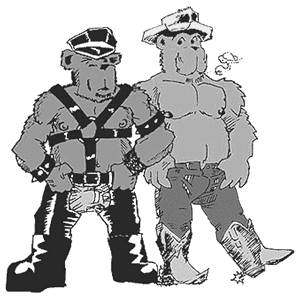
The Natural Bears Classification System (NBCS), also called the ‘bear code,’ is a set of symbols using letters, numbers and other characters commonly found on modern, Western computer keyboards, and used for the self-identification of those who self-identify as ‘bears’ in the sense of a mature gay or bisexual man with facial or substantial body hair.
These codes are used in email, Usenet, and Internet forum postings to identify the physical type and preferences of the poster.
read more »
Posted in Language, Sex |
Leave a Comment »
July 14, 2013
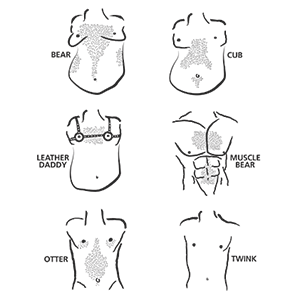
In gay culture, a Bear is a large, hairy man who projects an image of rugged masculinity. As a rising subculture in the gay and bisexual male communities, Bears are one of many LGBT communities with events, codes, and a culture-specific identity.
The term was popularized by Richard Bulger, who, along with his then partner Chris Nelson (1960–2006) founded ‘Bear Magazine’ in 1987. There is some contention surrounding whether Bulger originated the term and the subculture’s conventions. Author George Mazzei, for example, wrote an article for ‘The Advocate’ in 1979 called ‘Who’s Who in the Zoo?,’ that characterized homosexuals as seven types of animals, including bears.
read more »
Posted in Language, Sex |
1 Comment »
July 14, 2013
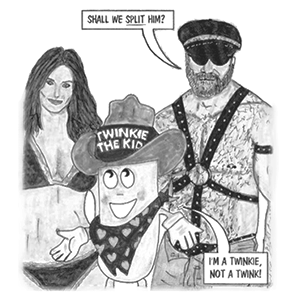
Twink [twingk] is a gay slang term describing a young or young-looking man with a slender, ectomorph build (long and thin), little or no body hair, and no facial hair. In some societies, the terms ‘fox,’ ‘plum,’ ‘chick,’ or ‘chicken’ are preferred. The related term ‘twinkle-toes,’ which implies that a man is effeminate, tends to be used in a derogatory manner. The terms can be complimentary or pejorative. The opposite of a twink in gay slang is a ‘bear,’ a large, hairy man who projects an image of rugged masculinity.
The term’s namesake is the ‘golden-colored phallic-shaped snack cake’ Hostess Twinkie, commonly regarded as the quintessential junk food: ‘little nutritional value, sweet to the taste and creme-filled.’ In ‘Queering Pornography: Desiring Youth, Race and Fantasy in Gay Porn,’ essayist Zeb J. Tortorici notes that gay twink porn thrives on the production and performance of ‘consumable and visually/anally receptive masculinity.’
read more »
Posted in Language, Sex |
Leave a Comment »
July 13, 2013

In historical analysis, biblical criticism and comparative mythology parallelomania [par-uh-lel-uh-mey-nee-uh] refers to a phenomenon where authors perceive apparent similarities and construct parallels and analogies without historical basis.
The concept was introduced to scholarly circles in 1961 by Rabbi Samuel Sandmel of the Hebrew Union College in a paper of the same title, where he stated that he had first encountered the term in a French book of 1830, but did not recall the author or the title. Sandmel stated that the simple observations of similarity between historical events are often less than valid, but at times lead to a phenomenon where authors first notice a supposed similarity, overdose on analogy, and then, ‘proceeds to describe source and derivation as if implying a literary connection flowing in an inevitable or predetermined direction.’
read more »
Posted in Education, Language, Philosophy |
Leave a Comment »
July 8, 2013
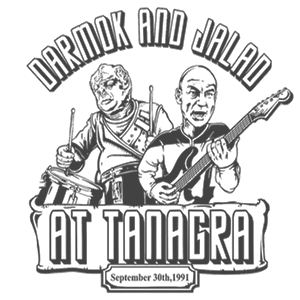
‘Darmok‘ is the 102nd episode of the science fiction television series ‘Star Trek: The Next Generation,’ the second episode of the fifth season. The episode features Paul Winfield, who previously played Captain Terrell in ‘Star Trek II: The Wrath of Khan.’
The senior crew discuss their latest mission: to make contact with the Tamarian race who have been transmitting signals toward Federation space for weeks. The Enterprise makes contact with a Tamarian ship in orbit around the planet El-Adrel. Though the universal translator can translate their words, the Tamarians only communicate through metaphor which baffles the Enterprise crew. Likewise, the Tamarians cannot understand Picard’s straightforward use of language.
read more »
Posted in Art, Language |
Leave a Comment »
July 3, 2013

An open secret is a concept or idea that is ‘officially’ secret or restricted in knowledge but is actually widely known; or it refers to something that is widely known to be true but which none of the people most intimately concerned is willing to categorically acknowledge in public.
The existence of the British Secret Intelligence Service (MI6) was widely known for several decades before the government’s official acknowledgement of the organization in 1994. Likewise, Delta Force, the elite US Army unit, can be considered an open secret, since its existence has been denied in the past by the government. Israel is widely acknowledged to possess nuclear weapons. This can be considered an open secret, because the Israeli government has never explicitly stated whether or not it possesses a nuclear stockpile, officially maintaining a policy of deliberate ambiguity.
read more »
Posted in Language, Politics, World |
1 Comment »


 The Daily Omnivore