April 24, 2013

Bullshit (also bullcrap) is a common English expletive which may be shortened to the euphemism bull or the initialism BS. In British English, ‘bollocks’ is a comparable expletive, although bullshit is commonly used in British English. It is a slang profanity term meaning either (literally) bovine excrement or, more commonly, ‘nonsense,’ especially in a rebuking response to communication or actions viewed as deceiving, misleading, disingenuous, or false. As with many expletives, the term can be used as an interjection or as many other parts of speech, and can carry a wide variety of meanings.
It can be used either as a noun or as a verb. While the word is generally used in a deprecating sense, it may imply a measure of respect for language skills, or frivolity, among various other benign usages. In philosophy, Harry Frankfurt, among others, analyzed the concept of bullshit as related to but distinct from lying. Outside of the philosophical and discursive studies, the everyday phrase bullshit conveys a measure of dissatisfaction with something or someone, but does not generally describe any role of truth in the matter.
read more »
Posted in Humor, Language, Philosophy |
Leave a Comment »
April 24, 2013

The Big Lie is a propaganda technique. The expression was coined by Adolf Hitler, when he dictated his 1925 book ‘Mein Kampf,’ about the use of a lie so ‘colossal’ that no one would believe that someone ‘could have the impudence to distort the truth so infamously.’
Hitler asserted the technique was used by Jews to unfairly blame Germany’s loss in World War I on German Army officer Erich Ludendorff.
read more »
Posted in Language, Politics, War |
Leave a Comment »
April 24, 2013
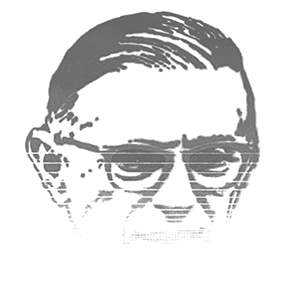
‘Being and Nothingness: An Essay on Phenomenological Ontology’ is a 1943 book by philosopher Jean-Paul Sartre. Its main purpose is to assert the individual’s existence as prior to the individual’s essence. Sartre’s overriding concern was to demonstrate that free will exists.
While a prisoner of war in 1940 and 1941, Sartre read Martin Heidegger’s ‘Being and Time,’ an ontological investigation through the lens and method of Husserlian phenomenology (Husserl was Heidegger’s teacher). Reading ‘Being and Time’ initiated Sartre’s own inquiry leading to the publication in 1943 of ‘Being and Nothingnes’s whose subtitle is ‘A Phenomenological Essay on Ontology.’
read more »
Posted in Language, Philosophy |
1 Comment »
April 22, 2013

Simplicity is the state or quality of being simple; it usually relates to the burden which a thing puts on someone trying to explain or understand it.
However, Herbert A. Simon (American political scientist, economist, sociologist, and psychologist) suggested, something is simple or complex depending on the way we choose to describe it. In some uses, simplicity can be used to imply beauty, purity, or clarity.
read more »
Posted in Language, Philosophy, Technology |
Leave a Comment »
April 22, 2013

Elegance is the attribute of being unusually effective and simple. It is frequently used as a standard of tastefulness, particularly in the areas of fashion and decoration. Some associate elegance with simplicity of design. Others understand the word in an opulent light as in tasteful richness of design or ornamentation. Visual stimuli are frequently considered elegant if a small number of colors and stimuli are used, emphasizing the remainder. The color white is often associated with elegance, usually along with blue or black.
Elegance is a synonym for beauty that has come to acquire the additional connotations of unusual effectiveness and simplicity. It is frequently used as a standard of tastefulness particularly in the areas of visual design, decoration, the sciences, and the esthetics of mathematics. Elegant things exhibit refined grace and dignified propriety.
read more »
Posted in Art, Language, Philosophy |
Leave a Comment »
April 19, 2013
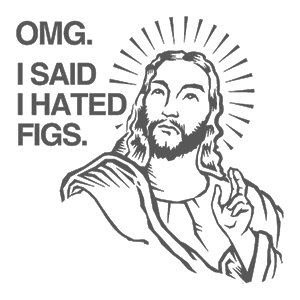
A hater is a person who expresses hatred in public forums, especially those found on the Internet such as YouTube. Haters are distinguished from trolls who seek to attract attention by making provocative comments.
Haters may become organized into groups and the seven stage model of hate crime developed by Schafer and Navarro for the FBI may explain their behavior: 1) the hater finds other with similar views to form a group; 2) the group develops symbols and rituals to identify itself; 3) the group shares its views to bond; 4) the target is taunted; 5) the target is attacked; 6) the target is attacked with weapons; and 7) the target is destroyed.
Posted in Language, Politics |
Leave a Comment »
April 17, 2013

A white elephant is an idiom for a valuable but burdensome possession of which its owner cannot dispose and whose cost (particularly cost of upkeep) is out of proportion to its usefulness or worth. The term derives from the story that the kings of Siam (now Thailand) were accustomed to make a present of one of these animals to courtiers who had rendered themselves obnoxious, in order to ruin the recipient by the cost of its maintenance. In modern usage, it is an object, scheme, business venture, facility, etc., considered to be without use or value.
The term derives from the sacred white elephants kept by Southeast Asian monarchs in Burma, Thailand, Laos, and Cambodia. To possess a white elephant was regarded (and is still regarded in Thailand and Burma) as a sign that the monarch reigned with justice and power, and that the kingdom was blessed with peace and prosperity.
read more »
Posted in Language, Philosophy |
Leave a Comment »
April 16, 2013
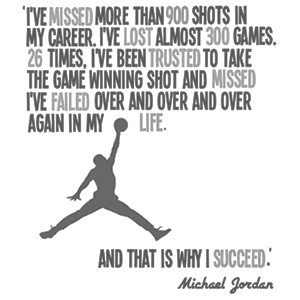
Failure is the state or condition of not meeting a desirable or intended objective, and may be viewed as the opposite of success. Product failure ranges from failure to sell the product to fracture of the product, in the worst cases leading to personal injury, the province of forensic engineering. Former IBM CEO Thomas J. Watson is attributed with saying ‘If you want to succeed, double your failure rate.’ ‘
Wired Magazine’ editor Kevin Kelly likewise explains that a great deal can be learned from things going unexpectedly, and that part of science’s success comes from keeping blunders ‘small, manageable, constant, and trackable.’ He uses the example of engineers and programmers who push systems to their limits, breaking them to learn about them. Kelly also warns against creating a culture (e.g. school system) that punishes failure harshly, because this inhibits a creative process, and risks teaching people not to communicate important failures with others (e.g. Null results).
read more »
Posted in Language, Money, Science |
Leave a Comment »
April 16, 2013

The evil twin is an antagonist found in many different fictional genres. They are physical copies of protagonists, but with radically inverted moralities. In filmed entertainment, they can have obvious physical differences with the protagonist—such as facial hair (often a goatee), eyepatches, scars or distinctive clothing—that make it easy for the audience to visually identify the two characters. Sometimes, however, the physical differences between the characters will be minimized, so as to confuse the audience. Both roles are almost always played by either the same actor or the actor’s actual twin (if the actor has one).
Though there may be moral disparity between actual biological twins, the term is more often a misnomer. In many cases, the two look-alikes are not actually twins, but rather physical duplicates produced by other phenomena (e.g. alternate universes). In others, the so-called ‘evil’ twin is more precisely a dual opposite to their ‘good’ counterpart, possessing at least some commonality with the value system of the protagonist.
read more »
Posted in Humor, Language, Philosophy |
Leave a Comment »
April 16, 2013
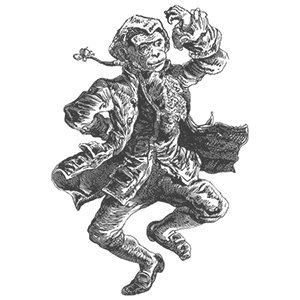
Signifyin’ (vernacular) is a practice in African-American culture, involving a verbal strategy of indirection that exploits the gap between the denotative and figurative meanings of words. According to African-American literary scholar Henry Louis Gates Jr., the practice derived from the Trickster archetype found in much African mythology, folklore, and religion: a god, goddess, spirit, man, woman, or anthropomorphic animal who plays tricks or otherwise disobeys normal rules and societal norms. In practice, signifyin’ often takes the form of quoting from subcultural vernacular, while extending the meaning at the same time through a rhetorical figure.
The expression itself derives from the numerous tales about the Signifying Monkey, a folk trickster figure said to have originated during slavery in the United States. In most of these narratives, the Monkey manages to dupe the powerful Lion by signifying. Signifyin(g) directs attention to the connotative, context-bound significance of words, which is accessible only to those who share the unique cultural values of a given speech community.
read more »
Posted in Humor, Language, Politics |
Leave a Comment »
April 15, 2013

The Signifying Monkey is a character of African-American folklore that derives from the trickster figure of Yoruba mythology, Esu Elegbara. This character was transported with Africans to the Americas under the names of Exu, Echu-Elegua, Papa Legba, and Papa Le Bas. Esu and his variants all serve as messengers who mediated between the gods and men by means of tricks. The Signifying Monkey is ‘distinctly Afro-American’ but is thought to derive from Yoruban mythology, which depicts Echu-Elegua with a monkey at his side.
Numerous songs and narratives concern the Signifying Monkey and his interactions with his friends, the Lion and the Elephant. In general the stories depict the Signifying Monkey insulting the Lion, but claiming that he is only repeating the Elephant’s words. The Lion then confronts the Elephant, who soundly beats the Lion. The Lion later comes to realize that the Monkey has been signifyin(g) and has duped him and returns angrily. The Signifying Monkey is a classic routine originally on a comedy album by Rudy Ray Moore.
Posted in Humor, Language |
Leave a Comment »
April 15, 2013
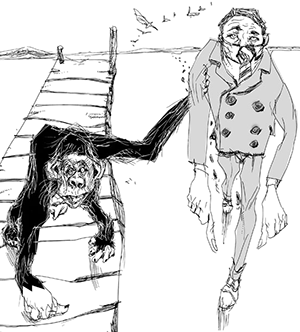
‘The Signifying Monkey: A Theory of African-American Literary Criticism’ is a work of literary criticism and theory by American scholar Henry Louis Gates Jr. first published in 1988. The book traces the folkloric origins of the African-American cultural practice of ‘signifying” and uses the concept to analyze the interplay between texts of prominent African American writers, specifically Richard Wright, Ralph Ellison, Zora Neale Hurston and Ishmael Reed.
Signifyin(g) is closely related to double-talk and trickery of the type used by the Monkey of these narratives, but, as Gates himself admits, ‘It is difficult to arrive at a consensus of definitions of signifyin(g).’ Bernard W. Bell defines it as an ‘elaborate, indirect form of goading or insult generally making use of profanity.’ Roger D. Abrahams writes that to signify is ‘to imply, goad, beg, boast by indirect verbal or gestural means.’ Signifyin(g) is a homonym with the concept of signification put forth by Semiotician Ferdinand de Saussure wherein the signifier (sound image) interacts with the signified (concept) to form one whole linguistic sign. Gates plays off this homonym and incorporates the linguistic concept of signifier and signified with the vernacular concept of signifyin(g).
read more »
Posted in Humor, Language, Politics |
Leave a Comment »



