February 10, 2013

Naked Lunch is a novel by William S. Burroughs originally published in 1959. The book is structured as a series of loosely-connected vignettes. Burroughs stated that the chapters are intended to be read in any order.
The reader follows the narration of junkie William Lee, who takes on various aliases, from the US to Mexico, eventually to Tangier and the dreamlike Interzone (international zone, a type of extraterritoriality governed by international law). The vignettes (called ‘routines’) are drawn from Burroughs’ own experience in these places, and his addiction to drugs (heroin, morphine, and while in Tangier, ‘Majoun’—a strong marijuana confection—as well as a German opioid, brand name Eukodol, of which he wrote frequently).
read more »
Posted in Drugs, Language, Politics |
Leave a Comment »
February 8, 2013

‘A Study of History‘ is the 12-volume magnum opus of British historian Arnold J. Toynbee, finished in 1961, in which the author traces the development and decay of all of the major world civilizations in the historical record. Toynbee applies his model to each of these civilizations, detailing the stages through which they all pass: genesis, growth, time of troubles, universal state, and disintegration.
The major civilizations, as Toynbee sees them, are: Egyptian, Andean, Sinic, Minoan, Sumerian, Mayan, Indic, Hittite, Hellenic, Western, Orthodox Christian (Russia), Far Eastern, Orthodox Christian (main body), Persian, Arabic, Hindu, Mexican, Yucatec, and Babylonic. There are four ‘abortive civilizations’ (Abortive Far Western Christian, Abortive Far Eastern Christian, Abortive Scandinavian, Abortive Syriac) and five ‘arrested civilizations’ (Polynesian, Eskimo, Nomadic, Ottoman, Spartan).
read more »
Posted in Language, Politics, World |
1 Comment »
February 7, 2013
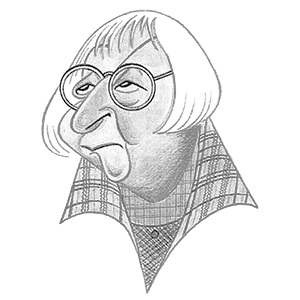
‘Dark Age Ahead‘ is a 2004 book by Jane Jacobs describing what she sees as the decay of five key ‘pillars’ in North America: community and family, higher education, science and technology, taxes and government responsive to citizen’s needs, and self-policing by the learned professions. She argues that this decay threatens to create a dark age unless the trends are reversed. Jacobs characterizes a dark age as a ‘mass amnesia’ where even the memory of what was lost is lost.
People are increasingly choosing consumerism over family welfare, that is: consumption over fertility; debt over family budget discipline; fiscal advantage to oneself at the expense of community welfare. Universities are more interested in credentials than providing high quality education. Economics has become as the main ‘science’ to consider in making major political decisions. Governments are more interested in deep-pocket interest groups than the welfare of the population. She describes, a culture that prevents people from understanding/realizing the deterioration of fundamental physical resources which the entire community depends on.
read more »
Posted in Language, Politics |
1 Comment »
February 7, 2013

Sturgeon’s revelation, commonly referred to as Sturgeon’s law, is an adage commonly cited as ‘ninety percent of everything is crap.’ It is derived from quotations by Theodore Sturgeon, an American science fiction author.
The phrase was derived from Sturgeon’s observation that while science fiction was often derided for its low quality by critics, it could be noted that the majority of examples of works in other fields could equally be seen to be of low quality and that science fiction was thus no different in that regard to other art.
read more »
Posted in Humor, Language |
Leave a Comment »
February 6, 2013
The ingénue [awn-zhuh-nyoo] is a stock character in literature, film, and a role type in the theater generally a girl or a young woman who is endearingly innocent and wholesome. Ingenue may also refer to a new young actress or one typecast in such roles.
The term comes from the French adjective ‘ingénu’ meaning ‘ingenuous’ or innocent, virtuous, and candid. The term may also imply a lack of sophistication and cunning.
read more »
Posted in Art, Language |
Leave a Comment »
February 5, 2013

Flaming Carrot Comics is a comic book series by cartoonist Bob Burden. The title character first appeared in ‘Visions’ #1, a magazine published by the Atlanta Fantasy Fair in 1979. ‘Flaming Carrot’ can be seen as a parody of various aspects of the superhero genre (though his origin story is much the same as that of Don Quixote).
‘The Flaming Carrot’ origin states that ‘having read 5,000 comics in a single sitting to win a bet, this poor man suffered brain damage and appeared directly thereafter as — the Flaming Carrot!’ Carrot, who lives in Palookaville, a neighborhood of Iron City, has staved off at least three alien invasions, a Communist take over, flying dead dogs, the Man in the Moon, Death itself, and a cloned horde of evil marching Hitler’s boots. Possessing no real super powers, the Carrot wins the day through sheer grit, raw determination, blinding stupidity, and bizarre luck.
read more »
Posted in Art, Humor, Language |
Leave a Comment »
February 5, 2013
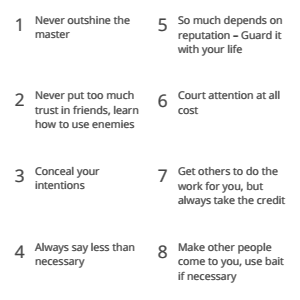
‘The 48 Laws of Power‘ (2000) is the first book by American author Robert Greene. The book, an international bestseller, is a practical guide for anyone who wants power, observes power, or wants to arm himself against power, and is popular with famous rappers, entrepreneurs, celebrities, athletes and actors including 50 Cent, Jay-Z, Kanye West, Dov Charney, Brian Grazer, Chris Bosh, and Will Smith. ‘The 48 Laws of Power’ is taught in business management classes and is one of the most requested books in American prison libraries.
The 48 Laws of Power are a distillation of 3,000 years of the history of power, drawing on the lives of strategists and historical figures like Niccolò Machiavelli, Sun Tzu, Carl von Clausewitz, Queen Elizabeth I, Henry Kissinger, and P.T. Barnum. The book is intended to show people how to gain power, preserve it, and defend themselves against power manipulators.
read more »
Posted in Language, Money, Politics |
Leave a Comment »
February 4, 2013
A double entendre is a figure of speech in which a spoken phrase is devised to be understood in either of two ways. Typically one of the interpretations is rather obvious whereas the other is more subtle. The more subtle of the interpretations may have a humorous, ironic, or risqué purpose. It may also convey a message that would be socially awkward, or even offensive, to state directly (the Oxford English Dictionary describes a double entendre as being used to ‘convey an indelicate meaning’).
A double entendre may exploit puns to convey the second meaning. Double entendres generally rely on multiple meanings of words, or different interpretations of the same primary meaning. They often exploit ambiguity and may be used to introduce it deliberately in a text. Sometimes a homophone (i.e. a different spelling that yields the same pronunciation) can be used as a pun as well as a ‘double entendre’ of the subject.
read more »
Posted in Humor, Language, Sex |
Leave a Comment »
February 4, 2013
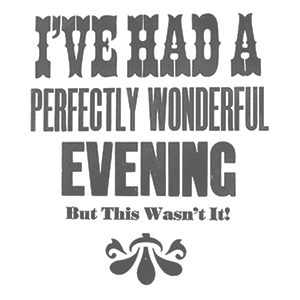
A paraprosdokian [par-uh-pros-doke-ee-uhn] is a figure of speech in which the latter part of a sentence or phrase is surprising or unexpected in a way that causes the reader or listener to reframe or reinterpret the first part. It is frequently used for humorous or dramatic effect, sometimes producing an anticlimax. For this reason, it is extremely popular among comedians and satirists. Some paraprosdokians not only change the meaning of an early phrase, but they also play on the double meaning of a particular word, creating a form of syllepsis.
‘Paraprosdokian’ comes from Greek for ‘against ‘expectation.’ Canadian linguist and etymology author William Gordon Casselman argues that, while the word is now in wide circulation, it is not a term of classical (or medieval) Greek or Latin rhetoric, but a late 20th century neologism. However, it occurs—with the same meaning—in Greek rhetorical writers of the 1st century BCE and the 1st and 2nd centuries CE.
Posted in Humor, Language |
2 Comments »
January 29, 2013
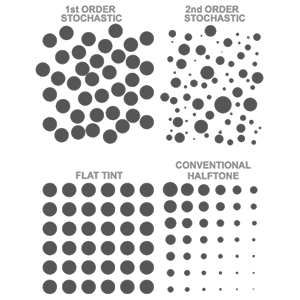
In the mathematics of probability, a stochastic [stuh-kas-tik] process is a random function, such as stock market and exchange rate fluctuations; signals such as speech, audio, and video; medical data such as a patient’s EKG, EEG, blood pressure, or temperature; and random movement such as Brownian motion (random moving of particles suspended in a fluid) or random walks (random, computer generated paths).
Other examples of random fields include static images, random topographies (landscapes), or composition variations of an inhomogeneous material. The stochastic process is the probabilistic counterpart to deterministic systems (in which no randomness is involved in the development of future states of the system). Instead of describing a process which can only evolve in one way, in a stochastic or random process there is some indeterminacy: even if the initial condition (or starting point) is known, there are several (often infinitely many) directions in which the process may evolve.
Posted in Language, Science |
Leave a Comment »
January 28, 2013

Mary Roach is an American author, specializing in popular science. She currently resides in Oakland, California. To date, she has published four books: ‘Stiff: The Curious Lives of Human Cadavers’ (2003), ‘Spook: Science Tackles the Afterlife’ (2005), ‘Bonk: The Curious Coupling of Science and Sex’ (2008) and ‘Packing for Mars: The Curious Science of Life in the Void’ (2010). Roach was raised in Etna, New Hampshire.
She received a bachelor’s degree in psychology from Wesleyan University in 1981. After college, Roach moved to San Francisco and spent a few years working as a freelance copy editor. She worked as a columnist, and also worked in public relations for a brief time. Her writing career began while working part-time at the San Francisco Zoological Society, producing press releases on topics such as elephant wart surgery.
read more »
Posted in Humor, Language, Science |
Leave a Comment »
January 28, 2013
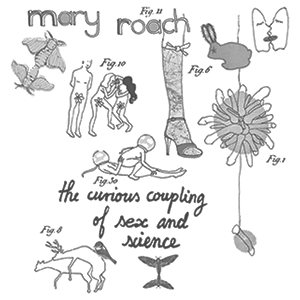
Bonk: The Curious Coupling of Science and Sex was written by Mary Roach in 2008. The book follows the winding history of science and its exploration of human sexuality, going back as far as Aristotle and finally ending with recent discoveries about the origination and anatomy of the female orgasm. Throughout, Mary Roach provides a humorous and often very personal view—both as a participant and observer—of humans, scientists, animals, and sex machines.
Of the book’s numerous accounts, Roach discusses artificial insemination of sows in Denmark, the notorious history of sex machines, as well as much discussion and commentary on Kinsey’s notorious attic sex experiments. Her footnotes provide additional humor; as in a sentence which includes several DSM diagnoses listed as acronyms she adds ‘And from HAFD (hyperactive acronym formation disorder).’ In the book, Mary Roach describes a session in which she and her husband Ed volunteer to have sex in a 20-inch-diameter (510 mm) MRI tube in the interests of science. During the experiment, a doctor looks on, making suggestions, and finally telling Ed that he ‘may ejaculate now.’
Posted in Humor, Language, Sex |
Leave a Comment »



