January 10, 2013

‘Moonwalking with Einstein: The Art and Science of Remembering Everything’ is a nonfiction book by Joshua Foer, first published in 2011. Foer describes his book as participatory journalism in the world of competitive memorization and attempts to delineate the capacity of the human mind. He sets out to investigate the underpinnings of those with enhanced memory, soon finding himself at the 2005 U.S. Memory Championship.
He covers the scientific basis of memory creation and historical attitudes towards memory, including its negative reputation in the Western educational system, a perception which Foer is largely opposed to. He explores common mnemonic tools for improving memory: the techniques of Roman rhetoricians and the tannaim (‘reciters’) of Sri Lanka, the Major System and the PAO System for memorizing numbers and cards, and Mind Mapping, a note-taking technique developed by educational consultant Tony Buzan. These methods are all a form of the method of loci, in which data is stored in a sequence of memorable images that are decomposable into their original form.
read more »
Posted in Education, Games, Language |
Leave a Comment »
January 9, 2013
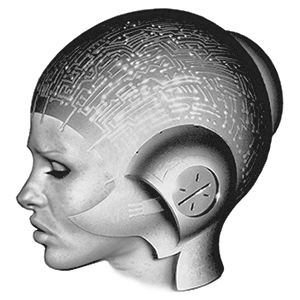
‘Burning Chrome‘ is a short story, written by William Gibson and first published in ‘Omni’ in 1982. Gibson first read the story at a science fiction convention in Denver in the autumn of 1981, to an audience of four people, among them Bruce Sterling (who Gibson later said ‘completely got it’). It was collected with the rest of Gibson’s early short fiction in a 1986 volume of the same name.
‘Burning Chrome’ tells the story of two hackers who breaking into computer systems for profit. The two main characters are Bobby Quine who specializes in software and Automatic Jack whose field is hardware. A third character in the story is Rikki, a girl with whom Bobby becomes infatuated and for whom he wants to become wealthy. Automatic Jack acquires a piece of Russian hacking software that is very sophisticated and hard to trace. The rest of the story unfolds with Bobby deciding to break into the system of a notorious and vicious criminal called Chrome, who handles money transfers for organized crime, and Automatic Jack reluctantly agreeing to help.
read more »
Posted in Art, Language, Technology |
Leave a Comment »
January 9, 2013

‘Neuromancer‘ is a 1984 novel by William Gibson, a seminal work in the cyberpunk genre and winner of the science-fiction ‘triple crown’ — the Nebula Award, the Philip K. Dick Award, and the Hugo Award. It was Gibson’s first novel and the beginning of the ‘Sprawl’ trilogy (which takes place in a near-future world dominated by corporations and ubiquitous technology, after a limited World War III).
The novel tells the story of a washed-up computer hacker hired by a mysterious employer to work on a dangerous hack. ‘Neuromancer’ is considered the archetypal cyberpunk work. Gibson himself coined the term ‘cyberspace’ in his novelette ‘Burning Chrome,’ published in 1982 by ‘Omni’ magazine.
read more »
Posted in Art, Language, Technology |
Leave a Comment »
January 8, 2013

Fear and Loathing: On the Campaign Trail ’72 is a collection of articles covering the 1972 presidential campaign written by Hunter S. Thompson and illustrated by Ralph Steadman. The articles were first serialized in ‘Rolling Stone’ magazine throughout 1972 and later released as a book in early 1973. The book focuses almost exclusively on the Democratic Party’s primaries and the breakdown of the party as it splits between the different candidates.
Of particular focus is the manic maneuvering of the George McGovern campaign during the Miami convention as they sought to ensure the Democratic nomination despite attempts by the Hubert Humphrey campaign and other candidates to block McGovern. Thompson began his coverage of the campaign in December 1971, just as the race toward the primaries was beginning, from a rented apartment in Washington, DC (a situation he compared to ‘living in an armed camp, a condition of constant fear’). Over the next 12 months, in voluminous detail, he covered every aspect of the campaign, from the smallest rally to the raucous conventions.
read more »
Posted in Humor, Language, Politics |
Leave a Comment »
January 8, 2013
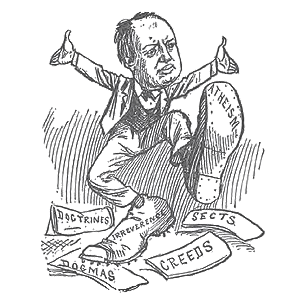
Robert Ingersoll (1833 – 1899) was a Civil War veteran, American political leader, and orator during the Golden Age of Freethought, noted for his broad range of culture and his defense of agnosticism. He was nicknamed ‘The Great Agnostic.’ He was born in upstate New York.
His father, John, was an abolitionist-leaning Congregationalist preacher, whose radical views forced his family to move frequently. For a time, Rev. Ingersoll filled the pulpit for American revivalist Charles G. Finney while Finney was on a tour of Europe. Upon Finney’s return, Rev. Ingersoll remained for a few months as co-pastor/associate pastor under Finney.
read more »
Posted in Language, Philosophy, Politics |
Leave a Comment »
January 8, 2013

Mottainai is a Japanese term meaning ‘a sense of regret concerning waste when the intrinsic value of an object or resource is not properly utilized.’
The expression can be uttered alone as an exclamation when something useful, such as food or time, is wasted, meaning roughly ‘Oh, what a waste!’ In addition to its primary sense of ‘wasteful,’ the word is also used to mean ‘impious; irreverent’ or ‘more than one deserves.’
read more »
Posted in Language, Money, World |
1 Comment »
January 7, 2013

Paralanguage refers to non-verbal elements of spoken communication used to modify meaning and convey emotion, such as change in pitch, volume, or intonation. Paralanguage may be expressed consciously or unconsciously. The term ‘paralanguage’ should not be confused with ‘kinesics,’ or the study of body language. While kinesics is non-linguistic (it is not necessarily related to vocal or written language), paralanguage is. Paralinguistic information, because it is phenomenal, belongs to the external speech signal but not to the arbitrary conventional code of language.
The paralinguistic properties of speech play an important role in human speech communication. There are no utterances or speech signals that lack paralinguistic properties, since speech requires the presence of a voice that can be modulated. This voice must have some properties, and all the properties of a voice as such are paralinguistic. However, the distinction linguistic vs. paralinguistic applies not only to speech but to writing and sign language as well, and it is not bound to any sensory modality. Even vocal language has some paralinguistic as well as linguistic properties that can be seen (lip reading, McGurk effect), and even felt, e.g. by the Tadoma method (a touch based language for the deafblind).
read more »
Posted in Health, Language, Science |
Leave a Comment »
January 7, 2013

Nunchi refers to a concept in Korean culture that describes the subtle art and ability to listen and gauge others’ moods. In Western culture, nunchi could be described as the concept of emotional intelligence. In Korea, it is the person’s ‘kibun’ being read, which is his or her pride, mood, or state of mind. It is of central importance to the dynamics of interpersonal relationships in Korean culture.
Nunchi is literally translated as ‘eye-measure.’ It is closely related to the broader concept of paralanguage (non-verbal elements of communication used to modify meaning and convey emotion), however nunchi also relies on an understanding of one’s status relative to the person with whom they’re interacting. It can be seen as the embodiment of skills necessary to communicate effectively in Korea’s high context culture. The concept of nunchi, and one’s abundance or lack thereof, forms the basis of many common expressions and idioms. For example, a socially clumsy person can be described as ‘nunchi eoptta,’ meaning ‘absence of nunchi.’
Posted in Health, Language, World |
Leave a Comment »
January 6, 2013

Black propaganda is false information and material that purports to be from a source on one side of a conflict, but is actually from the opposing side. It is typically used to vilify, embarrass or misrepresent the enemy.
Black propaganda contrasts with grey propaganda, the source of which is not identified, and white propaganda, in which the real source is declared and usually more accurate information is given, albeit slanted, distorted and omissive. Black propaganda is covert in nature in that its aims, identity, significance, and sources are hidden.
read more »
Posted in Language, Politics, War |
Leave a Comment »
January 6, 2013
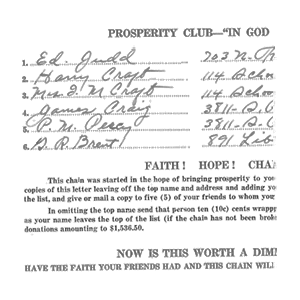
A typical chain letter consists of a message that attempts to convince the recipient to make a number of copies of the letter and then pass them on to as many recipients as possible. Common methods used in chain letters include emotionally manipulative stories, get-rich-quickly pyramid schemes, and the exploitation of superstition to threaten the recipient with bad luck or even physical violence or death if he or she ‘breaks the chain’ and refuses to adhere to the conditions set out in the letter.
Chain letters started as actual letters that one received in the mail. Today, chain letters are generally no longer actual letters. They are sent through email messages, postings on social network sites, and text messages.
read more »
Posted in Language, Money, Technology |
Leave a Comment »
January 6, 2013

Viral phenomena are objects or patterns able to replicate themselves or convert other objects into copies of themselves when these objects are exposed to them.
The concept of something, other than a biological virus, being viral came into vogue just after the Internet became widely popular in the mid-to-late 1990s. An object, even an immaterial object, is considered to be viral when it has the ability to spread copies of itself or change other similar objects to become more like itself when those objects are simply exposed to the viral object.
read more »
Posted in Health, Language, Technology |
Leave a Comment »
January 6, 2013

Memetic [meh-met-ik] engineering is a term developed and coined by Leveious Rolando, John Sokol, and Gibran Burchett while they researched and observed the behavior of people after being purposely exposed (knowingly and unknowingly) to certain memetic themes. The term is based on Richard Dawkins’ theory of memes (a proposed basic unit of cultural information).
Memetic engineering refers to the process of developing memes, through ‘meme-splicing’ and ‘memetic synthesis,’ with the intent of altering the behavior of others in society or humanity; the process of creating and developing theories or ideologies based on an analytical study of societies, cultures, their ways of thinking and the evolution of their minds; and the process of modifying human beliefs, thought patterns, etc.
read more »
Posted in Language, Science, Technology |
Leave a Comment »



