January 2, 2013
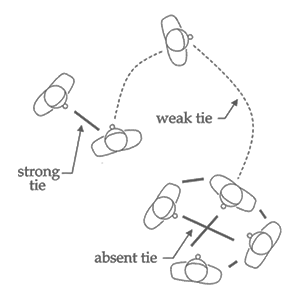
Heterophily [het-er-uh-fil-ee], or ‘love of the different,’ is the tendency of individuals to collect in diverse groups; it is the opposite of homophily (‘love of the same,’ the tendency of individuals to associate and bond with similar others). This phenomenon is notable in successful organizations, where the resulting diversity of ideas is thought to promote an innovative environment. Recently it has become an area of social network analysis. Most of the early work in heterophily was done in the 1960s by sociologist Everett Rogers in his book ‘Diffusion Of Innovations.’
Rogers showed that heterophilious networks were better able to spread innovations. Later, scholars such as Paul Burton, draw connections between modern Social Network Analysis as practiced by Stanford sociologist Mark Granovetter in his theory of weak ties (if A is linked to both B and C, then there is a greater-than-chance probability that B and C are linked to each other) and the work of German sociologist Georg Simmel. Burton found that Simmel’s notion of ‘the stranger’ is equivalent to Granovetter’s weak tie in that both can bridge homophilious networks, turning them into one larger heterophilious network.
Posted in Language, Science, Technology |
Leave a Comment »
January 2, 2013
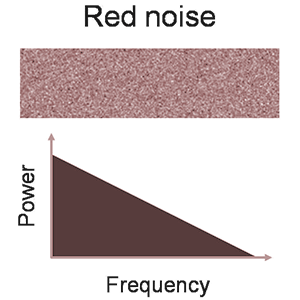
Noises are classified based on their spectral properties; they are named for the color they most resemble in the visible light spectrum. If the sound wave pattern of ‘red noise’ were translated into light waves, the resulting light would be red, and so on. White noise is an audio signal that contains all the frequencies audible to the human ear. It is analogous to white light, which contains all the colors of light visible to the human eye.
Pink noise is a signal that is louder at low frequencies and decreases at a constant rate. It is sometimes referred to as flicker noise particularly when it describes background noise emitted by an electronic device. Pink noise is used to make music, sound effects, or merely as a pleasant background sound and is reported to sound more like the ocean than white noise (which is often compared to the sound of rainfall or TV static) because of its bias towards lower frequencies.
read more »
Posted in Language, Science, Technology |
Leave a Comment »
December 30, 2012

Neophobia [nee-oh-foh-bee-uh] is the fear of new things or experiences. It is also called cainophobia. In psychology, neophobia is defined as the persistent and abnormal fear of anything new. In its milder form, it can manifest as the unwillingness to try new things or break from routine.
Mild manifestations are often present in young children (who want the small portion of the world that they ‘know’ to remain constant) and elderly people (who often cope using long established habits and don’t want to learn ‘new tricks’).
read more »
Posted in Food, Health, Language |
3 Comments »
December 29, 2012

The tragic mulatto [muh-lat-oh] is a stereotypical fictional character that appeared in American literature during the 19th and 20th centuries, from the 1840s.
The ‘tragic mulatto’ is an archetypical mixed-race person (a ‘mulatto’), who is assumed to be sad, or even suicidal, because they fail to completely fit in the ‘white world’ or the ‘black world.’ As such, the ‘tragic mulatto’ is depicted as the victim of the society they live in, a society divided by race.
read more »
Posted in Art, Language, Politics |
Leave a Comment »
December 29, 2012

Negative capability describes the capacity of human beings to transcend and revise their contexts. The term has been used by poets and philosophers to describe the ability of the individual to perceive, think, and operate beyond any presupposition of a predetermined capacity of the human being.
It further captures the rejection of the constraints of any context, and the ability to experience phenomenon free from epistemological bounds, as well as to assert one’s own will and individuality upon their activity. The term was first used by the Romantic poet John Keats to critique those who sought to categorize all experience and phenomena and turn them into a theory of knowledge.
read more »
Posted in Art, Language, Philosophy |
1 Comment »
December 29, 2012

Ithkuil is a constructed language marked by outstanding grammatical complexity, expressed with a rich phonemic inventory or through an original, graphically structured, system of writing. The language’s author, John Quijada, presents Ithkuil as a cross between an a priori philosophical and a logical language designed to express deeper levels of human cognition overtly and clearly, particularly in regard to human categorization, yet briefly. It also strives to minimize the ambiguities and semantic vagueness found in natural human languages.
The many examples from the original grammar book show that a message, like a meaningful phrase or a sentence, can usually be expressed in Ithkuil with fewer sounds, or lexically distinct speech-elements, than in natural human languages. Quijada deems his creation too complex and strictly regular a language to have developed ‘naturally,’ but nonetheless a language suited for human conversation. No person is hitherto known to be able to speak Ithkuil fluently; Quijada, for one, does not.
read more »
Posted in Language, Philosophy, World |
Leave a Comment »
December 24, 2012

‘No Logo: Taking Aim at the Brand Bullies’ is a book by Canadian author Naomi Klein.
First published in December 1999, shortly after the 1999 WTO Ministerial Conference protests in Seattle had generated media attention around such issues, it became one of the most influential books about the alter-globalization movement. The book focuses on branding, and often makes connections with the alter-globalization movement (also known as the the global justice movement).
read more »
Posted in Language, Money, Politics |
1 Comment »
December 23, 2012

The Adbusters Media Foundation is a Canadian-based not-for-profit, anti-consumerist, pro-environment organization founded in 1989 by Kalle Lasn and Bill Schmalz in Vancouver. Adbusters describes itself as ‘a global network of artists, activists, writers, pranksters, students, educators and entrepreneurs who want to advance the new social activist movement of the information age.’
Characterized by some as anti-capitalist or opposed to capitalism, it publishes the reader-supported, advertising-free ‘Adbusters,’ an activist magazine with an international circulation of 120,000 devoted to challenging consumerism. Adbusters has launched numerous international campaigns, including ‘Buy Nothing Day,’ ‘TV Turnoff Week,’ and ‘Occupy Wall Street,’ and is known for their ‘subvertisements’ that spoof popular advertisements.
read more »
Posted in Language, Money, Politics |
Leave a Comment »
December 22, 2012

Ingri (1904 – 1980) and Edgar (1898 – 1986) Parin d’Aulaire [doe-lair] were married writers and illustrators of children’s books in the 20th century.
Using their research and travel experiences as inspiration, the husband and wife team produced 27 picture books for children. They also wrote and illustrated introductory books of Greek and Norse mythology.
read more »
Posted in Art, Education, Language |
Leave a Comment »
December 21, 2012

The Last Picture Show is a 1971 American drama film directed by Peter Bogdanovich, adapted from a semi-autobiographical 1966 novel of the same name by Larry McMurtry. Set in a small town in north Texas during the year November 1951 – October 1952, it is about the coming of age of Sonny Crawford (Timothy Bottoms) and his friend Duane Jackson (Jeff Bridges). The cast includes Cybill Shepherd in her film debut, Ben Johnson, Eileen Brennan, Ellen Burstyn, Cloris Leachman, Clu Gulager, Randy Quaid in his film debut, and John Hillerman.
For aesthetic and technical reasons it was shot in black and white, which was unusual for its time. The film was nominated for eight Academy Awards, including Best Picture, Best Director, and four nominations for acting: Ben Johnson and Jeff Bridges for Best Supporting Actor, and Ellen Burstyn and Cloris Leachman for Best Supporting Actress. It won two: Johnson and Leachman.
read more »
Posted in Art, Language |
Leave a Comment »
December 20, 2012

Affective computing is the study and development of systems and devices that can recognize, interpret, process, and simulate human affects.
It is an interdisciplinary field spanning computer sciences, psychology, and cognitive science, which originated at MIT with Rosalind Picard’s 1995 paper on affective computing. A motivation for the research is the ability to simulate empathy. The machine should interpret the emotional state of humans and adapt its behavior to them, giving an appropriate response for those emotions.
read more »
Posted in Health, Language, Technology |
Leave a Comment »
December 13, 2012

Psychohistory [sahy-koh-his-tuh-ree] is a fictional science in Isaac Asimov’s ‘Foundation’ universe which combines history, sociology, and mathematical statistics to make general predictions about the future behavior of very large groups of people. It was first introduced in the five short stories (1942–1944) which would later be collected as the 1951 novel ‘Foundation.’
Psychohistory depends on the idea that, while one cannot foresee the actions of a particular individual, the laws of statistics as applied to large groups of people could predict the general flow of future events. Asimov used the analogy of a gas: an observer has great difficulty in predicting the motion of a single molecule in a gas, but can predict the mass action of the gas to a high level of accuracy (physicists know this as the Kinetic theory). Asimov applied this concept to the population of his fictional Galactic Empire, which numbered a quintillion.
read more »
Posted in Art, Language, Science |
Leave a Comment »


 The Daily Omnivore