December 11, 2012
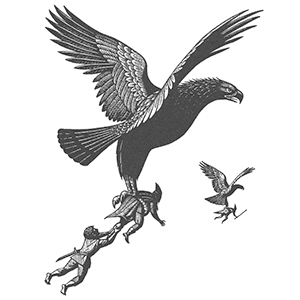
Eucatastrophe [yew-kuh-tas-truh-fee] is a term coined by J. R. R. Tolkien which refers to the sudden turn of events at the end of a story which ensure that the protagonist does not meet some terrible, impending, and very plausible doom. He formed the word by affixing the Greek prefix ‘eu,’ meaning ‘good,’ to ‘catastrophe,’ the word traditionally used in classically-inspired literary criticism to refer to the ‘unraveling’ or conclusion of a drama’s plot.
For Tolkien, the term appears to have had a thematic meaning that went beyond its implied meaning in terms of form. In his definition as outlined in his 1947 essay ‘On Fairy-Stories,’ it is a fundamental part of his conception of mythopoeia (the creation of myths). Though Tolkien’s interest is in myth, it is also connected to the gospels; Tolkien calls the Incarnation (God taking a physical form, as Jesus in Tolkien’s view) the eucatastrophe of ‘human history’ and the Resurrection the eucatastrophe of the Incarnation.
read more »
Posted in Art, Language |
1 Comment »
December 11, 2012
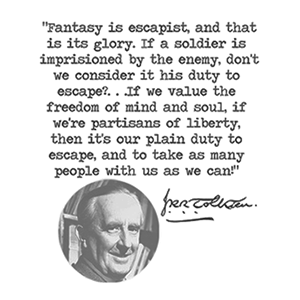
‘On Fairy-Stories‘ is an essay by J. R. R. Tolkien which discusses the fairy-tale as a literary form. It was initially written (and entitled simply ‘Fairy Stories’) for presentation by Tolkien as the Andrew Lang lecture at the University of St Andrews, Scotland, in 1939.
It first appeared in print, with some enhancement, in 1947, in a festschrift volume (a book honoring a respected person), ‘Essays Presented to Charles Williams,’ compiled by C. S. Lewis. British poet Charles Williams, a friend of Lewis’s, had been relocated with the Oxford University Press staff from London to Oxford during the London blitz in World War II. This allowed him to participate in gatherings of the Inklings (an informal literary discussion group) with Lewis and Tolkien.
read more »
Posted in Art, Language, Philosophy |
Leave a Comment »
December 6, 2012

The Shockwave Rider is a 1975 science fiction novel by John Brunner, notable for its hero’s use of computer hacking skills to escape pursuit in a dystopian future, and for the coining of the word ‘worm’ to describe a program that propagates itself through a computer network. It also introduces the concept of a ‘Delphi pool’ (a large group of people used as a statistical sampling resource), perhaps derived from the RAND Corporation’s Delphi method – a futures market on world events which bears close resemblance to DARPA’s controversial and cancelled Policy Analysis Market (dubbed the ‘Terrorism Market’ by the media).
The title derives from the futurist work ‘Future Shock’ by Alvin Toffler. The hero is a survivor in a hypothetical world of quickly changing identities, fashions, and lifestyles, where individuals are still controlled and oppressed by a powerful and secretive state apparatus. His highly developed computer skills enable him to use any public telephone to punch in a new identity, thus reinventing himself. As a fugitive, he must do this from time to time in order to escape capture. The title is also a metaphor for survival in an uncertain world.
read more »
Posted in Art, Language, Technology |
Leave a Comment »
December 6, 2012
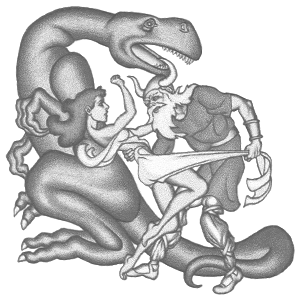
‘Sidewise in Time‘ is a science fiction short story by Murray Leinster that was first published in a 1934 issue of ‘Astounding Stories.’ In the story, professor Minott is a mathematician at Robinson College in Virginia who has determined that an apocalyptic cataclysm is fast approaching that could destroy the entire universe. The cataclysm manifests itself on June 5, 1935 (one year in the future in terms of the story’s original publication) when sections of the Earth’s surface begin changing places with their counterparts in alternate timelines.
A Roman legion from a timeline where the Roman Empire never fell appears on the outskirts of St. Louis, Missouri. Viking longships from a timeline where the Vikings settled North America raid a seaport in Massachusetts. A traveling salesman from Louisville, Kentucky finds himself in trouble with the law when he travels into an area where the South won the American Civil War. A ferry approaching San Francisco finds the flag of Czarist Russia flying from a grim fortress dominating the city.
read more »
Posted in Art, Language |
Leave a Comment »
December 6, 2012
‘A Logic Named Joe‘ is a science fiction short story by Murray Leinster that was first published in a 1946 issue of ‘Astounding Science Fiction.’ The story actually appeared under Leinster’s real name, Will F. Jenkins, since the issue also included a story under the Leinster pseudonym ‘Adapter.’
The story is particularly noteworthy as a prediction of massively networked personal computers and their drawbacks, written at a time when computing was in its infancy. The story’s narrator is a ‘logic’ (much like a personal computer) repairman nicknamed Ducky. In the story, a logic whom he names ‘Joe’ develops some degree of sapience and ambition.
read more »
Posted in Art, Language, Technology |
Leave a Comment »
December 5, 2012
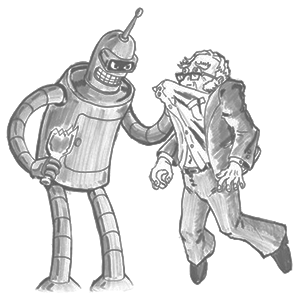
The Three Laws of Robotics are a set of rules devised by the science fiction author Isaac Asimov. The rules were introduced in his 1942 short story ‘Runaround,’ although they had been foreshadowed in a few earlier stories.
The Three Laws are: ‘A robot may not injure a human being or, through inaction, allow a human being to come to harm; A robot must obey the orders given to it by human beings, except where such orders would conflict with the First Law; and A robot must protect its own existence as long as such protection does not conflict with the First or Second Laws. These form an organizing principle and unifying theme for Asimov’s robotic-based fiction, appearing in his ‘Robot’ series, the stories linked to it, and his ‘Lucky Starr’ series of young-adult fiction.
read more »
Posted in Language, Politics, Technology |
1 Comment »
December 4, 2012
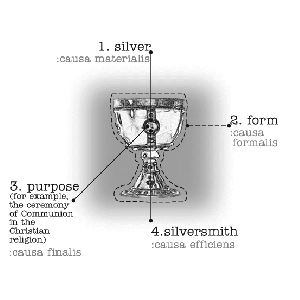
For German philosopher Martin Heidegger broadly, the question of being formed the essence of his philosophical inquiry.
In ‘The Question Concerning Technology‘ (‘Die Frage nach der Technik’), Heidegger sustains this inquiry, but turns to the particular phenomenon of technology, seeking to derive the essence of technology and humanity’s role of being with it. Heidegger originally published the text in 1954, in ‘Vorträge und Aufsätze’ (‘Letters and Essays’).
read more »
Posted in Language, Philosophy, Technology |
2 Comments »
December 4, 2012

Gestell [gesh-tell] is a German word used by philosopher Martin Heidegger to describe what lies behind or beneath modern technology. This concept was applied to Heidegger’s exposition of the essence of technology.
The conclusion regarding the essence of technology was that technology is fundamentally enframing. As such, the essence of technology is Gestell. Indeed, ‘Gestell, literally ‘framing,’ is an all-encompassing view of technology, not as a means to an end, but rather a mode of human existence.’
read more »
Posted in Language, Philosophy, Technology |
Leave a Comment »
December 4, 2012
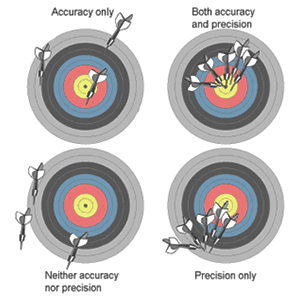
The accuracy of a measurement system is the degree of closeness of measurements of a quantity to that quantity’s actual value. The precision of a measurement system, also called reproducibility or repeatability, is the degree to which repeated measurements under unchanged conditions show the same results. Although the two words reproducibility and repeatability can be synonymous in colloquial use, they are deliberately contrasted in the context of the scientific method.
A measurement system can be accurate but not precise, precise but not accurate, neither, or both. For example, if an experiment contains a systematic error, then increasing the sample size generally increases precision but does not improve accuracy. The result would be a consistent yet inaccurate string of results from the flawed experiment. Eliminating the systematic error improves accuracy but does not change precision.
Posted in Language, Science |
Leave a Comment »
December 2, 2012
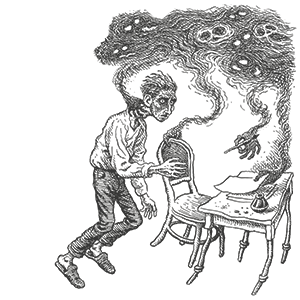
Introducing Kafka, also known as Kafka for Beginners, is a 1993 illustrated biography of Franz Kafka by David Zane Mairowitz and Robert Crumb. The book includes comic adaptations of some of Kafka’s most famous works including ‘The Metamorphosis,’ ‘A Hunger Artist,’ ‘In the Penal Colony,’ and ‘The Judgment,’ as well as brief sketches of his three novels ‘The Trial,’ ‘The Castle,’ and ‘Amerika.’
The book also details Kafka’s biography in a format that is part illustrated essay, part sequential comic panels. The book was released as part of the ‘Introducing…’ series by Totem Books which also features a volume each on Sigmund Freud and Wilhelm Reich. The popularity of Crumb’s renditions of Kafka’s works led to additional printings under the title ‘R. Crumb’s Kafka.’
Posted in Art, Humor, Language |
1 Comment »
November 30, 2012
David Rees (b. 1972) is a cartoonist and humorist whose best-known work combines bland clip art with outrageous ‘trash talk’ to incongruous effect. The comic strips have achieved wide popularity and some controversy.
Rees grew up in Chapel Hill, North Carolina and was an avid reader of ‘Rex Morgan, M.D.’ comics. He is a graduate of Oberlin College, and drew comics for the school’s newspaper. His office-cubicle humor is partly inspired by his experience working in a basement for Citicorp; he was later a part time fact-checker for ‘Maxim’ magazine and ‘Martha Stewart Weddings’ magazine, until he was laid off. Rees’s best-known and most controversial comic is ‘Get Your War On.’
read more »
Posted in Humor, Language, Money |
Leave a Comment »
November 29, 2012
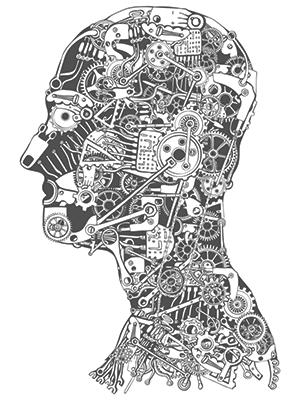
‘The Singularity Is Near: When Humans Transcend Biology’ is a 2005 update of Raymond Kurzweil’s 1999 book ‘The Age of Spiritual Machines’ and his 1990 book ‘The Age of Intelligent Machines.’ In it, as in the two previous versions, Kurzweil attempts to give a glimpse of what awaits us in the near future.
He proposes a coming technological singularity (a period of rapid change), and how we would thus be able to augment our bodies and minds with technology. He describes the singularity as resulting from a combination of three important technologies of the 21st century: genetics, nanotechnology, and robotics (including artificial intelligence).
read more »
Posted in Language, Technology |
Leave a Comment »


 The Daily Omnivore