December 4, 2012
For German philosopher Martin Heidegger broadly, the question of being formed the essence of his philosophical inquiry.
In ‘The Question Concerning Technology‘ (‘Die Frage nach der Technik’), Heidegger sustains this inquiry, but turns to the particular phenomenon of technology, seeking to derive the essence of technology and humanity’s role of being with it. Heidegger originally published the text in 1954, in ‘Vorträge und Aufsätze’ (‘Letters and Essays’).
read more »
Posted in Language, Philosophy, Technology |
2 Comments »
December 4, 2012

Gestell [gesh-tell] is a German word used by philosopher Martin Heidegger to describe what lies behind or beneath modern technology. This concept was applied to Heidegger’s exposition of the essence of technology.
The conclusion regarding the essence of technology was that technology is fundamentally enframing. As such, the essence of technology is Gestell. Indeed, ‘Gestell, literally ‘framing,’ is an all-encompassing view of technology, not as a means to an end, but rather a mode of human existence.’
read more »
Posted in Language, Philosophy, Technology |
Leave a Comment »
December 4, 2012
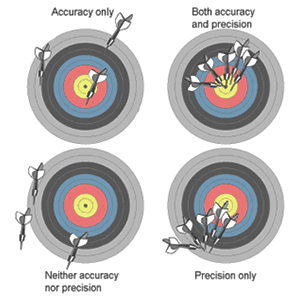
The accuracy of a measurement system is the degree of closeness of measurements of a quantity to that quantity’s actual value. The precision of a measurement system, also called reproducibility or repeatability, is the degree to which repeated measurements under unchanged conditions show the same results. Although the two words reproducibility and repeatability can be synonymous in colloquial use, they are deliberately contrasted in the context of the scientific method.
A measurement system can be accurate but not precise, precise but not accurate, neither, or both. For example, if an experiment contains a systematic error, then increasing the sample size generally increases precision but does not improve accuracy. The result would be a consistent yet inaccurate string of results from the flawed experiment. Eliminating the systematic error improves accuracy but does not change precision.
Posted in Language, Science |
Leave a Comment »
December 2, 2012
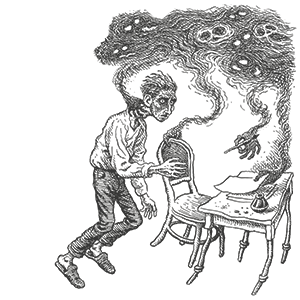
Introducing Kafka, also known as Kafka for Beginners, is a 1993 illustrated biography of Franz Kafka by David Zane Mairowitz and Robert Crumb. The book includes comic adaptations of some of Kafka’s most famous works including ‘The Metamorphosis,’ ‘A Hunger Artist,’ ‘In the Penal Colony,’ and ‘The Judgment,’ as well as brief sketches of his three novels ‘The Trial,’ ‘The Castle,’ and ‘Amerika.’
The book also details Kafka’s biography in a format that is part illustrated essay, part sequential comic panels. The book was released as part of the ‘Introducing…’ series by Totem Books which also features a volume each on Sigmund Freud and Wilhelm Reich. The popularity of Crumb’s renditions of Kafka’s works led to additional printings under the title ‘R. Crumb’s Kafka.’
Posted in Art, Humor, Language |
1 Comment »
November 30, 2012
David Rees (b. 1972) is a cartoonist and humorist whose best-known work combines bland clip art with outrageous ‘trash talk’ to incongruous effect. The comic strips have achieved wide popularity and some controversy.
Rees grew up in Chapel Hill, North Carolina and was an avid reader of ‘Rex Morgan, M.D.’ comics. He is a graduate of Oberlin College, and drew comics for the school’s newspaper. His office-cubicle humor is partly inspired by his experience working in a basement for Citicorp; he was later a part time fact-checker for ‘Maxim’ magazine and ‘Martha Stewart Weddings’ magazine, until he was laid off. Rees’s best-known and most controversial comic is ‘Get Your War On.’
read more »
Posted in Humor, Language, Money |
Leave a Comment »
November 29, 2012
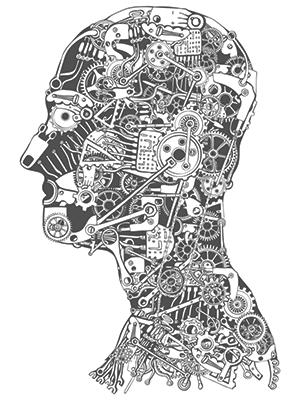
‘The Singularity Is Near: When Humans Transcend Biology’ is a 2005 update of Raymond Kurzweil’s 1999 book ‘The Age of Spiritual Machines’ and his 1990 book ‘The Age of Intelligent Machines.’ In it, as in the two previous versions, Kurzweil attempts to give a glimpse of what awaits us in the near future.
He proposes a coming technological singularity (a period of rapid change), and how we would thus be able to augment our bodies and minds with technology. He describes the singularity as resulting from a combination of three important technologies of the 21st century: genetics, nanotechnology, and robotics (including artificial intelligence).
read more »
Posted in Language, Technology |
Leave a Comment »
November 28, 2012
How to Speak Hip is a spoken-word comedy album by improv pioneer Del Close and John Brent, released by Mercury Records in 1959. The album is designed as a satire of language-learning records, where the secret language of the ‘hipster’ is treated as a foreign language.
Part of the joke, however, is that it actually does a good job of describing the Beat Generation/Beatnik sub-culture: Basic concepts such as ‘cool’ and ‘uncool’ are taught, as well as vocabulary building (‘dig,’ ‘dig it,’ ‘dig yourself, baby,’ ‘dig the chick,’ ‘dig the cat,’ ‘What a drag!’).
read more »
Posted in Art, Humor, Language |
Leave a Comment »
November 27, 2012

Patton’s Speech to the Third Army was given by General George S. Patton on June 5, 1944, the day before D-day. Patton delivered variations of the speech on several different occasions to his troops, although the June 5 date is the most well known. A hard copy of the speech exists. It has since become immortalized in George C. Scott’s rendition in the movie ‘Patton,’ where he delivers it in front of a large American flag. Patton’s actual words were so colorful that the movie edited and toned down the language, e.g. substituting ‘fornicating’ for ‘fucking.’ Certain phrases from the speech were also used in Scott’s dialogue later on in the film.
Patton’s speech was largely designed to motivate U.S. troops that were to be under fire. There had been much talk about superior German firepower, and the level of fear and doubt was so great in the armed forces that the U.S. Army even resorted to making propaganda films claiming that the infamous German machine gun, the MG-42 (a reliable and deadly weapon), had a bark louder than its bite. The Army did not want US soldiers to get pinned down, and knew that their forces would have to be motivated as they were to be charging German heavy fire on foot.
read more »
Posted in Death, Language, War |
2 Comments »
November 26, 2012

The Knowledge Graph is a knowledge base used by Google to enhance its search engine’s search results with semantic-search information gathered from a wide variety of sources. Knowledge Graph display was added to Google’s search engine in 2012, starting in the United States. It provides structured and detailed information about the topic in addition to a list of links to other sites. The goal is that users would be able to use this information to resolve their query without having to navigate to other sites and assemble the information themselves.
According to Google, this information is derived from many sources, including the CIA World Factbook, Freebase, and Wikipedia. The feature is similar in intent to answer engines such as Ask Jeeves and Wolfram Alpha. As of 2012, its semantic network contained over 500 million objects and more than 3.5 billion facts about and relationships between these different objects which are used to understand the meaning of the keywords entered for the search.
Posted in Education, Language, Technology |
Leave a Comment »
November 26, 2012
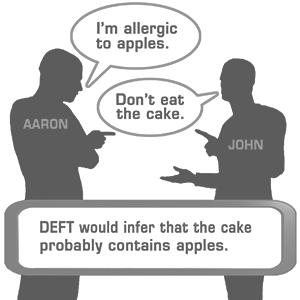
Natural language processing (NLP) is a field of computer science, artificial intelligence, and linguistics concerned with the interactions between computers and human (natural) languages.
As such, NLP is related to the area of human–computer interaction. Many challenges in NLP involve natural language understanding — that is, enabling computers to derive meaning from human or natural language input. An automated online assistant providing customer service on a web page, an example of an application where natural language processing is a major component.
read more »
Posted in Language, Technology, World |
Leave a Comment »
November 20, 2012

A memory hole is any mechanism for the alteration or disappearance of inconvenient or embarrassing documents, photographs, transcripts, or other records, such as from a web site or other archive, particularly as part of an attempt to give the impression that something never happened.
The concept was first popularized by George Orwell’s dystopian novel ‘Nineteen Eighty-Four,’ in which the memory hole is a small chute leading to a large incinerator used for censorship.
read more »
Posted in Language, Politics |
2 Comments »
November 19, 2012
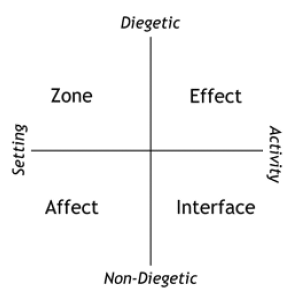
Diegesis [dahy-uh-jee-sis] is a style of storytelling in fiction which presents an interior view of a world and is: that world itself experienced by the characters in situations and events of the narrative; telling, recounting, as opposed to showing, enacting. In diegesis the narrator tells the story. The narrator presents to the audience or the implied readers the actions, and perhaps thoughts, of the characters.
Diegesis (‘narration’) and ‘mimesis’ (‘imitation’) have been contrasted since Plato’s and Aristotle’s times. Mimesis shows rather than tells, by means of action that is enacted. Diegesis, however, is the telling of the story by a narrator. The narrator may speak as a particular character or may be the invisible narrator or even the all-knowing narrator who speaks from above in the form of commenting on the action or the characters.
read more »
Posted in Art, Language, Philosophy |
1 Comment »



