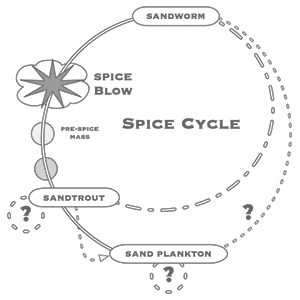
Melange [mey-lahnj] from French ‘mélange’ (‘set of diverse elements’) – also called the ‘spice’ – is the name of the fictional drug central to the ‘Dune’ series of science fiction novels by Frank Herbert, and derivative works.
In the series, the most essential and valuable commodity in the universe is melange, a geriatric drug that gives the user a longer life span, greater vitality, and heightened awareness; it can also unlock prescience (foreknowledge of events) in some humans, depending upon the dosage and the consumer’s physiology. This prescience-enhancing property makes safe and accurate interstellar travel possible. Melange comes with a steep price, however: it is addictive, and withdrawal is fatal.
read more »
October 22, 2012
Melange
October 21, 2012
Cognitive Surplus

‘Cognitive Surplus: Creativity and Generosity in a Connected Age’ is a 2010 non-fiction book by Clay Shirky. The book is an indirect sequel to Shirky’s ‘Here Comes Everybody,’ which covered the impact of social media. The book’s central theme is that people are now learning how to use more constructively the free time afforded to them since the 1940s for creative acts rather than consumptive ones, particularly with the advent of online tools that allow new forms of collaboration.
It goes on to catalog the means and motives behind these new forms of cultural production, as well as key examples. While Shirky acknowledges that the activities that we use our cognitive surplus for may be frivolous (such as creating ‘LOLcats’), the trend as a whole is leading to valuable and influential new forms of human expression. He also asserts that even the most inane forms of creation and sharing are preferable to the hundreds of billions of hours spent consuming television.
read more »
October 21, 2012
Here Comes Everybody

‘Here Comes Everybody: The Power of Organizing Without Organizations’ is a 2008 book by Clay Shirky, which evaluates the effect of the Internet on modern group dynamics. The author considers examples such as ‘Wikipedia’ and ‘MySpace’ in his analysis, and says his book is about ‘what happens when people are given the tools to do things together, without needing traditional organizational structure.’
The title of the work alludes to ‘HCE,’ a recurring and central figure in James Joyce’s ‘Finnegans Wake.’ In the book, Shirky recounts how social tools such as blogging software like WordPress and Twitter, file sharing platforms like Flickr, and online collaboration platforms like Wikipedia support group conversation and group action in a way that previously could only be achieved through institutions.
read more »
October 10, 2012
Rockism
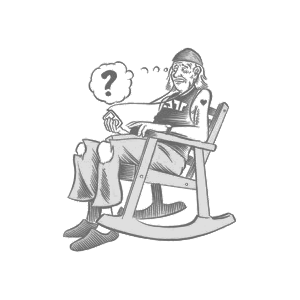
Rockism is a term referring to perceived biases in popular music criticism, coined by UK singer songwriter Pete Wylie in the early 1980s. The fundamental tenet of rockism is that some forms of popular music, and some musical artists, are more authentic than others. While there are many vague interpretations of it, rockism is essentially believed to treat rock music as normative.
From a rockist view, rock is the standard state of popular music. Interestingly, it is not entirely rockist to love rock, or to write about it. One may also care about R&B or norteño or bubblegum pop, but discuss them in a rockist way. The idea is built into the way people talk informally about what kinds of popular music interest them. Rockism is often suspicious of the use of computer-based production systems.
read more »
October 10, 2012
Assemblage
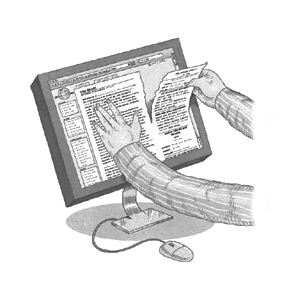
Assemblage [uh-sem-blij] refers to a text ‘built primarily and explicitly from existing texts in order to solve a writing or communication problem in a new context.’ The concept was first proposed by Johndan Johnson-Eilola (author of ‘Datacloud’) and Stuart Selber in the journal, ‘Computers & Composition,’ in 2007. The notion of assemblages builds on remix practices, which blur distinctions between invented and borrowed work.
Johnson-Eilola and Selber discuss the intertextual nature of writing, and they assert that participation in existing discourse necessarily means that composition cannot occur separate from that discourse. They state that ‘productive participation involves appropriation and re-appropriation of the familiar’ in a manner that conforms to existing discourse and audience expectations.
read more »
October 10, 2012
Swipe
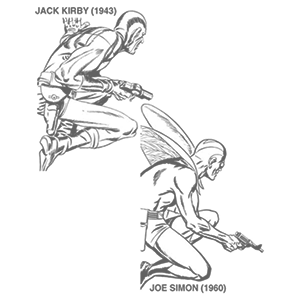
Swipe is a comics term that refers to the intentional copying of a cover, panel, or page from an earlier comic book or graphic novel without crediting the original artist.
Artists Jack Kirby, Neal Adams, Hergé, and Jim Lee are common targets of swipes (though even ‘The King’ is not above reproach: Kirby was known to have swiped from Hal Foster early in his career, as were many Golden Age artists — many of whom kept ‘swipe files’ of material to be copied as needed).
read more »
October 10, 2012
Beatboxing
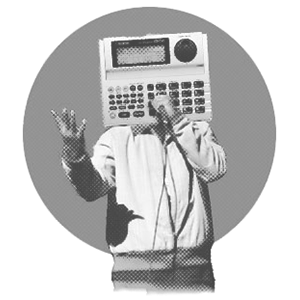
Beatboxing is a form of vocal percussion primarily involving the art of producing drum beats, rhythm, and musical sounds using one’s mouth, lips, tongue, and voice. It may also involve singing, vocal imitation of turntablism, and the simulation of horns, strings, and other musical instruments.
Beatboxing today is connected with hip-hop culture, being one of ‘the elements,’ although it is not limited to hip-hop music.
read more »
October 10, 2012
Freestyle Rap

Freestyle is a style of a cappella rap, with instrumental beats, in which rap lyrics are improvised, i.e. performed with no previously composed lyrics, or ‘off the top of the head.’ It is similar to other improvisational music such as jazz – Myka 9 of Freestyle Fellowship describes it as being ‘like a jazz solo’ where there is a lead saxophonist acting as the improviser and the rest of the band providing the beat. Rap battles are sometimes improvised in this way.
It is similar in both form and function to the ancient practice of flyting (contest consisting of the exchange of insults). Originally, in old school hip hop of the 1980s, the term ‘freestyle’ referred to a pre-written rap verse that was not on any particular subject matter, but rather was written for the purpose of demonstrating skill. The term is still occasionally used in this way, though since the 1990s, the majority of today’s artists use it to mean improvised rapping.
read more »
October 10, 2012
The Dozens

The Dozens is a game of spoken words between two contestants, common in Hip-hop/Urban communities, where participants insult each other until one gives up or violence erupts. It is customary for the Dozens to be played in front of an audience of bystanders, who encourage the participants to reply with more egregious insults to heighten the tension and consequently, to be more interesting to watch. It is also known as ‘sounding,’ ‘joning,’ ‘woofing,’ ‘sigging,’ or ‘signifying,’ while the insults themselves are known as ‘snaps.’
The origin of the game is unclear, but it has roots in Africa: similar contests are held in Nigeria among the Igbo people, and in Ghana. Comments in the game focus on the opposite player’s intelligence, appearance, competency, social status, financial situation, and disparaging remarks about the other player’s family members—mothers in particular (‘yo′ mama…’)—are common. Commentary is often related to sexual issues, where the game is then referred to as the ‘Dirty Dozens.’
read more »
October 10, 2012
Roast

A roast is an event, almost exclusively in the United States, in which an individual is subjected to a public presentation of comedic insults, praise, outlandish true and untrue stories, and heartwarming tributes, the implication being that the roastee is able to take the jokes in good humor and not as serious criticism or insult, and therefore, show their good nature.
It is seen by some as a great honor to be roasted, as the individual is surrounded by friends, fans, and well-wishers, who can receive some of the same treatment as well during the course of the evening. The party and presentation itself are both referred to as a ‘roast.’ The host of the event is called the ‘roastmaster.’ Anyone who is honored in such a way is said to have been ‘roasted.’
read more »
October 9, 2012
Propaganda Model
The propaganda model is a conceptual model in political economy advanced by Edward S. Herman and Noam Chomsky that states how propaganda, including systemic biases, function in mass media. The model seeks to explain how populations are manipulated and how consent for economic, social and political policies is ‘manufactured’ in the public mind due to this propaganda. The theory posits that the way in which news is structured (through advertising, media ownership, government sourcing and others) creates an inherent conflict of interest which acts as propaganda for undemocratic forces.
First presented in their 1988 book ‘Manufacturing Consent: The Political Economy of the Mass Media,’ the ‘propaganda model’ views the private media as businesses interested in the sale of a product—readers and audiences—to other businesses (advertisers) rather than that of quality news to the public. Describing the media’s ‘societal purpose,’ Chomsky writes, ‘… the study of institutions and how they function must be scrupulously ignored, apart from fringe elements or a relatively obscure scholarly literature.’
read more »
October 9, 2012
Manufacturing Consent
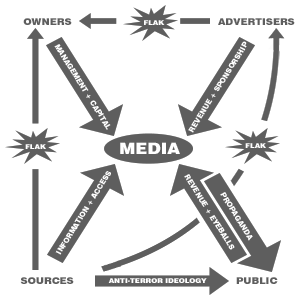
‘Manufacturing Consent: The Political Economy of the Mass Media’ (1988), by Edward S. Herman and Noam Chomsky, is an analysis of the news media, arguing that the mass media of the United States ‘are effective and powerful ideological institutions that carry out a system-supportive propaganda function by reliance on market forces, internalized assumptions, and self-censorship, and without overt coercion.’
The title derives from the phrase ‘the manufacture of consent’ that essayist–editor Walter Lippmann employed in the book ‘Public Opinion’ (1922). Chomsky has said that Australian social psychologist Alex Carey, to whom the book was dedicated, was in large part the impetus of his and Herman’s work. The book introduced the propaganda model of the media. A film, ‘Manufacturing Consent: Noam Chomsky and the Media,’ was later released based on the book.
read more »


 The Daily Omnivore