November 7, 2012
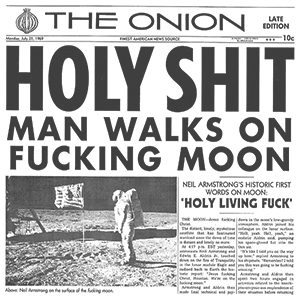
‘Our Dumb Century: The Onion Presents 100 Years of Headlines from America’s Finest News Source’ is a satirical humor book written by the staff of ‘The Onion’ and published in 1999. The chief editor of the book was Scott Dikkers, with specific sections edited by Robert D. Siegel, Maria Schneider, and John Krewson.
The book, spun off from ‘The Onion’ weekly-newspaper format of dryly satirizing current events, features mocked-up newspaper front pages from the entire 20th century, presented as though ‘The Onion’ had been continuously in print since before 1900. The publication of the book is in itself a parody of other end of the century retrospectives that had been published in 1999, notably ‘Time’ magazine and ‘The New York Times.’
read more »
Posted in Humor, Language, Politics |
Leave a Comment »
November 7, 2012


A hyperforeignism is a non-standard language form resulting from an unsuccessful attempt to apply the rules of a foreign language to a loan word (for example, the application of the rules of one language to a word borrowed from another) or, occasionally, a word believed to be a loan word.
The result reflects ‘neither the… rules of English nor those of the language from which the word in question comes.’
read more »
Posted in Language, World |
Leave a Comment »
November 7, 2012

The gay lisp is a stereotypical manner of speech associated with gay males, particularly in English-speaking countries, that involves their pronunciation of sibilant consonants (fricatives, made by directing a stream of air with the tongue towards the sharp edge of the teeth, which are held close together) and sometimes others verbal features.
The phenomenon of the ‘gay lisp’ and its study are poorly understood, similar to other secondary external attributes or verbal and non-verbal mannerisms of both gay and straight people. These attributes have proven difficult to define and quantify but seem somewhat independent of other variables in the phonology of the English language, such as accent and register.
read more »
Posted in Language, Sex |
Leave a Comment »
November 7, 2012
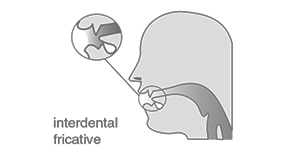

A fricative [frik-uh-tiv] is a consonant that is made when you squeeze air through a small hole or gap in your mouth. For example, the gaps in between your teeth can make fricative consonants. When the gaps in the teeth are used, these fricatives are called sibilants (e.g. ‘voiceless coronal sibilant,’ as in ‘sip’; ‘voiced coronal sibilant,’ as in ‘zip’). There are also non-sibilant fricatives (e.g. ‘voiceless labiodental fricative,’ as in ‘fine’; ‘voiced dental fricative,’ as in ‘that’).
A small number of languages including Navajo and Welsh have lateral fricatives (consonants, in which the airstream proceeds along the sides of the tongue, blocked by the tongue from going through the middle of the mouth). Many languages also have pseudo-fricatives (unvoiced vowels, e.g. ‘voiceless glottal transition,’ as in ‘hat’).
read more »
Posted in Language, World |
Leave a Comment »
November 6, 2012

There are numerous fallacious ideas and beliefs about the origins (or etymologies) of common English words. The word ‘fuck’ did not originate in Christianized Anglo-Saxon England as an acronym of ‘Fornication Under Consent of King’; nor did it originate as an acronym of ‘For Unlawful Carnal Knowledge,’ either as a sign posted above adulterers in the stocks, or as a criminal charge against members of the British Armed Forces; nor did it originate during the 15th-century Battle of Agincourt as a corruption of ‘pluck yew’ (an idiom falsely attributed to the English for drawing a longbow).
Modern English was not spoken until the 16th century, and words such as ‘fornication’ and ‘consent’ did not exist in any form in English until the influence of Anglo-Norman in the late 12th century. The earliest recorded use of ‘fuck’ in English comes from c. 1475, in the poem ‘Flen flyys,’ where it is spelled ‘fuccant’ (conjugated as if a Latin verb meaning ‘they fuck’). It is of Proto-Germanic origin, and is related to Dutch ‘fokken’ and Norwegian ‘fukka.’
read more »
Posted in Language, World |
Leave a Comment »
November 6, 2012
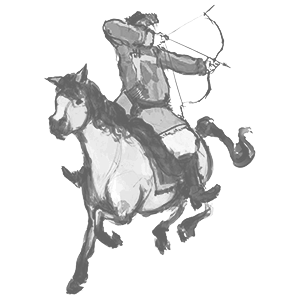
The Parthian [pahr-thee-uhn] shot was a military tactic made famous by the Parthians (an ancient Iranian empire). Their archers mounted on light horse, while retreating at a full gallop, would turn their bodies back to shoot at the pursuing enemy. The maneuver required superb equestrian skills, since the rider’s hands were occupied by his bow. As the stirrup had not been invented yet, the rider relied solely on pressure from his legs to guide his horse. The tactic was first employed by Eurasian nomads, including the Scythians, Huns, Turks, Magyars, and Mongols, before spreading to armies away from the Eurasian steppe, such as the Sassanid clibanariis and cataphract.
The Parthians famously used it to defeat the Roman general Crassus in the Battle of Carrhae. The phrase ‘parting shot’ has its origins from the Parthian shot. The first recorded usage was by John McCleod, surgeon on board the HMS Alceste contained in: ‘A narrative of a Voyage to the Yellow Sea’ (1818). The two phrases have rather similar phonetic soundings but are actually separately derived at different times. Although the Parthian archers of old have been famous for their shooting, the term ‘parthian shot’ was recorded for the first time in 1832 by Captain Mundy, ADC to Lord Combermere on a hunting trip in India.
Posted in Language, War, World |
1 Comment »
November 5, 2012

The phrase ‘naturalistic fallacy‘ refers to the claim that what is natural is inherently good or right, and that what is unnatural is bad or wrong (‘appeal to nature’). It is the converse of the ‘moralistic fallacy,’ the notion that what is good or right is natural and inherent. The naturalistic fallacy is related to (and even confused with) Hume’s ‘is–ought problem,’ which examines the difference between descriptive statements (about what is) and prescriptive or normative statements (about what ought to be).
Another usage of ‘naturalistic fallacy’ was described by British philosopher G. E. Moore in his 1903 book ‘Principia Ethica.’ Moore stated that a naturalistic fallacy is committed whenever a philosopher attempts to prove a claim about ethics by appealing to a definition of the term ‘good’ in terms of one or more natural properties (such as ‘pleasant,’ ‘more evolved,’ ‘desired,’ etc.).
read more »
Posted in Language, Philosophy, Science |
Leave a Comment »
November 4, 2012

Night Thoughts of a Classical Physicist is a 1918 novel by historian of science Russell McCormmach, which explores the world of physics in the early 20th century—including the advent of modern physics and the role of physicists in World War I—through the recollections of the fictional Viktor Jakob.
Jakob is an old German physicist who spent most of his career during the period of classical physics, a paradigm being confronted by the rapid and radical developments of relativistic physics of Albert Einstein in 1900s and 1910s. This conflict allows for extensive examination of the various tensions placed on Jakob by the academic environment, the German academic system and the changing academic culture of the early 20th century.
read more »
Posted in Language, Science |
Leave a Comment »
November 3, 2012


A paradigm [par-uh-dahym] shift (or revolutionary science) is, according to American physicist Thomas Kuhn, in his influential book ‘The Structure of Scientific Revolutions’ (1962), a change in the basic assumptions, or paradigms, within the ruling theory of science.
It is in contrast to his idea of ‘normal science’ (everyday problem solving within an existing paradigm). According to Kuhn, ‘A paradigm is what members of a scientific community, and they alone, share.’ Unlike a normal scientist, Kuhn held, ‘a student in the humanities has constantly before him a number of competing and incommensurable solutions to these problems, solutions that he must ultimately examine for himself.’
read more »
Posted in Language, Science |
Leave a Comment »
November 2, 2012

The Structure of Scientific Revolutions by Thomas S. Kuhn, is an analysis of the history of science, published in 1962. Its publication was a landmark event in the history, philosophy, and sociology of scientific knowledge and it triggered an ongoing worldwide assessment and reaction in—and beyond—those scholarly communities. In this work, Kuhn challenged the then prevailing view of progress in ‘normal science’ (the routine work of scientists experimenting within a paradigm).
Scientific progress had been seen primarily as ‘development-by-accumulation’ of accepted facts and theories. Kuhn argued for an episodic model in which periods of such conceptual continuity in normal science were interrupted by periods of revolutionary science. During revolutions in science the discovery of anomalies leads to a whole new paradigm that changes the rules of the game and the ‘map’ directing new research, asks new questions of old data, and moves beyond the puzzle-solving of normal science.
read more »
Posted in Language, Philosophy, Science |
1 Comment »
November 1, 2012
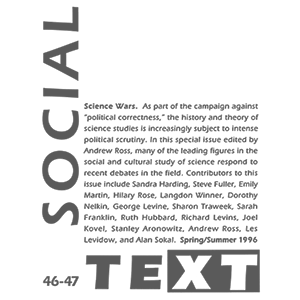
The science wars were a series of intellectual exchanges, between scientific realists and postmodernist critics, about the nature of scientific theory which took place principally in the United States in the 1990s. The postmodernists questioned scientific objectivity, and critiqued the scientific method and scientific knowledge in cultural studies, cultural anthropology, feminist studies, comparative literature, media studies, and science and technology studies. The scientific realists countered that objective scientific knowledge is real, and accused postmodernist critics of having little understanding of the science they were criticizing.
Until the mid-20th century, the philosophy of science had concentrated on the viability of scientific method and knowledge, proposing justifications for the truth of scientific theories and observations and attempting to discover on a philosophical level why science worked. Already Karl Popper had begun to attack this view. Popper denied outright that justification existed for such concepts as truth, probability or even belief in scientific theories, thereby laying fertile foundations for the growth of postmodernist attitudes.
read more »
Posted in Education, Language, Science |
Leave a Comment »
November 1, 2012
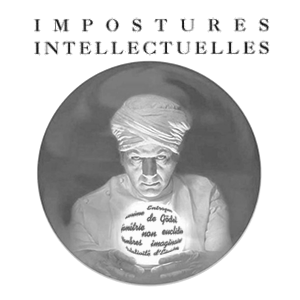
‘Fashionable Nonsense: Postmodern Intellectuals’ Abuse of Science’ (French: ‘Impostures Intellectuelles’) is a 1997 book by NYU physics professor Alan Sokal and Belgian theoretical physicist Jean Bricmont. Sokal is best known for the Sokal Affair, in which he submitted a deliberately absurd article to ‘Social Text,’ a critical theory journal, and was able to get it published. The English editions were revised for greater relevance to debates in the English-speaking world.
As part of the so-called ‘science wars’ (a series of intellectual exchanges, between scientific realists and postmodernist critics), the book criticizes postmodernism in academia for what it claims are misuses of scientific and mathematical concepts in postmodern writing. According to some reports, the response within the humanities was ‘polarized.’ Critics of Sokal and Bricmont charge that they lack understanding of the writing they were criticizing. Responses from the scientific community were more supportive.
read more »
Posted in Language, Philosophy, Science |
Leave a Comment »



