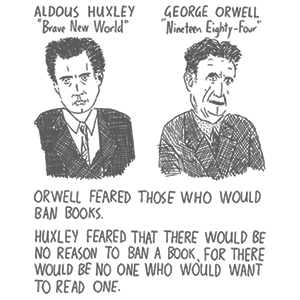
‘Amusing Ourselves to Death: Public Discourse in the Age of Show Business’ (1985) is a book by educator Neil Postman. The book’s origins lie in a talk Postman gave to the Frankfurt Book Fair in 1984. He was participating in a panel on Orwell’s ‘1984’ and the contemporary world. In the introduction to his book Postman said that the contemporary world was better reflected by Aldous Huxley’s ‘Brave New World,’ whose public was oppressed by their addiction to amusement, than by Orwell’s ‘Nineteen Eighty-Four,’ where they were oppressed by state control. It is regarded as one of the most important texts of media ecology (the study of how communication processes affect human perception).
Postman distinguishes the Orwellian vision of the future, in which totalitarian governments seize individual rights, from that offered by Aldous Huxley in ‘Brave New World,’ where people medicate themselves into bliss, thereby voluntarily sacrificing their rights. Drawing an analogy with the latter scenario, Postman sees television’s entertainment value as a present-day ‘soma,’ by means of which the consumers’ rights are exchanged for entertainment. (Note that there is no contradiction between an intentional ‘Orwellian’ conspiracy using ‘Huxleyan’ means)
read more »
Amusing Ourselves to Death
Technopoly

‘Technopoly: The Surrender of Culture to Technology’ is a book by Neil Postman published in 1992 that describes a society in which technology is deified, meaning ‘the culture seeks its authorization in technology, finds its satisfactions in technology, and takes its orders from technology.’ It is characterized by a surplus of information generated by technology, which technological tools are in turn employed to cope with, in order to provide direction and purpose for society and individuals. Postman considers technopoly to be the most recent of three kinds of cultures distinguished by shifts in their attitude towards technology – tool-using cultures, technocracies, and technopolies.
Each, he says, is produced by the emergence of new technologies that ‘compete with old ones…mostly for dominance of their worldviews.’ According to Postman, a tool-using culture employs technologies only to solve physical problems, as spears, cooking utensils, and water mills do, and to ‘serve the symbolic world’ of religion, art, politics and tradition, as tools used to construct cathedrals do. He claims that all such cultures are either theocratic or ‘unified by some metaphysical theory,’ which forced tools to operate within the bounds of a controlling ideology and made it ‘almost impossible for technics to subordinate people to its own needs.’
read more »
The Cult of the Amateur
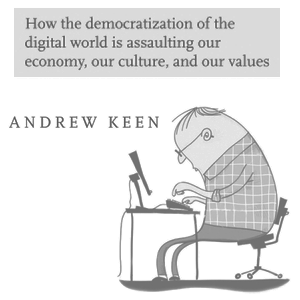
‘The Cult of the Amateur: How Today’s Internet Is Killing Our Culture’ is a 2007 book written by entrepreneur and Internet critic Andrew Keen; it is a critique of the enthusiasm surrounding user generated content, peer production, and other Web 2.0-related phenomena.
The book was written after Keen wrote a controversial essay in ‘The Weekly Standard’ criticizing Web 2.0 for being similar to Marxism, for destroying professionalism and for making it impossible to find high quality material amidst all the user-generated web content. The book was based in part on that essay. Keen argues against the idea of a ‘read-write culture’ in media, stating that ‘most of the content being shared— no matter how many times it has been linked, cross-linked, annotated, and copied— was composed or written by someone from the sweat of their creative brow and the disciplined use of their talent.’
read more »
Deletionism and Inclusionism


Deletionism and inclusionism are opposing philosophies that largely developed and came to public notice within the context of the community of editors of the online encyclopedia Wikipedia. The terms are connected to views on the appropriate scope of the encyclopedia, and the appropriate point for a topic to be allowed to ‘include’ an encyclopedia article (i.e., ‘inclusion’) or ‘delete’ the article (i.e., ‘deletion’).
Inclusionism and deletionism are broad terms falling within a spectrum of views. The concepts are closely related to the concept of notability, with deletionists and inclusionists taking a strong or relaxed stance on ‘notability’ accordingly. Many users do not identify strongly with either position. ‘Deletionists’ are proponents of selective coverage and removal of articles seen as unnecessary or highly substandard. Deletionist viewpoints are commonly motivated by a desire that Wikipedia be focused on and cover significant topics – along with the desire to place a firm cap upon proliferation of promotional use (seen as abuse of the website), trivia, and articles which are of no general interest, lack suitable source material for high quality coverage, or are too short or otherwise unacceptably poor in quality.
read more »
Reliability of Wikipedia


The reliability of Wikipedia (primarily of the English-language edition), compared to other encyclopedias and more specialized sources, is assessed in many ways, including statistically, through comparative review, analysis of the historical patterns, and strengths and weaknesses inherent in the editing process unique to Wikipedia.
Several studies have been done to assess the reliability of Wikipedia. A notable early study in the journal ‘Nature’ said that in 2005, ‘Wikipedia scientific articles came close to the level of accuracy in Encyclopædia Britannica and had a similar rate of ‘serious errors.’ The study was disputed by ‘Encyclopædia Britannica,’ and later ‘Nature’ responded to this refutation with both a formal response and a point-by-point rebuttal of Britannica’s main objections.
read more »
Wikiality
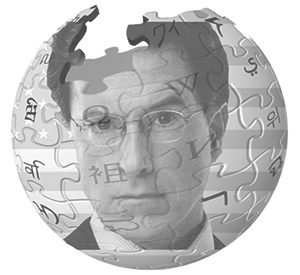

In a 2006 episode of the satirical news show ‘The Colbert Report,’ Stephen Colbert announced the neologism ‘Wikiality‘ (a portmanteau of the words ‘Wiki’ and ‘reality’) defined as ‘truth by consensus’ (rather than fact), modeled after the approval-by-consensus format of Wikipedia. He ironically praised Wikipedia for following his philosophy of ‘truthiness,’ in which intuition and consensus is a better reflection of reality than fact:
‘You see, any user can change any entry, and if enough other users agree with them, it becomes true. … If only the entire body of human knowledge worked this way. And it can, thanks to tonight’s word: ‘Wikiality.’ Now, folks, I’m no fan of reality, and I’m no fan of encyclopedias. I’ve said it before. Who is Britannica to tell me that George Washington had slaves? If I want to say he didn’t, that’s my right. And now, thanks to Wikipedia, it’s also a fact. We should apply these principles to all information. All we need to do is convince a majority of people that some factoid is true. … What we’re doing is bringing democracy to knowledge.’
read more »
Negative and Positive Atheism

Positive atheism (also called ‘strong atheism’ and ‘hard atheism’) is the form of atheism that asserts that no deities exist. Negative atheism (also called ‘weak atheism’ and ‘soft atheism’) is any other type of atheism, wherein a person does not believe in the existence of any deities, but does not explicitly assert there to be none.
The terms negative atheism and positive atheism were used by British philosopher Antony Flew in 1976,[1] and appeared again in Boston University philosopher Michael Martin’s writings in 1990. Because of flexibility in the term ‘god,’ it is possible that a person could be a positive/strong atheist in terms of certain conceptions of God, while remaining a negative/weak atheist in terms of others.
read more »
The End of Work

‘The End of Work: The Decline of the Global Labor Force and the Dawn of the Post-Market Era’ is a non-fiction book by American economist Jeremy Rifkin, published in 1995.
Rifkin contended that worldwide unemployment would increase as information technology eliminated tens of millions of jobs in the manufacturing, agricultural, and service sectors. He predicted devastating impact of automation on blue-collar, retail and wholesale employees.
read more »
Technology Evangelist

A technology evangelist is a person who attempts to build a critical mass of support for a given technology in order to establish it as a technical standard in a market that is subject to network effects (when such effects are present, the value of a product or service is dependent on the number of others using it).
Professional technology evangelists are often employed by firms which seek to establish their proprietary technologies as de facto standards or to participate in setting non-proprietary open standards. Non-professional technology evangelists may act out of altruism or self-interest (e.g., to gain the benefits of early adoption or the network effect).
read more »
Correlation does not imply Causation
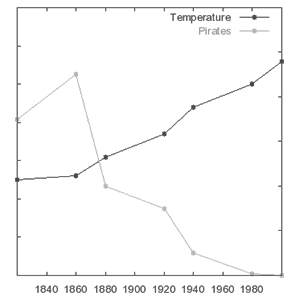
‘Correlation does not imply causation‘ is a phrase used in science and statistics to emphasize that a relationship between two variables does not automatically imply that one causes the other. The opposite belief, ‘correlation proves causation,’ is one of several questionable cause logical fallacies by which two events that occur together are claimed to have a cause-and-effect relationship.
The fallacy is also known as ‘cum hoc ergo propter hoc’ (Latin for ‘with this, therefore because of this’) and ‘false cause.’ It is a common fallacy in which it is assumed that, because two things or events occur together, one must be the cause of the other. By contrast, the fallacy, ‘post hoc ergo propter hoc,’ requires that one event occur after the other, and so may be considered a related fallacy.
read more »
Hysterical Realism

Hysterical realism, also called ‘recherché postmodernism,’ is a term coined in 2000 by the English critic James Wood in an essay for ‘The New Republic’ on Zadie Smith’s novel ‘White Teeth’ to describe what he sees as a literary genre typified by a strong contrast between elaborately absurd prose, plotting, or characterization and careful, detailed investigations of real specific social phenomena.
Wood uses the term to denote the contemporary conception of the ‘big, ambitious novel’ that pursues ‘vitality at all costs’ and consequently ‘knows a thousand things but does not know a single human being.’ He decried the genre as an attempt to ‘turn fiction into social theory,’ and an attempt to tell us ‘how the world works rather than how somebody felt about something.’ Wood points to Don DeLillo and Thomas Pynchon as the forefathers of the genre, which continues in writers like David Foster Wallace and Salman Rushdie.
read more »
Hypergamy

Hypergamy [hahy-pur-guh-mee] (colloquially referred to as ‘marrying up’) is the act or practice of seeking a spouse of higher looks, socioeconomic, caste or status than oneself. The term is often used more specifically in reference to a perceived tendency among human cultures for females to seek or be encouraged to pursue male suitors that are higher status than themselves, which often manifests itself as being attracted to men who are comparatively older, wealthier, or otherwise more privileged than themselves.
According to evolutionary psychologists, females have evolved a preference for higher status males because they offer their prospective children both ‘better’ genes and greater resources, e.g. food and security. Men, who invest less in their children, have less reason to prefer mates with high social status. Some have even argued that men ‘marry-down’ to ensure that their mates have a higher incentive to remain faithful.
read more »


 The Daily Omnivore
