July 25, 2012

Joke thievery is the act of performing and taking credit for comic material written by another person without their consent. This is a form of plagiarism and sometimes can be copyright infringement. A common epithet for a joke thief is ‘hack,’ which is derived from the term, ‘hackneyed’ (over used and thus cheapened, or trite).
From the music hall and vaudeville beginnings of stand-up comedy, joke thievery was common as there were few chances that a performer from one area would meet one from another and a single twenty-minute set could sustain a comic for a decade. Most jokes at the time were one-liners and there was little in the way of proof of a joke’s origin, but the value of each joke was immeasurable to a comedian. Milton Berle and Bob Hope had a long-standing feud due to Hope’s accusation that Berle had stolen some of his jokes. Berle never refuted the claim, but instead embraced the title ‘The Thief of Bad Gag.’
read more »
Posted in Humor, Language, Money |
Leave a Comment »
July 25, 2012

Truthiness is a quality characterizing a ‘truth’ that a person claims to know intuitively ‘from the gut’ or because it ‘feels right’ without regard to evidence, logic, intellectual examination, or facts. American television comedian Stephen Colbert coined the word in this meaning as the subject of a segment called ‘The Wørd’ during the 2005 pilot episode of his political satire program ‘The Colbert Report.’
By using this as part of his routine, Colbert satirized the misuse of appeal to emotion and ‘gut feeling’ as a rhetorical device in contemporaneous socio-political discourse. He particularly applied it to President George W. Bush’s nomination of Harriet Miers to the Supreme Court and the decision to invade Iraq in 2003. Colbert later ascribed truthiness to other institutions and organizations, including Wikipedia. Colbert has sometimes used a mock Latin version of the term, ‘Veritasiness.’
read more »
Posted in Humor, Language, Politics |
Leave a Comment »
July 25, 2012

Common sense is ‘sound and prudent judgment based on a simple perception of the situation or facts.’ Thus, ‘common sense’ (in this view) equates to the knowledge and experience which most people already have, or which the person using the term believes that they do or should have. It is ‘the basic level of practical knowledge and judgment that we all need to help us live in a reasonable and safe way.’
However, identifying particular items of knowledge as ‘common sense’ is difficult. Philosophers may choose to avoid using the phrase when using precise language. Common sense remains a perennial topic in epistemology (the study of knowledge) and many philosophers make wide use of the concept or at least refer to it. Some related concepts include intuitions, pre-theoretic belief, ordinary language, the frame problem, foundational beliefs, good sense, endoxa, axioms, wisdom, folk wisdom, folklore, and public opinion.
read more »
Posted in Language, Philosophy, Science |
Leave a Comment »
July 25, 2012
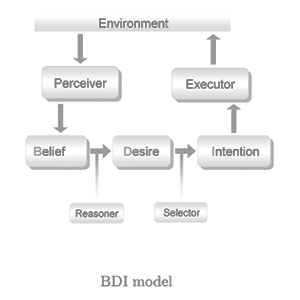
Folk psychology can be described as the common understanding of mental processes (e.g. pain, pleasure, excitement, anxiety, etc.), grounded in the use of common linguistic terms as opposed to technical or scientific jargon. Folk psychology and analogy are invariably linked, with both concepts having evolved as a result of the relationship they have with each other. Once technical terms are stripped, the easiest way to describe something is through references to familiar items. In this way, the union between analogy and folk psychology was inevitable.
Traditionally, the study of folk psychology has focused on how everyday people—those without formal training in the various academic fields of science—go about attributing mental states. This domain has primarily been centered on intentional states reflective of an individual’s beliefs and desires; each described in terms of everyday language and concepts such as ‘beliefs,’ ‘desires,’ ‘fear,’ and ‘hope.’ As a result of this among other intrinsic factors, the domain’s scope, method, and contributions are consistently subjects of dispute in many scientific quarters.
read more »
Posted in Health, Language, Science |
Leave a Comment »
July 25, 2012
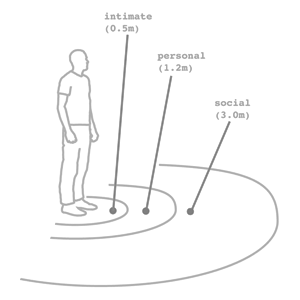
Proxemics [prok-see-miks] is a subcategory of the study of nonverbal communication along with haptics (touch), kinesics (body movement), vocalics (paralanguage), and chronemics (structure of time). Proxemics can be defined as ‘the interrelated observations and theories of man’s use of space as a specialized elaboration of culture.’
Edward T. Hall, the cultural anthropologist who coined the term in 1963, emphasized the impact of proxemic behavior (the use of space) on interpersonal communication. Hall believed that the value in studying proxemics comes from its applicability in evaluating not only the way man interacts with others in his daily life, but also ‘the organization of space in his houses and buildings, and ultimately the layout of his towns.’
read more »
Posted in Language, Science, World |
Leave a Comment »
July 25, 2012


Ambient awareness is a term used by social scientists to describe a new form of peripheral social awareness. This awareness is propagated from relatively constant contact with one’s friends and colleagues via social networking platforms on the Internet. Marketing professor Andreas Kaplan defines ambient awareness as ‘awareness created through regular and constant reception, and/or exchange of information fragments through social media.’
The term essentially defines the sort of omnipresent knowledge one experiences by being a regular user of media outlets that allow a constant connection with one’s social circle. According to Clive Thompson of ‘The New York Times,’ ambient awareness is ‘very much like being physically near someone and picking up on mood through the little things; body language, sighs, stray comments…’ Therefore, in effect two friends who regularly follow one another’s digital information can already be aware of each other’s lives without actually being physically present to have a conversation.
read more »
Posted in Language, Money, Technology |
Leave a Comment »
July 24, 2012


Pronoia [proh-noi-uh] is a neologism that is defined as the opposite state of mind as paranoia: having the sense that there is a conspiracy that exists to help the person. It is also used to describe a philosophy that the world is set up to secretly benefit people. The writer and Electronic Frontier Foundation co-founder John Perry Barlow defined pronoia as ‘the suspicion the Universe is a conspiracy on your behalf.’ The academic journal ‘Social Problems’ published an article entitled ‘Pronoia’ by Fred H. Goldner in 1982.
According to Goldner: ‘Pronoia is the positive counterpart of paranoia. It is the delusion that others think well of one. Actions and the products of one’s efforts are thought to be well received and praised by others. Mere acquaintances are thought to be close friends; politeness and the exchange of pleasantries are taken as expressions of deep attachment and the promise of future support. Pronoia appears rooted in the social complexity and cultural ambiguity of our lives: we have become increasingly dependent on the opinions of others based on uncertain criteria.’
read more »
Posted in Health, Humor, Language |
1 Comment »
July 23, 2012

Inherent Vice is a novel by Thomas Pynchon, originally published in 2009. The term ‘inherent vice’ as a legal phrase refers to a ‘hidden defect (or the very nature) of a good or property which of itself is the cause of (or contributes to) its deterioration, damage, or wastage. Such characteristics or defects make the item an unacceptable risk to a carrier or insurer. If the characteristic or defect is not visible, and if the carrier or the insurer has not been warned of it, neither of them may be liable for any claim arising solely out of the inherent vice.’ The phrase appears often in William Gaddis’ ‘The Recognitions,’ a novel that influenced American post-modern literature and Pynchon. Gaddis’ novel uses the term to refer to defects in works of art.
In a generally favorable review, Michiko Kakutani of ‘The New York Times’ called it ‘Pynchon Lite,’ describing it as ‘a simple shaggy-dog detective story that pits likable dopers against the Los Angeles Police Department and its ‘countersubversive’ agents, a novel in which paranoia is less a political or metaphysical state than a byproduct of smoking too much weed.’
Posted in Art, Humor, Language |
2 Comments »
July 23, 2012
‘The Recognitions,’ published in 1955, is American author William Gaddis’s first novel.
The novel was poorly received initially, but Gaddis’s reputation grew, and the novel received belated fame as a masterpiece of American literature.
read more »
Posted in Art, Language |
Leave a Comment »
July 18, 2012

Yhprum’s Law is the opposite of Murphy’s Law (Yhprum = Murphy backwards). The simple formula of Yhprum’s Law is: ‘Everything, that can work, will work. It is attributed to Richard Zeckhauser, a professor for political economy at Harvard University: ‘Sometimes systems that should not work, work nevertheless.’
In 2006, Paul Resnick of the University of Michigan School of Information used this law to describe how intensive and seemingly altruistic participation by giving ranking is observed in the eBay system.
Posted in Humor, Language |
1 Comment »
July 18, 2012

Hanlon’s Razor is an eponymous adage that reads: ‘Never attribute to malice that which is adequately explained by stupidity.’
A common (and more laconic) British English variation, coined by Sir Bernard Ingham, is the saying ‘cock-up before conspiracy,’ deriving from this quotation: ‘Many journalists have fallen for the conspiracy theory of government. I do assure you that they would produce more accurate work if they adhered to the cock-up theory.’
read more »
Posted in Humor, Language |
1 Comment »
July 18, 2012
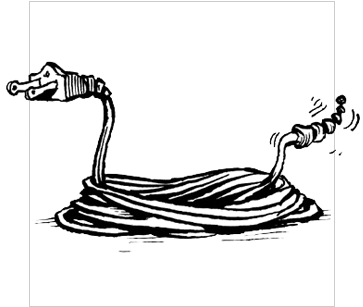
Resistentialism [ri-zis-ten-shul-iz-um] is a jocular theory to describe ‘seemingly spiteful behavior manifested by inanimate objects.’ For example, objects that cause problems (like lost keys or a fleeing bouncy ball) exhibit a high degree of malice toward humans and lend support to resistentialist beliefs. In other words, a war is being fought between humans and inanimate objects, and all the little annoyances objects give people throughout the day are battles between the two.
The term was coined by humorist Paul Jennings in a piece titled ‘Report on Resistentialism,’ published in ‘The Spectator’ in 1948 and reprinted in ‘The New York Times.’ The movement is a spoof of existentialism in general, and Jean-Paul Sartre in particular (Jennings gives the inventor of Resistentialism as Pierre-Marie Ventre). The slogan of Resistentialism is ‘Les choses sont contre nous’ — ‘Things are against us.’
read more »
Posted in Humor, Language, Philosophy |
Leave a Comment »


 The Daily Omnivore