March 28, 2012
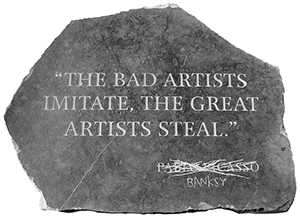
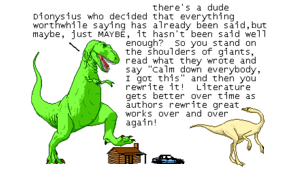
Dionysian imitatio is the influential literary method of imitation as formulated by Greek author Dionysius of Halicarnassus in the first century BCE, which conceived it as the rhetoric practice of emulating, adapting, reworking and enriching a source text by an earlier author. It marked the beginning of the doctrine of imitation, which dominated the Western history of art up until 18th century, when the notion of romantic originality was introduced.
The imitation literary approach is closely linked with the widespread observation that ‘everything has been said already,’ which was also stated by Egyptian scribes around 2000 BCE. The ideal aim of this approach to literature was not originality, but to surpass the predecessor by improving their writings and set the bar to a higher level.
read more »
Posted in Art, Language, Philosophy |
Leave a Comment »
March 27, 2012

The Grass Mud Horse or Caoníma, is a Chinese Internet meme widely used as a form of symbolic defiance of the widespread Internet censorship in China. It is a play on the Mandarin language words which translate literally to, ‘fuck your mother,’ and is one of the so-called ’10 mythical creatures’ created in a hoax article on ‘Baidu Baike’ (a collaborative encyclopedia) in early 2009 whose names form obscene puns. Official ‘cleanup’ of the internet, which threatens the Caonima, has led Chinese internet users to create other ‘Mud Horse’ variants, such as the ‘Rolling Mud Horse’ and ‘Working Mud Horse,’ which are also puns for ‘fuck your mother.’
The ‘China Digital Times’ sees Caonima as the ‘de facto mascot of netizens in China fighting for free expression, inspiring poetry, photos and videos, artwork, lines of clothing, and more.’ It is an illustration of the ‘resistance discourse’ of Chinese internet users with ‘increasingly dynamic and sometimes surprising presence of an alternative political discourse: images, frames, metaphors and narratives that have been generated from Internet memes [that] undermine the values and ideology that reproduce compliance with the Chinese Communist Party’s authoritarian regime, and, as such, force an opening for free expression and civil society in China.’
read more »
Posted in Humor, Language, Politics |
1 Comment »
March 27, 2012
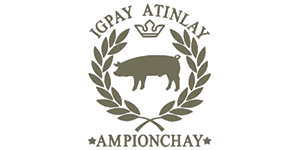
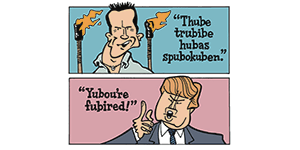
A language game (also called secret language or ludling or argot) is a system of manipulating spoken words to render them incomprehensible to the untrained ear. Language games are used primarily by groups attempting to conceal their conversations from others.
Some common examples are Pig Latin, which is used all over the globe; the Gibberish family, prevalent in the United States and Sweden; and Verlan, spoken in France. Each of these language games involves a usually simple standard transformation to speech, thus encoding it. The languages can be easily mentally encoded and decoded by a skilled speaker at the rate of normal speech, while those who either don’t know the key or aren’t practiced in rapid speech are left hearing nothing but gibberish.
read more »
Posted in Games, Humor, Language |
Leave a Comment »
March 27, 2012
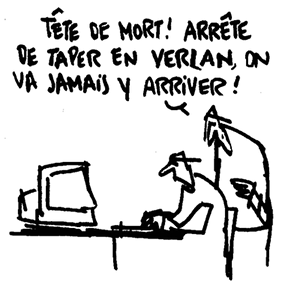
Verlan [veyr-lahn] is a French argot (secret language) featuring inversion of syllables in a word, and is common in slang and youth language. It rests on a long French tradition of transposing syllables of individual words to create slang words.
The name verlan is an example: it is derived from inverting the syllables in ‘l’envers’ [lan-ver](‘the inverse’). Different rules apply for one-syllable words, and words with more than one syllable may be verlanized in more than one way. For example, ‘cigarette’ may yield ‘garetsi’ or ‘retsiga.’
read more »
Posted in Drugs, Language, Sex |
Leave a Comment »
March 27, 2012


Valspeak is a common name for an American sociolect (social dialect), originally of the San Fernando Valley in Southern California, in particular Valley girls. This stereotype, which originated in the 1970s, became an international fad for a certain period.
Many phrases and elements of Valleyspeak, along with surfer slang and skateboarding slang, are stable elements of the California English dialect lexicon, and in some cases wider American English (such as the use of ‘like’ as a hedge, a mitigating device used to lessen the impact of an utterance).
read more »
Posted in Language, Money |
Leave a Comment »
March 27, 2012

The high rising terminal (HRT), also known as uptalk, upspeak, rising inflection, or high rising intonation, is a feature of some accents of English where statements have a rising intonation pattern in the final syllable or syllables of the utterance.
The origins of HRT remain uncertain. Geographically, anecdotal evidence places the conception of the American English variety on the West Coast – anywhere from Southern California to the Pacific Northwest. Others have suggested it originated in New Zealand, and it is unclear whether the American English varieties and the Oceanic varieties had any influence on each other regarding the spread of HRT.
read more »
Posted in Language, World |
Leave a Comment »
March 27, 2012
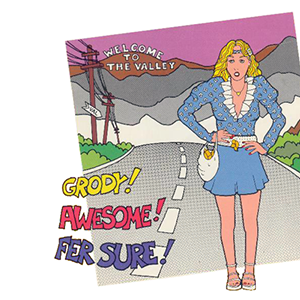
Valley Girl is a stereotype leveled at a socio-economic and ethnic class of American women who can be described as colloquial English-speaking and materialistic. Valspeak is also a form of this trait, based on an exaggerated version of ’80s California English.
The term originally referred to the ever increasing number of semi-affluent and affluent middle-class and upper-middle class girls living in the bedroom community neighborhoods of San Fernando Valley. Due to the Valley’s proximity to the Hollywood media machine, the demographic group which the term stereotyped garnered large exposure to the rest of the world.
read more »
Posted in Language, Money |
Leave a Comment »
March 26, 2012


Librarian.net was founded in 1999 by Jessamyn Charity West (b. 1968), an American librarian and blogger. West characterizes librarian.net as generally ‘anti-censorship, pro-freedom of speech, pro-porn (for lack of a better way to explain that we don’t find the naked body shameful), antiglobalization, anti-outsourcing, anti-Dr. Laura, pro-freak, pro-social responsibility, and just generally pro-information and in favor of the profession getting a better image.’
‘Wired’ described her as ‘on the front lines in battling the USA PATRIOT Act,’ particularly the provisions that allow warrantless searches of library records. The act not only prohibits libraries from notifying the subjects of such searches, it prohibits them from disclosing to the public whether any such searches have been made. In protest, West created a number of notices that libraries can post which she suggests are ‘technically legal.’ One of them, for example, reads: ‘The FBI has not been here. Watch very closely for the removal of this sign.’ The Vermont Library Association provided copies of this sign to every public library in Vermont.
Posted in Language, Politics, War |
2 Comments »
March 26, 2012

The Onion is an American news satire organization. It is a newspaper and a website featuring satirical articles reporting on international, national, and local news, in addition to a non-satirical entertainment section known as The A.V. Club (which features interviews and reviews of various newly released media, as well as other weekly features). Since 2007, the organization has been publishing satirical news audios and videos online, as the ‘Onion News Network.’
The Onion’s articles comment on current events, both real and fictional. It parodies such traditional newspaper features as editorials, man-on-the-street interviews, and stock quotes on a traditional newspaper layout with an AP-style editorial voice. Much of its humor depends on presenting everyday events as newsworthy and by playing on commonly used phrases, as in the headline ‘Drugs Win Drug War.’
read more »
Posted in Humor, Language, Politics |
Leave a Comment »
March 25, 2012
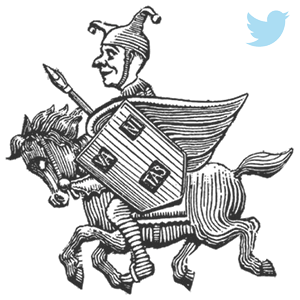
The Harvard Lampoon is an undergraduate humor publication founded in 1876. It is the world’s longest continually published humor magazine. It is also the second longest-running English-language humor magazine, after the ‘Yale Record.’ The organization also produces occasional humor books and parodies of national magazines. Much of the organization’s capital is provided by the licensing of the ‘Lampoon’ name to ‘National Lampoon,’ begun by ‘Harvard Lampoon’ graduates in 1970.
The Lampoon is known for its bacchanalian parties, which can result in smashed plates and furniture. Robert K. Hoffman, co-founder of the ‘National Lampoon’ and major donor to the Dallas Museum of Art was a Trustee until his death in 2006, and was declared a Trustee ‘Ad-Infinitum’ a year later. The bone of his pinky finger is said to be encased in a block of lucite in the Harvard Lampoon’s ‘Brainatorium Crypt.’
read more »
Posted in Education, Humor, Language |
Leave a Comment »
March 25, 2012


National Lampoon was both a ground-breaking American humor magazine and also a wide range of productions directly associated with that magazine. The magazine ran from 1970 to 1998, and was originally a spinoff of the ‘Harvard Lampoon’ (is an undergraduate humor publication founded in 1876 at Harvard University).
The magazine reached its height of popularity and critical acclaim during the 1970s, when it had a far-reaching effect on American humor. It spawned films, radio, live theater, various kinds of recordings, and print products including books. Many members of the creative staff from the magazine subsequently went on to contribute creatively to successful media of all types.
read more »
Posted in Art, Humor, Language |
Leave a Comment »
March 25, 2012

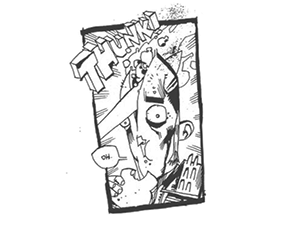
Heavy Metal is an American science fiction and fantasy comics magazine, known primarily for its blend of dark fantasy/science fiction and erotica. In the mid-1970s, while publisher Leonard Mogel was in Paris to jump-start the French edition of ‘National Lampoon,’ he discovered the French science-fantasy magazine ‘Métal Hurlant’ which had debuted in 1974. The French title translates literally as ‘Howling Metal.’
When Mogel licensed the American version, he chose to rename it, and ‘Heavy Metal’ began in the U.S. in 1977 as a glossy, full-color monthly. Initially, it displayed translations of graphic stories originally published in ‘Métal Hurlant,’ including work by Enki Bilal, Jean Giraud (also known as Moebius), Philippe Druillet, Milo Manara and Philippe Caza. The magazine later ran Stefano Tamburini and Tanino Liberatore’s ultra-violent ‘RanXerox.’ Since the color pages had already been shot in France, the budget to reproduce them in the U.S. version was greatly reduced.
read more »
Posted in Art, Language, Sex |
Leave a Comment »



