February 14, 2012

A shill, plant or stooge helps someone without disclosing that he or she has a close relationship with that person or organization. Shill typically refers to someone who purposely gives onlookers the impression that he or she is an enthusiastic independent customer of a seller that he or she is secretly working for. The person or group that hires the shill is using crowd psychology, to encourage other onlookers or audience members to make a purchase.
Shills are often employed by confidence artists. Plant and stooge more commonly refer to any person who is secretly in league with another person or organization while pretending to be neutral or actually a part of the organization he or she is planted in, such as a magician’s audience, a political party, or an intelligence organization (double agent).
read more »
Posted in Language, Money, Politics |
Leave a Comment »
February 13, 2012

The term middlebrow describes both a certain type of easily accessible art, often literature, as well as the population that uses art to acquire culture and class that is usually unattainable. First used by the British satire magazine ‘Punch’ in 1925, middlebrow is derived as the intermediary between highbrow and lowbrow, terms derived from phrenology.
Middlebrow has famously gained notoriety from derisive attacks by Dwight Macdonald, Virginia Woolf, and to a certain extent, Russell Lynes. It has been classified as a forced and ineffective attempt at cultural and intellectual achievement, as well as characterizing literature that emphasizes emotional and sentimental connections rather than literary quality and innovation.
read more »
Posted in Art, Language |
Leave a Comment »
February 13, 2012
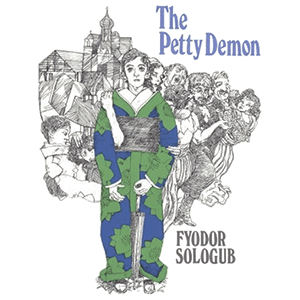
Poshlost is a Russian word that has been defined as ‘petty evil or self-satisfied vulgarity,’ however there is no single English translation.
At more length, ‘Poshlost’ is the Russian version of banality, with a characteristic national flavoring of metaphysics and high morality, and a peculiar conjunction of the sexual and the spiritual. This one word encompasses triviality, vulgarity, sexual promiscuity, and a lack of spirituality. The war against poshlost’ was a cultural obsession of the Russian and Soviet intelligentsia from the 1860s to 1960s.’
read more »
Posted in Language, Sex, World |
Leave a Comment »
February 13, 2012

Bathos [bey-thos] (Greek: ‘depth’) is an abrupt transition in style from the exalted to the commonplace, producing a ludicrous effect. While often unintended, bathos may be used deliberately to produce a humorous effect. If bathos is overt, it may be described as Burlesque or mock-heroic.
As used in English bathos originally referred to a particular type of bad poetry, but it is now used more broadly to cover any seemingly ridiculous artwork or bad performance. It should not be confused with pathos, a mode of persuasion within the discipline of rhetoric, intended to arouse emotions of sympathy and pity.
read more »
Posted in Art, Humor, Language |
Leave a Comment »
February 13, 2012

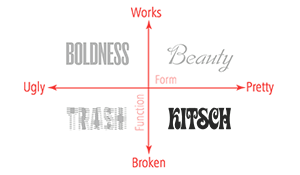
Camp is an aesthetic sensibility that regards something as appealing or humorous because of its deliberate ridiculousness. The concept is closely related to kitsch, and things with camp appeal may also be described as being ‘cheesy.’
When the usage appeared, in 1909, it denoted: ostentatious, exaggerated, affected, theatrical, and effeminate behaviour, and, by the middle of the 1970s, the definition comprised: banality, artifice, mediocrity, and ostentation so extreme as to have perversely sophisticated appeal. American writer Susan Sontag’s essay ‘Notes on ‘Camp” (1964) emphasised its key elements as: artifice, frivolity, naïve middle-class pretentiousness, and ‘shocking’ excess. Camp as an aesthetic has been popular from the 1960s to the present.
read more »
Posted in Art, Humor, Language |
Leave a Comment »
February 13, 2012


Kitsch [kich] (loanword from German) is a form of art that is considered an inferior, tasteless copy of an extant style of art or a worthless imitation of art of recognized value. The concept is associated with the deliberate use of elements that may be thought of as cultural icons while making cheap mass-produced objects that are unoriginal.
Kitsch also refers to the types of art that are aesthetically deficient (whether or not being sentimental, glamorous, theatrical, or creative) and that make creative gestures which merely imitate the superficial appearances of art through repeated conventions and formulae. Excessive sentimentality often is associated with the term.
read more »
Posted in Art, Language, Philosophy |
1 Comment »
February 9, 2012

An egg of Columbus refers to a brilliant idea or discovery that seems simple or easy after the fact. The expression refers to a popular story of how Christopher Columbus, having been told that discovering the Americas was no great accomplishment, challenged his critics to make an egg stand on its tip.
After his challengers gave up, Columbus did it himself by tapping the egg on the table so as to flatten its tip. The story is often alluded to when discussing creativity.
read more »
Posted in Games, Humor, Language |
Leave a Comment »
February 9, 2012

The role of salt in the Bible is relevant to understanding Hebrew society during the Old Testament and New Testament periods. Salt is a necessity of life and was a mineral that was used since ancient times in many cultures as a seasoning, a preservative, a disinfectant, a component of ceremonial offerings, and as a unit of exchange.
The Bible contains numerous references to salt. In various contexts, it is used metaphorically to signify permanence, loyalty, durability, fidelity, usefulness, value, and purification. The main source of salt in the region was the area of the Dead Sea, especially the massive six mile long salt cliffs of Jebel Usdum. The face of the ridge is constantly changing as weather interacts with the rock salt. The Hebrew people harvested salt by pouring sea water into pits and letting the water evaporate until only salt was left. They used the mineral for seasoning and as a preservative. In addition, salt was used to disinfect wounds.
read more »
Posted in Language, Philosophy |
Leave a Comment »
February 8, 2012

‘Manifold Destiny‘ is a 2006 article in ‘The New Yorker’ written by Sylvia Nasar (known for her biography of John Forbes Nash, ‘A Beautiful Mind’) and David Gruber. It gives a detailed account (including interviews with many mathematicians) of some of the circumstances surrounding the proof of the Poincaré conjecture, one of the most important accomplishments of 20th and 21st century mathematics, and traces the attempts by three teams of mathematicians to verify the proof given by Grigori Perelman.
Subtitled ‘A legendary problem and the battle over who solved it,’ the article concentrates on the human drama of the story, especially the discussion on who contributed how much to the proof of the Poincaré conjecture. Interwoven with the article is an interview with the reclusive mathematician Grigori Perelman, whom the authors tracked down to the St. Petersburg apartment he shares with his mother. The article describes Perelman’s disillusionment and withdrawal from the mathematical community and paints an unflattering portrait of the 1982 Fields Medalist, Shing-Tung Yau.
read more »
Posted in Language, Science |
1 Comment »
February 7, 2012

New Historicism is a school of literary theory that developed in the 1980s, primarily through the work of the critic Stephen Greenblatt, and gained widespread influence in the 1990s. The goal of the theory is to understand information by its historical context, and to understand cultural and intellectual history through literature. Michel Foucault based his approach both on his theory of the limits of collective cultural knowledge and on his technique of examining a broad array of documents in order to understand a particular time. New Historicism is claimed to be a more neutral approach to historical events, and to be sensitive towards different cultures.
‘Sub-literary’ texts and uninspired non-literary texts all came to be read as documents of historical discourse, side-by-side with the ‘great works of literature.’ A typical focus of New Historicist critics, led by Stephen Orgel, has been on understanding Shakespeare less as an autonomous great author in the modern sense than as a clue to the conjunction of the world of Renaissance theater—a collaborative and largely anonymous free-for-all—and the complex social politics of the time. In this sense, Shakespeare’s plays are seen as inseparable from the context in which he wrote.
read more »
Posted in Language, Philosophy, Politics |
1 Comment »
February 7, 2012

A bible for screenwriters is a reference document used for information on a story’s characters, settings and other elements. Show bibles are commonly used in television series; new writers and freelancers are often referred to it when writing scripts for the show to ensure continuity with previous episodes; they’re also used by individual writers for books and movies to keep track of details.
However, according to writer and producer Jane Espenson, ‘Show bibles … just aren’t as important as you might think to the daily life of the [writing] staff. The truth is that once you’re living inside a show, you’re swimming as fast as you can from one island to the next, and there is neither the time nor the need to record decisions that have been made (these are in the scripts), or that are in the process of being made (these are in the notes taken in the room as the writers work).’
read more »
Posted in Art, Language, Money |
Leave a Comment »
February 6, 2012

A sleeper hit refers to a film, book, single, album, TV show, or video game that gains unexpected success or recognition. Sleeper hits often grow in popularity over time. Some sleeper hits achieve unexpected success at the box office immediately upon their initial theatrical release, but this is not typical. Because these films are not expected to do particularly well they often receive little promotion or advertising and take time to register with the public.
Typically the sleeper hit relies instead on positive ‘word of mouth’ as well as the publicity generated by awards and good reviews. Two good examples of these are Mike Judge’s ‘Office Space’ and ‘Idiocracy,’ both of which quickly became cult classics. The movie ‘Caddyshack’ is another good example.
read more »
Posted in Art, Language, Money |
1 Comment »


 The Daily Omnivore