February 9, 2012

An egg of Columbus refers to a brilliant idea or discovery that seems simple or easy after the fact. The expression refers to a popular story of how Christopher Columbus, having been told that discovering the Americas was no great accomplishment, challenged his critics to make an egg stand on its tip.
After his challengers gave up, Columbus did it himself by tapping the egg on the table so as to flatten its tip. The story is often alluded to when discussing creativity.
read more »
Posted in Games, Humor, Language |
Leave a Comment »
February 9, 2012

The role of salt in the Bible is relevant to understanding Hebrew society during the Old Testament and New Testament periods. Salt is a necessity of life and was a mineral that was used since ancient times in many cultures as a seasoning, a preservative, a disinfectant, a component of ceremonial offerings, and as a unit of exchange.
The Bible contains numerous references to salt. In various contexts, it is used metaphorically to signify permanence, loyalty, durability, fidelity, usefulness, value, and purification. The main source of salt in the region was the area of the Dead Sea, especially the massive six mile long salt cliffs of Jebel Usdum. The face of the ridge is constantly changing as weather interacts with the rock salt. The Hebrew people harvested salt by pouring sea water into pits and letting the water evaporate until only salt was left. They used the mineral for seasoning and as a preservative. In addition, salt was used to disinfect wounds.
read more »
Posted in Language, Philosophy |
Leave a Comment »
February 8, 2012

‘Manifold Destiny‘ is a 2006 article in ‘The New Yorker’ written by Sylvia Nasar (known for her biography of John Forbes Nash, ‘A Beautiful Mind’) and David Gruber. It gives a detailed account (including interviews with many mathematicians) of some of the circumstances surrounding the proof of the Poincaré conjecture, one of the most important accomplishments of 20th and 21st century mathematics, and traces the attempts by three teams of mathematicians to verify the proof given by Grigori Perelman.
Subtitled ‘A legendary problem and the battle over who solved it,’ the article concentrates on the human drama of the story, especially the discussion on who contributed how much to the proof of the Poincaré conjecture. Interwoven with the article is an interview with the reclusive mathematician Grigori Perelman, whom the authors tracked down to the St. Petersburg apartment he shares with his mother. The article describes Perelman’s disillusionment and withdrawal from the mathematical community and paints an unflattering portrait of the 1982 Fields Medalist, Shing-Tung Yau.
read more »
Posted in Language, Science |
1 Comment »
February 7, 2012

New Historicism is a school of literary theory that developed in the 1980s, primarily through the work of the critic Stephen Greenblatt, and gained widespread influence in the 1990s. The goal of the theory is to understand information by its historical context, and to understand cultural and intellectual history through literature. Michel Foucault based his approach both on his theory of the limits of collective cultural knowledge and on his technique of examining a broad array of documents in order to understand a particular time. New Historicism is claimed to be a more neutral approach to historical events, and to be sensitive towards different cultures.
‘Sub-literary’ texts and uninspired non-literary texts all came to be read as documents of historical discourse, side-by-side with the ‘great works of literature.’ A typical focus of New Historicist critics, led by Stephen Orgel, has been on understanding Shakespeare less as an autonomous great author in the modern sense than as a clue to the conjunction of the world of Renaissance theater—a collaborative and largely anonymous free-for-all—and the complex social politics of the time. In this sense, Shakespeare’s plays are seen as inseparable from the context in which he wrote.
read more »
Posted in Language, Philosophy, Politics |
1 Comment »
February 7, 2012

A bible for screenwriters is a reference document used for information on a story’s characters, settings and other elements. Show bibles are commonly used in television series; new writers and freelancers are often referred to it when writing scripts for the show to ensure continuity with previous episodes; they’re also used by individual writers for books and movies to keep track of details.
However, according to writer and producer Jane Espenson, ‘Show bibles … just aren’t as important as you might think to the daily life of the [writing] staff. The truth is that once you’re living inside a show, you’re swimming as fast as you can from one island to the next, and there is neither the time nor the need to record decisions that have been made (these are in the scripts), or that are in the process of being made (these are in the notes taken in the room as the writers work).’
read more »
Posted in Art, Language, Money |
Leave a Comment »
February 6, 2012

A sleeper hit refers to a film, book, single, album, TV show, or video game that gains unexpected success or recognition. Sleeper hits often grow in popularity over time. Some sleeper hits achieve unexpected success at the box office immediately upon their initial theatrical release, but this is not typical. Because these films are not expected to do particularly well they often receive little promotion or advertising and take time to register with the public.
Typically the sleeper hit relies instead on positive ‘word of mouth’ as well as the publicity generated by awards and good reviews. Two good examples of these are Mike Judge’s ‘Office Space’ and ‘Idiocracy,’ both of which quickly became cult classics. The movie ‘Caddyshack’ is another good example.
read more »
Posted in Art, Language, Money |
1 Comment »
February 6, 2012

New sincerity is a term that has been used in music, aesthetics, film criticism, poetry, literary criticism and philosophy, generally to describe art or concepts that run against prevailing modes of postmodernist irony or cynicism. ‘New Sincerity’ was used as a collective name for a loose group of alternative rock bands, centered in Austin, Texas in the years from about 1985 to 1990, who were perceived as reacting to the ironic outlook of then-prominent music movements like punk rock and New Wave.
The use of ‘New Sincerity’ in connection with these bands began with an off-handed comment by Austin punk rocker/author Jesse Sublett to his friend, local music writer Margaret Moser: ‘All those new sincerity bands, they’re crap.’
read more »
Posted in Art, Humor, Language |
Leave a Comment »
February 6, 2012


A cult following is a group of fans who are highly dedicated to a specific area of pop culture. A film, book, band, or video game, among other things, will be said to have a cult following when it has a small but very passionate fan base. A common component of cult followings is the emotional attachment fans have with the object of the cult following, often identifying themselves and other fans as members of a community.
Cult followings are also commonly associated with niche markets. Cult media are often associated with underground culture, and are considered too eccentric, bizarre, controversial or anti-establishment to be appreciated by the general public.
read more »
Posted in Art, Language, Money |
Leave a Comment »
February 6, 2012

A cult film, also commonly referred to as a cult classic, is a film that has acquired a highly devoted but specific group of fans. Often, cult movies have failed to achieve fame outside the small fanbases; however, there have been exceptions that have managed to gain fame among mainstream audiences. Many cult movies have gone on to transcend their original cult status and have become recognized as classics; others are of the ‘so bad it’s good’ variety and are destined to remain in obscurity.
Cult films often become the source of a thriving, obsessive, and elaborate subculture of fandom, hence the analogy to cults. However, not every film with a devoted fanbase is necessarily a cult film. Usually, cult films have limited but very special, noted appeal. Cult films are often known to be eccentric, often do not follow traditional standards of popular cinema and usually explore topics not considered in any way mainstream—yet there are examples that are relatively normal. Many are often considered controversial because they step outside standard narrative and technical conventions.
read more »
Posted in Art, Language, Money |
1 Comment »
February 6, 2012

Qualia [kwah-lee-uh], singular ‘quale’ [kwah-lee], from a Latin word meaning for ‘what sort’ or ‘what kind,’ is a term used in philosophy to refer to subjective conscious experiences as ‘raw feels.’ Examples of qualia are the pain of a headache, the taste of wine, the experience of taking a recreational drug, or the perceived redness of an evening sky.
American philosopher Daniel Dennett writes that qualia is ‘an unfamiliar term for something that could not be more familiar to each of us: the ways things seem to us.’ Erwin Schrödinger, the famous physicist, had this counter-materialist take: ‘The sensation of color cannot be accounted for by the physicist’s objective picture of light-waves. Could the physiologist account for it, if he had fuller knowledge than he has of the processes in the retina and the nervous processes set up by them in the optical nerve bundles and in the brain? I do not think so.’
read more »
Posted in Language, Philosophy, Science |
1 Comment »
February 6, 2012
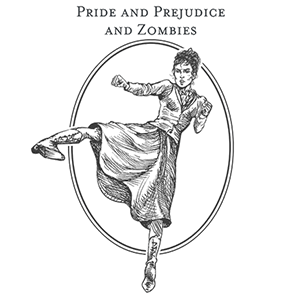
A mashup novel is a work of fiction which combines a pre-existing text, often a classic work of fiction, with a certain popular genre such as vampire or zombie narratives. ‘Pride and Prejudice and Zombies,’ which combines Jane Austen’s classic novel ‘Pride and Prejudice’ with elements of modern zombie fiction, is arguably the first, and certainly one of the most famous and successful works in the genre, and has been credited with spawning a rash of imitations. The term ‘Mashup’ was borrowed from the world of computers and music. Mashup books are seen as distinct from parody novels like ‘Bored of the Rings,’ and parallel novels like ‘The Wind Done Gone’ or ‘Wicked’ since they do not merely make fun of the original text, or tell an alternative version of it, but also introduce the themes and characteristics of a wholly different genre.
While most works in this genre (or cross-genre trend) rely on fictional texts as their basis, other works like ‘Abraham Lincoln, Vampire Hunter’ superimpose the popular genres over historical figures and events. A more recent phenomenon within the genre is the combination of more than two original works, or genres, as in the case of ‘Robinson Crusoe (The Eerie Adventures of the Lycanthrope),’ which combines the original novel with elements borrowed from the works of H.P. Lovecraft as well as the popular genre of werewolf fiction, and is accordingly attributed to three authors – Daniel Defoe, H.P. Lovecraft, and Peter Clines.
Posted in Art, Humor, Language |
Leave a Comment »
February 4, 2012

A gentlemen’s agreement is an informal agreement between two or more parties. It is typically oral, though may be written, or simply understood as part of an unspoken agreement by convention or through mutually beneficial etiquette.
The essence of a gentlemen’s agreement is that it relies upon the honor of the parties for its fulfillment, rather than being in any way enforceable. It is, therefore, distinct from a legal agreement or contract, which can be enforced if necessary. A variation on the gentlemen’s agreement is the gentlemen’s bet, wherein there is nothing to win or lose through the bet, other than the honor of winning and shame of losing.
read more »
Posted in Language, Money, Politics |
Leave a Comment »



