October 21, 2011

Action Comics #1 (June 1938) features the first appearance of Jerry Siegel/Joe Shuster creation Superman. Published on April 18, 1938 by National Allied Publications, a corporate predecessor of DC Comics, it is considered the first true superhero comic; and though today ‘Action Comics’ is a monthly title devoted to Superman, it began, like many early comics, as an anthology. Copies have sold at auction for $1.5 million.
The first issue had a print run of 200,000 copies. Jerry Siegel and Joe Shuster were paid $10 per page, for a total of $130 for their work on this issue. They effectively signed away millions in future rights and royalties payments. Starting in 1978, Siegel and Shuster were provided with a $20,000 a month annuity which was later raised to $30,000. Liebowitz would later say that selecting Superman to run in Action Comics #1 was ‘pure accident’ based on deadline pressure and that he selected a ‘thrilling’ cover, depicting Superman lifting a car over his head. It has been compared ‘Hercules Clubs the Hydra’ by Antonio del Pollaiolo.
read more »
Posted in Art, Language, Money |
Leave a Comment »
October 21, 2011

Blake Snyder (1957 – 2009) was an American screenwriter based in Los Angeles, who became one of the most popular writing mentors in the film industry. The author of three books on screenwriting and story structure, Snyder led international seminars and workshops for writers in various disciplines, as well as consultation sessions for some of Hollywood’s largest studios. His nonfiction book ‘Save the Cat!
The Last Book on Screenwriting You’ll Ever Need’ was written in a no-nonsense and conversational tone, which has resonated with both seasoned and novice screenwriters. The title is a term coined by Snyder and describes the scene where the audience meets the hero of a movie for the first time. The hero does something nice — e.g. saving a cat—that makes the audience like the hero and root for him. According to Snyder, it is a simple scene that helps the audience invest themselves in the character and the story, but is often lacking in many movies.
read more »
Posted in Art, Language, Money |
Leave a Comment »
October 21, 2011

In a monomyth, (the theory that all myths are the same story) the hero begins in the ordinary world, and receives a call to enter an unknown world of strange powers and events. The hero who accepts the call to enter this strange world must face tasks and trials, either alone or with assistance. In the most intense versions of the narrative, the hero must survive a severe challenge, often with help. If the hero survives, he may achieve a great gift or ‘boon.’ The hero must then decide whether to return to the ordinary world with this boon. If the hero does decide to return, he or she often faces challenges on the return journey. If the hero returns successfully, the boon or gift may be used to improve the world. The stories of Osiris, Prometheus, Moses, and Buddha, for example, follow this structure closely.
Campbell describes 17 stages or steps along this journey. Very few myths contain all 17 stages—some myths contain many of the stages, while others contain only a few; some myths may focus on only one of the stages, while other myths may deal with the stages in a somewhat different order. These 17 stages may be organized in a number of ways, including division into three sections: ‘Departure’ (sometimes called ‘Separation’), the hero’s adventure prior to the quest; ‘Initiation,’ the hero’s many adventures along the way; and ‘Return,’ the hero’s return home with knowledge and powers acquired on the journey.
read more »
Posted in Art, Language, Philosophy |
Leave a Comment »
October 21, 2011
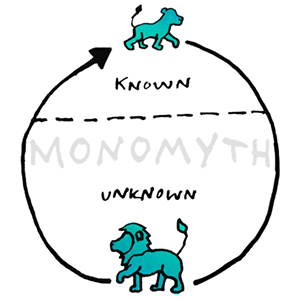
The Hero with a Thousand Faces (first published in 1949) is a non-fiction book, and seminal work of comparative mythology by Joseph Campbell. In this publication, Campbell discusses his theory of the journey of the archetypal hero found in world mythologies. Since publication, Campbell’s theory has been consciously applied by a wide variety of modern writers and artists. The best known is perhaps George Lucas, who has acknowledged a debt to Campbell regarding the stories of the ‘Star Wars’ films.
Campbell explores the theory that important myths from around the world which have survived for thousands of years all share a fundamental structure, which Campbell called the monomyth and ‘the hero’s journey. ‘In a well-known quote from the introduction to ‘The Hero with a Thousand Faces,’ Campbell summarized the monomyth: ‘A hero ventures forth from the world of common day into a region of supernatural wonder: fabulous forces are there encountered and a decisive victory is won: the hero comes back from this mysterious adventure with the power to bestow boons on his fellow man.’
read more »
Posted in Art, Language, Philosophy |
Leave a Comment »
October 21, 2011

Watership Down is a classic heroic fantasy novel, written by English author Richard Adams, about a small group of rabbits. Although the animals in the story live in their natural environment, they are anthropomorphized, possessing their own culture, language (Lapine), proverbs, poetry, and mythology. Evoking epic themes, the novel recounts the rabbits’ odyssey as they escape the destruction of their warren to seek a place in which to establish a new home, encountering perils and temptations along the way.
The novel takes its name from the rabbits’ destination, Watership Down, a hill in the north of Hampshire, England, near the area where Adams grew up. The story is based on a collection of tales that Adams told to his young children to pass the time on trips to the countryside.
read more »
Posted in Language |
1 Comment »
October 20, 2011


Corporatocracy [kawr-prit-tok-ruh-see], in social theories that focus on conflicts and opposing interests within society, denotes a system of government that serves the interest of, and may be run by, corporations and involves ties between government and business. Where corporations, conglomerates, and/or government entities with private components, control the direction and governance of a country, including carrying out economic planning (notwithstanding the ‘free market’ label).
The concept of corporatocracy is that corporations, to a significant extent, have power over governments, including those governments nominally elected by the people. They exercise their power via corporate monopolies and mergers, and through their subsequent capacity to leverage broad economic interests, which allows them the luxury of being declared ‘too big to fail’; this is accomplished by legal mechanisms (i.e., lobbyists, campaign contributions to office holders and candidates, threats to leave the state or country for another with less oversight and/or more personally beneficial subsidies, etc.), which renders them immune to vague accusations and prosecution.
Posted in Language, Money, Politics |
Leave a Comment »
October 20, 2011

The digerati [dij-uh-rah-tee] are people highly skilled in the processing and manipulation of digital information; wealthy or scholarly techno-geeks. They are the elite of the computer industry and online communities. The word is a portmanteau, derived from ‘digital’ and ‘literati,’ and reminiscent of the earlier coinage glitterati (wealthy or famous people who conspicuously or ostentatiously attend fashionable events). Famous computer scientists, tech magazine writers and well-known bloggers are included among the digerati. The word is used in several related but different ways. It can mean: Opinion leaders who, through their writings, promoted a vision of digital technology and the Internet as a transformational element in society; people regarded as celebrities within the Silicon Valley computer subculture, particularly during the dot-com boom years; and anyone regarded as influential within the digital technology community.
The first mention of the word Digerati on USENET occurred in 1992, and referred to an article by George Gilder in ‘Upside’ magazine. According to William Safire, the term was coined by New York Times editor Tim Race in a 1992. In Race’s words: ‘Actually the first use of ‘digerati’ was in a article, ‘Pools of Memory, Waves of Dispute,’ by John Markoff, into which I edited the term. The article was about a controversy engendered by a George Gilder article that had recently appeared in ‘Upside’ magazine.’
Posted in Language, Money, Technology |
Leave a Comment »
October 18, 2011

Multistable perceptual phenomena are a form of perceptual phenomena in which there are unpredictable sequences of spontaneous subjective changes. While usually associated with visual perception, such phenomena can be found for auditory and olfactory percepts. Perceptual multistability can be evoked by visual patterns that are too ambiguous for the human visual system to recognise with one unique interpretation.
Famous examples include the ‘Necker cube,’ ‘structure from motion,’ ‘monocular rivalry’ (two different images, optically superimposed), and ‘binocular rivalry’ (perception alternates between different images presented to each eye), but many more visually ambiguous patterns are known. Since most of these images lead to an alternation between two mutually exclusive perceptual states, they are sometimes also referred to as bistable perception.
read more »
Posted in Art, Language, Science |
Leave a Comment »
October 18, 2011

Pseudorealism is an artistic and a dramatic technique in which an apparently unreal matter is presented in a fashion that makes it appear real. Though use of pseudorealism has been in practice for sometime in theater, film, fashion, textiles and literature, as an art genre, it was initiated in Indian art in early 21st century by Devajyoti Ray.
The idea that something unreal can still give the impression of the real has a parallel in mathematical field of representation theory. The idea has also often been used to describe certain set of movies, TV programs, and video games where special effects, computer generated imagery and 3D animation are used to create a fantasy but which has the impact of a reality based image. However in this context the word has a negative connotation.
Posted in Art, Language, Technology |
Leave a Comment »
October 18, 2011

Plop art (or Plonk art) is a pejorative slang term for public art (usually large, abstract, modernist or contemporary sculpture) made for government or corporate plazas, spaces in front of office buildings, skyscraper atriums, parks, and other public venues. The term connotes that the work is unattractive or inappropriate to its surroundings – that is, it has been thoughtlessly ‘plopped’ where it lies.
The very word ‘plop’ suggested something falling wetly and heavily in the manner of excrement — extruded, as it were, from the fundament of the art world, and often at public expense. Plop art is a play on the term pop art. The term was coined by architect James Wines in 1969. Wines was critical of the failure of much public art to take an environmentally-oriented approach to the relationship between public art and architecture.
Posted in Art, Humor, Language |
Leave a Comment »
October 16, 2011
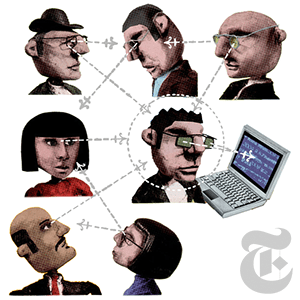
A Keynesian beauty contest [keyn-zee-uhn] is a concept developed by economist John Maynard Keynes in 1936 to explain price fluctuations in equity markets. Keynes described the action of rational agents in a market using an analogy based on a fictional newspaper contest, in which entrants are asked to choose a set of six faces from photographs of women that are the ‘most beautiful.’ Those who picked the most popular face are then eligible for a prize.
Keynes said: ‘It is not a case of choosing those [faces] that, to the best of one’s judgment, are really the prettiest, nor even those that average opinion genuinely thinks the prettiest. We have reached the third degree where we devote our intelligences to anticipating what average opinion expects the average opinion to be. And there are some, I believe, who practice the fourth, fifth and higher degrees.’ Keynes believed that similar behavior was at work within the stock market. This would have people pricing shares not based on what they think their fundamental value is, but rather on what they think everyone else thinks their value is, or what everybody else would predict the average assessment of value is.
Posted in Games, Language, Money |
Leave a Comment »
October 15, 2011


This article lists and discusses the usage and derivation of names of large numbers, together with their possible extensions. There are two main ways of naming a number: scientific notation and naming by grouping. For example, the number 500,000,000,000,000,000,000 can be called 5 x 10²⁰ in scientific notation since there are 20 zeros behind the 5. If the number is named by grouping, it is five hundred quintillion (American) or 500 trillion (European).
At times, the names of large numbers have been forced into common usage as a result of excessive inflation. The highest numerical value banknote ever printed was a note for 1 sextillion pengő (1021 or 1 milliard bilpengő as printed) printed in Hungary in 1946. In 2009, Zimbabwe printed a 100 trillion (1014) Zimbabwean dollar note, which at the time of printing was only worth about US$30.
read more »
Posted in Language, Money, Science |
Leave a Comment »




 The Daily Omnivore