October 20, 2011

The digerati [dij-uh-rah-tee] are people highly skilled in the processing and manipulation of digital information; wealthy or scholarly techno-geeks. They are the elite of the computer industry and online communities. The word is a portmanteau, derived from ‘digital’ and ‘literati,’ and reminiscent of the earlier coinage glitterati (wealthy or famous people who conspicuously or ostentatiously attend fashionable events). Famous computer scientists, tech magazine writers and well-known bloggers are included among the digerati. The word is used in several related but different ways. It can mean: Opinion leaders who, through their writings, promoted a vision of digital technology and the Internet as a transformational element in society; people regarded as celebrities within the Silicon Valley computer subculture, particularly during the dot-com boom years; and anyone regarded as influential within the digital technology community.
The first mention of the word Digerati on USENET occurred in 1992, and referred to an article by George Gilder in ‘Upside’ magazine. According to William Safire, the term was coined by New York Times editor Tim Race in a 1992. In Race’s words: ‘Actually the first use of ‘digerati’ was in a article, ‘Pools of Memory, Waves of Dispute,’ by John Markoff, into which I edited the term. The article was about a controversy engendered by a George Gilder article that had recently appeared in ‘Upside’ magazine.’
Posted in Language, Money, Technology |
Leave a Comment »
October 18, 2011
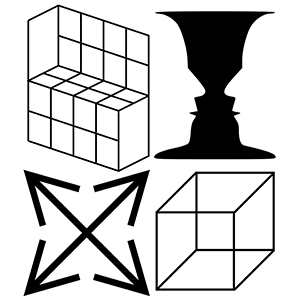
Multistable perceptual phenomena are a form of perceptual phenomena in which there are unpredictable sequences of spontaneous subjective changes. While usually associated with visual perception, such phenomena can be found for auditory and olfactory percepts. Perceptual multistability can be evoked by visual patterns that are too ambiguous for the human visual system to recognise with one unique interpretation.
Famous examples include the ‘Necker cube,’ ‘structure from motion,’ ‘monocular rivalry’ (two different images, optically superimposed), and ‘binocular rivalry’ (perception alternates between different images presented to each eye), but many more visually ambiguous patterns are known. Since most of these images lead to an alternation between two mutually exclusive perceptual states, they are sometimes also referred to as bistable perception.
read more »
Posted in Art, Language, Science |
Leave a Comment »
October 18, 2011

Pseudorealism is an artistic and a dramatic technique in which an apparently unreal matter is presented in a fashion that makes it appear real. Though use of pseudorealism has been in practice for sometime in theater, film, fashion, textiles and literature, as an art genre, it was initiated in Indian art in early 21st century by Devajyoti Ray.
The idea that something unreal can still give the impression of the real has a parallel in mathematical field of representation theory. The idea has also often been used to describe certain set of movies, TV programs, and video games where special effects, computer generated imagery and 3D animation are used to create a fantasy but which has the impact of a reality based image. However in this context the word has a negative connotation.
Posted in Art, Language, Technology |
Leave a Comment »
October 18, 2011
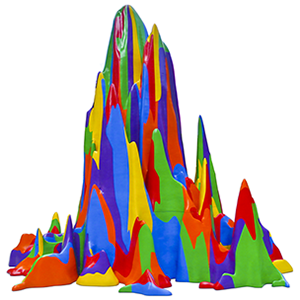
Plop art (or Plonk art) is a pejorative slang term for public art (usually large, abstract, modernist or contemporary sculpture) made for government or corporate plazas, spaces in front of office buildings, skyscraper atriums, parks, and other public venues. The term connotes that the work is unattractive or inappropriate to its surroundings – that is, it has been thoughtlessly ‘plopped’ where it lies.
The very word ‘plop’ suggested something falling wetly and heavily in the manner of excrement — extruded, as it were, from the fundament of the art world, and often at public expense. Plop art is a play on the term pop art. The term was coined by architect James Wines in 1969. Wines was critical of the failure of much public art to take an environmentally-oriented approach to the relationship between public art and architecture.
Posted in Art, Humor, Language |
Leave a Comment »
October 16, 2011
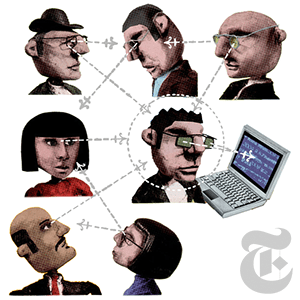
A Keynesian beauty contest [keyn-zee-uhn] is a concept developed by economist John Maynard Keynes in 1936 to explain price fluctuations in equity markets. Keynes described the action of rational agents in a market using an analogy based on a fictional newspaper contest, in which entrants are asked to choose a set of six faces from photographs of women that are the ‘most beautiful.’ Those who picked the most popular face are then eligible for a prize.
Keynes said: ‘It is not a case of choosing those [faces] that, to the best of one’s judgment, are really the prettiest, nor even those that average opinion genuinely thinks the prettiest. We have reached the third degree where we devote our intelligences to anticipating what average opinion expects the average opinion to be. And there are some, I believe, who practice the fourth, fifth and higher degrees.’ Keynes believed that similar behavior was at work within the stock market. This would have people pricing shares not based on what they think their fundamental value is, but rather on what they think everyone else thinks their value is, or what everybody else would predict the average assessment of value is.
Posted in Games, Language, Money |
Leave a Comment »
October 15, 2011


This article lists and discusses the usage and derivation of names of large numbers, together with their possible extensions. There are two main ways of naming a number: scientific notation and naming by grouping. For example, the number 500,000,000,000,000,000,000 can be called 5 x 10²⁰ in scientific notation since there are 20 zeros behind the 5. If the number is named by grouping, it is five hundred quintillion (American) or 500 trillion (European).
At times, the names of large numbers have been forced into common usage as a result of excessive inflation. The highest numerical value banknote ever printed was a note for 1 sextillion pengő (1021 or 1 milliard bilpengő as printed) printed in Hungary in 1946. In 2009, Zimbabwe printed a 100 trillion (1014) Zimbabwean dollar note, which at the time of printing was only worth about US$30.
read more »
Posted in Language, Money, Science |
Leave a Comment »
October 15, 2011

Somniloquy [som-nil-o-kwee] or sleep-talking is a parasomnia (sleep disorder) that refers to talking aloud in one’s sleep. It can be quite loud, ranging from simple sounds to long speeches, and can occur many times during sleep. Listeners may or may not be able to understand what the person is saying. Sleep-talking usually occurs during transitory arousals from NREM sleep, which is when the body does not move smoothly from one stage in NREM sleep to another, and they become partially aroused from sleep. Further it can also occur during REM sleep at which time it represents a motor breakthrough (see sleep paralysis) of dream speech, words spoken in a dream are spoken out loud.
Sleep-talking is very common and is reported in 50% of young children, with most of them outgrowing it by puberty, although it may persist into adulthood (about 4% of adults are reported to talk in their sleep). It appears to run in families. Sleep-talking can be associated with fever. Sleep-talking by itself is harmless; however, it can wake up others and cause them consternation—especially when misinterpreted as conscious speech by an observer. If the sleep-talking is dramatic, emotional, or profane it may be a sign of another sleep disorder. Sleep-talking can be monitored by a partner or by using an audio recording device; devices which remain idle until detecting a sound wave are ideal for this purpose. Polysomnography (sleep recording) shows episodes of sleep talking that can occur in any stage of sleep.
Posted in Health, Language |
Leave a Comment »
October 14, 2011

Future Shock is a book written by the futurist Alvin Toffler in 1970. In the book, Toffler defines the term ‘future shock’ as a certain psychological state of individuals and entire societies. His shortest definition for the term is a personal perception of ‘too much change in too short a period of time.’ The book, which became an international bestseller, grew out of an article ‘The Future as a Way of Life’ in ‘Horizon’ magazine in 1965.
Toffler argues that society is undergoing an enormous structural change, a revolution from an industrial society to a ‘super-industrial society.’ This change will overwhelm people, the accelerated rate of technological and social change leaving them disconnected and suffering from ‘shattering stress and disorientation’ – future shocked. Toffler stated that the majority of social problems were symptoms of the future shock. In his discussion of the components of such shock, he also popularized the term ‘information overload.’
Posted in Language, Politics, Technology |
1 Comment »
October 13, 2011

Hypnagogia [hip-nuh-gah-jee-uh] is a term coined by French physician Alfred Maury in the 19th century for the transitional state between wakefulness and sleep (i.e. the onset of sleep). It is characterized by dreamlike auditory, visual, or tactile sensations.
Sometimes the word hypnagogia is used in a restricted sense to refer to the onset of sleep, and contrasted with hypnopompia, Frederic Myers’s term for waking up. The hypnagogic state can provide insight into a problem, the best known example being August Kekulé’s realization that the structure of benzene was a closed ring after dozing in front of a fire and seeing atoms forming into snakes, one of who grabbed its tail in its mouth.
read more »
Posted in Health, Language, Science |
1 Comment »
October 13, 2011

A power nap is a short sleep which terminates before the occurrence of deep sleep or slow-wave sleep (SWS), intended to quickly revitalize the subject. The expression was coined by Cornell University social psychologist James Maas. The power nap is thought to maximize the benefits of sleep versus time. It is used to supplement normal sleep, especially when a sleeper has accumulated a sleep deficit. Scientific experiments and anecdotal evidence suggest that an average power nap duration of around 15–30 minutes is most effective. Any more time, and the body enters into its usual sleep cycle.
Various durations are recommended for power naps, which are very short compared to regular sleep. The short duration of a power nap is designed to prevent nappers from sleeping so long that they enter a normal sleep cycle without being able to complete it. Entering a normal sleep cycle, but failing to complete it, can result in a phenomenon known as sleep inertia, where one feels groggy, disoriented, and even more sleepy than before beginning the nap. In order to attain maximum post-nap performance, it is critical that a power nap be limited to the beginning of a sleep cycle, specifically sleep stages I and II.
read more »
Posted in Health, Language, Science |
Leave a Comment »
October 13, 2011
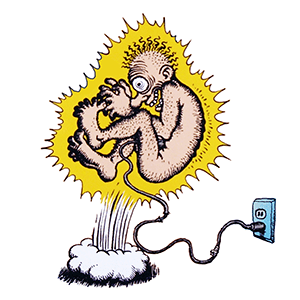
Symptoms described as ‘brain zaps,’ ‘brain shocks,’ ‘brain shivers,’ or ‘cranial zings’ are a withdrawal symptom experienced during discontinuation (or reduction of dose) of antidepressant drugs. The symptoms are widely variable in description and of unknown etiology; common descriptions include dizziness, electric shock-like sensations, sweating, nausea, insomnia, tremor, confusion, nightmares, and vertigo.
The ‘preferred term’ for coding these types of symptoms in adverse drug reaction reports is ‘paraesthesia’ (more generally known as the feeling of ‘pins and needles’).
Posted in Drugs, Health, Language |
Leave a Comment »
October 11, 2011

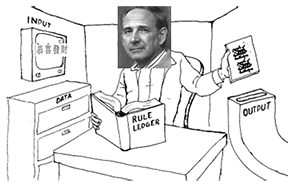
Strong AI is artificial intelligence that matches or exceeds human intelligence — the intelligence of a machine that can successfully perform any intellectual task that a human being can. It is a primary goal of artificial intelligence research and an important topic for science fiction writers and futurists.
Strong AI is also referred to as ‘artificial general intelligence’ or as the ability to perform ‘general intelligent action.’ Science fiction associates strong AI with such human traits as consciousness (subjective experience and thought), sentience (subjective feelings and emotion), sapience (wisdom) and self-awareness (identification of oneself as a separate individual, especially to be aware of one’s own thoughts). Some references emphasize a distinction between strong AI and ‘applied AI’ (also called ‘narrow AI’ or ‘weak AI’): the use of software to study or accomplish specific problem solving or reasoning tasks that do not encompass (or in some cases are completely outside of) the full range of human cognitive abilities.
read more »
Posted in Language, Philosophy, Technology |
1 Comment »




