December 13, 2016
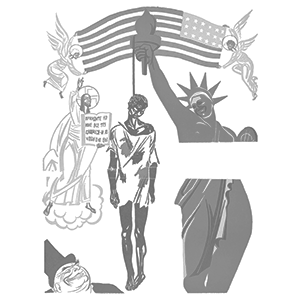
Whataboutism is a term describing a propaganda technique used by the Soviet Union in its dealings with the Western world during the Cold War. When criticisms were leveled at the Soviet Union, the response would be ‘What about…’ followed by the naming of an event in the Western world.
It represents a case of ‘tu quoque’ (Latin: ‘you also’) or the ‘appeal to hypocrisy,’ a logical fallacy which attempts to discredit the opponent’s position by asserting the opponent’s failure to act consistently in accordance with that position, without directly refuting or disproving the opponent’s initial argument.
read more »
Posted in Language, Politics, World |
Leave a Comment »
November 15, 2016

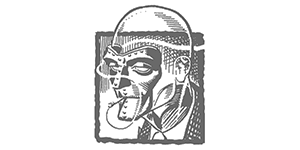
Steve Ditko (b. 1927) is an American comic book artist and writer best known as the artist and co-creator, with Stan Lee, of ‘Spider-Man’ and ‘Doctor Strange.’ As of mid-2012, Ditko continues to work at a studio in Manhattan’s Midtown West neighborhood. He has refused to give interviews or make public appearances since the 1960s, explaining in 1969 that, ‘When I do a job, it’s not my personality that I’m offering the readers but my artwork. It’s not what I’m like that counts; it’s what I did and how well it was done…. I produce a product, a comic art story. Steve Ditko is the brand name.’ He has, however, contributed numerous essays to Robin Snyder’s fanzine ‘The Comics.’
Ditko studied under ‘Batman’ artist Jerry Robinson in Manhattan at the Cartoonist and Illustrators School (later the School of Visual Arts). He began his professional career in 1953, working in the studio of Joe Simon and Jack Kirby, beginning as an inker and coming under the influence of artist Mort Meskin. During this time, he then began his long association with Charlton Comics, where he did work in the genres of science fiction, horror, and mystery. He also co-created the superhero ‘Captain Atom’ in 1960.
read more »
Posted in Art, Language |
Leave a Comment »
November 14, 2016
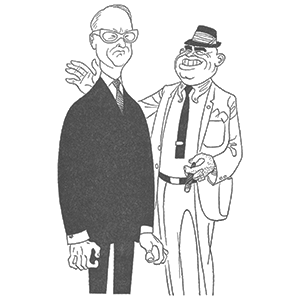
A snob is a pejorative term for a person who believes there is a correlation between social status and human worth. The term also refers to a person who judges, stigmatizes others and believes that some people are inherently inferior to others result from the perception of beliefs, values, intellect, creativity, talent, wealth, occupation, education, ancestry, ethnicity, relationship, power, religion, physical strength, class, taste, prestige, beauty, nationality, and fame. The word ‘snobbery’ came into use the first time in England during the 1820s.
English social commentator William Hazlitt observed, in a culture where deference to class was accepted as a positive and unifying principle, ‘Fashion is gentility running away from vulgarity, and afraid of being overtaken by it,’ adding subversively, ‘It is a sign the two things are not very far apart.’ The English novelist Bulwer-Lytton remarked in passing, ‘Ideas travel upwards, manners downwards.’ It was not the deeply ingrained and fundamentally accepted idea of ‘one’s betters’ that has marked snobbery in traditional European and American culture, but ‘aping one’s betters.’
read more »
Posted in Language, Money, Politics |
Leave a Comment »
October 17, 2016
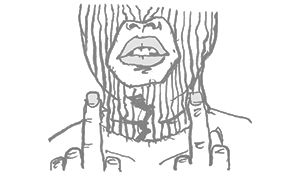
The word pussy is a noun, an adjective, and in rare uses a verb in the English language. It has several meanings, including use as slang, as euphemism, and as vulgarity. Common meanings of the noun include ‘cat,’ ‘coward or weakling,’ and ‘the human vulva or vagina.’ Because of its multiple senses including both innocent and vulgar connotations, ‘pussy’ is often the subject of double entendre, including the late-19th-century vaudeville act the Barrison Sisters, who performed the notorious routine ‘Do You Want To See My Pussy?’ in which they raised their skirts to reveal live kittens.
The etymology of the word is not entirely clear. Several different senses of the word have different histories or origins. The feline variant comes from the Modern English word ‘puss,’ a conventional name or term of address for a pet cat in several Germanic languages, including Dutch (‘poes’) and Middle Low German (pūse). The word puss is attested in English as early as 1533. Earlier etymology is uncertain, but similar words exist in other European languages, including Lithuanian (puižė) and Irish (puisín) as traditional calls to attract a cat.
read more »
Posted in Language, Sex, World |
Leave a Comment »
September 27, 2016
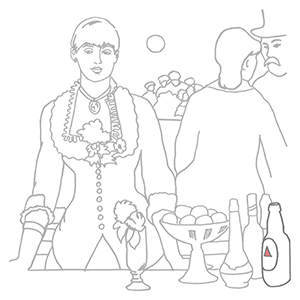
A logo is a graphic mark, emblem, or symbol commonly used by commercial enterprises, organizations and even individuals to aid and promote instant public recognition. Logos are either purely graphic (symbols/icons) or are composed of the name of the organization (a ‘logotype’ or ‘wordmark’).
In the days of hot metal typesetting, a logotype was one word cast as a single piece of type, e.g. ‘The’ (as opposed to a ‘ligature,’ which is two or more letters joined, but not forming a word). By extension, the term was also used for a uniquely set and arranged typeface or colophon (a brief description of the manuscript or book to which it is attached). At the level of mass communication and in common usage, a company’s logo is today often synonymous with its trademark or brand.
read more »
Posted in Art, Language, Money |
Leave a Comment »
September 13, 2016


The three wishes joke is a form of joke in which the protagonist is given three wishes by a supernatural being, and fails to make the best use of them. Common scenarios include releasing a genie from confinement – perhaps finding an old oil lamp and rubbing it; catching and agreeing to release a mermaid or magical fish; or crossing paths with the devil.
The protagonist of the joke makes their first two wishes and finds that all is well. Often, the third wish is either misinterpreted, or intentionally granted in an awkwardly literal fashion, and cannot be reversed because it is the final wish, resulting in the punchline of the joke. Alternatively, the wishes are split between three people, with the last person inadvertently or intentionally messing up or undoing the wishes of the others with their wish to form the punchline.
read more »
Posted in Humor, Language |
Leave a Comment »
September 6, 2016
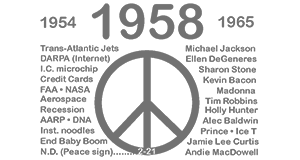

Generation Jones is a term coined by the author Jonathan Pontell to describe those born from approximately 1954 to 1965. This group is essentially the latter half of the ‘Baby Boomers’ to the first years of Generation X. The name has several connotations, including a large anonymous generation, a ‘keeping up with the Joneses’ competitiveness, and the slang word ‘jones’ or ‘jonesing,’ meaning a yearning or craving.
It is said that Jonesers were given huge expectations as children in the 1960s, and then confronted with a different reality as they came of age during a long period of mass unemployment. When de-industrialization arrived full force in the mid to late 1970s and 1980s, they were left with a certain unrequited ‘jonesing’ quality for the more prosperous days in the past.
read more »
Posted in Language, Money, Politics |
Leave a Comment »
July 28, 2016

Leo Burnett (1891 – 1971) was an American advertising executive and the founder of Leo Burnett Company, Inc. He was responsible for creating some of advertising’s most well-known characters and campaigns of the 20th century, including ‘Tony the Tiger,’ ‘Charlie the Tuna,’ the ‘Marlboro Man,’ the ‘Maytag Repairman,’ United’s ‘Fly the Friendly Skies,’ Allstate’s ‘Good Hands,’ and for garnering relationships with multinational clients such as McDonald’s, Hallmark, and Coca-Cola.
His first job out of college was as a reporter for the ‘Peoria Journal Star’ in Peoria, Illinois. In 1917, Leo moved to Detroit and was hired to edit an in-house publication for ‘Cadillac Clearing House,’ later becoming an advertising director for the same institution. At Cadillac, Leo met his advertising mentor, Theodore F. MacManus, whom Leo called ‘one of the great advertising men of all time.’
read more »
Posted in Language, Money |
Leave a Comment »
July 14, 2016
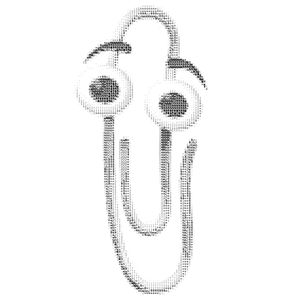
A chatterbot (also known as a talkbot, chatbot, Bot, chatterbox, or Artificial Conversational Entity) is a computer program which conducts a conversation via auditory or textual methods. Such programs are often designed to convincingly simulate how a human would behave as a conversational partner, thereby passing the Turing test (a measure of how well a computer can trick a person into believing that the computer is a person too).
Chatbots are typically used in dialog systems for various practical purposes including customer service or information acquisition. Some chatbots use sophisticated natural language processing systems (programs that understand not just recognize language), but many simpler systems scan for keywords within the input, then pull a reply with the most matching keywords, or the most similar wording pattern, from a database. The term ‘ChatterBot’ was originally coined by Michael Mauldin (creator of the first Verbot, Julia) in 1994 to describe these conversational programs.
read more »
Posted in Language, Technology |
Leave a Comment »
July 4, 2016


Flat design is a minimalist user interface design genre, or design language, commonly used in graphical user interfaces (such as web applications and mobile apps), and in graphical materials such as posters, arts, guide documents, and publishing products.
Flat design is a style of interface design emphasizing minimum use of stylistic elements that give the illusion of three dimensions (such as the use of drop shadows, gradients or textures) and is focused on simple elements, typography and flat colors. Designers may prefer flat design because it allows interface designs to be more streamlined and efficient. It is easier to quickly convey information while still looking visually appealing and approachable.
read more »
Posted in Art, Language, Technology |
Leave a Comment »
June 20, 2016

The turboencabulator (and its later incarnation, the ‘retroencabulator’) is a fictional machine whose alleged existence became an in-joke and subject of professional humor among engineers. The explanation of the supposed product makes extensive use of ‘technobabble’ (jargon that uses buzzwords, esoteric language, specialized technical terms).
‘Time’ magazine reported on the joke in 1946: ‘The original machine had a base-plate of prefabulated amulite, surmounted by a malleable logarithmic casing in such a way that the two spurving bearings were in a direct line with the pentametric fan. The main winding was of the normal lotus-o-delta type placed in panendermic semi-boloid slots in the stator, every seventh conductor being connected by a nonreversible tremie pipe to the differential girdlespring on the ‘up’ end of the grammeters.’
read more »
Posted in Humor, Language, Technology |
Leave a Comment »
June 15, 2016
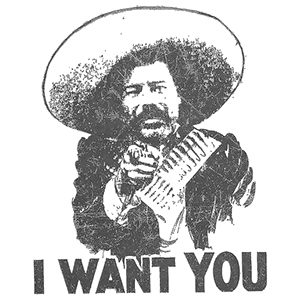
Gringo [gring-goh] is a term, mainly used in Spanish-speaking and in Portuguese-speaking countries, to refer to foreigners. In Spanish, gringo refers especially to someone from the United States. The word was originally used in Spain (although it’s mostly unused in the country nowadays) to denote any foreign, non-native speakers of Spanish.
The word was first recorded in a 1787 Castilian dictionary: “Gringos is what, in Malaga, they call foreigners who have a certain type of accent that prevents them from speaking Castilian easily and naturally; and in Madrid they give the same name, and for the same reason, in particular to the Irish.’ The dominant view among etymologists is that gringo is most likely a variant of ‘griego’ ‘Greek’ speech (cf. ‘Greek to me’).
read more »
Posted in Language, World |
Leave a Comment »


 The Daily Omnivore