September 6, 2016
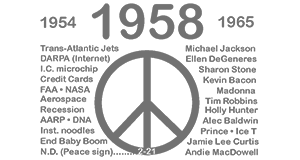

Generation Jones is a term coined by the author Jonathan Pontell to describe those born from approximately 1954 to 1965. This group is essentially the latter half of the ‘Baby Boomers’ to the first years of Generation X. The name has several connotations, including a large anonymous generation, a ‘keeping up with the Joneses’ competitiveness, and the slang word ‘jones’ or ‘jonesing,’ meaning a yearning or craving.
It is said that Jonesers were given huge expectations as children in the 1960s, and then confronted with a different reality as they came of age during a long period of mass unemployment. When de-industrialization arrived full force in the mid to late 1970s and 1980s, they were left with a certain unrequited ‘jonesing’ quality for the more prosperous days in the past.
read more »
Posted in Language, Money, Politics |
Leave a Comment »
July 28, 2016

Leo Burnett (1891 – 1971) was an American advertising executive and the founder of Leo Burnett Company, Inc. He was responsible for creating some of advertising’s most well-known characters and campaigns of the 20th century, including ‘Tony the Tiger,’ ‘Charlie the Tuna,’ the ‘Marlboro Man,’ the ‘Maytag Repairman,’ United’s ‘Fly the Friendly Skies,’ Allstate’s ‘Good Hands,’ and for garnering relationships with multinational clients such as McDonald’s, Hallmark, and Coca-Cola.
His first job out of college was as a reporter for the ‘Peoria Journal Star’ in Peoria, Illinois. In 1917, Leo moved to Detroit and was hired to edit an in-house publication for ‘Cadillac Clearing House,’ later becoming an advertising director for the same institution. At Cadillac, Leo met his advertising mentor, Theodore F. MacManus, whom Leo called ‘one of the great advertising men of all time.’
read more »
Posted in Language, Money |
Leave a Comment »
July 14, 2016

A chatterbot (also known as a talkbot, chatbot, Bot, chatterbox, or Artificial Conversational Entity) is a computer program which conducts a conversation via auditory or textual methods. Such programs are often designed to convincingly simulate how a human would behave as a conversational partner, thereby passing the Turing test (a measure of how well a computer can trick a person into believing that the computer is a person too).
Chatbots are typically used in dialog systems for various practical purposes including customer service or information acquisition. Some chatbots use sophisticated natural language processing systems (programs that understand not just recognize language), but many simpler systems scan for keywords within the input, then pull a reply with the most matching keywords, or the most similar wording pattern, from a database. The term ‘ChatterBot’ was originally coined by Michael Mauldin (creator of the first Verbot, Julia) in 1994 to describe these conversational programs.
read more »
Posted in Language, Technology |
Leave a Comment »
July 4, 2016


Flat design is a minimalist user interface design genre, or design language, commonly used in graphical user interfaces (such as web applications and mobile apps), and in graphical materials such as posters, arts, guide documents, and publishing products.
Flat design is a style of interface design emphasizing minimum use of stylistic elements that give the illusion of three dimensions (such as the use of drop shadows, gradients or textures) and is focused on simple elements, typography and flat colors. Designers may prefer flat design because it allows interface designs to be more streamlined and efficient. It is easier to quickly convey information while still looking visually appealing and approachable.
read more »
Posted in Art, Language, Technology |
Leave a Comment »
June 20, 2016

The turboencabulator (and its later incarnation, the ‘retroencabulator’) is a fictional machine whose alleged existence became an in-joke and subject of professional humor among engineers. The explanation of the supposed product makes extensive use of ‘technobabble’ (jargon that uses buzzwords, esoteric language, specialized technical terms).
‘Time’ magazine reported on the joke in 1946: ‘The original machine had a base-plate of prefabulated amulite, surmounted by a malleable logarithmic casing in such a way that the two spurving bearings were in a direct line with the pentametric fan. The main winding was of the normal lotus-o-delta type placed in panendermic semi-boloid slots in the stator, every seventh conductor being connected by a nonreversible tremie pipe to the differential girdlespring on the ‘up’ end of the grammeters.’
read more »
Posted in Humor, Language, Technology |
Leave a Comment »
June 15, 2016
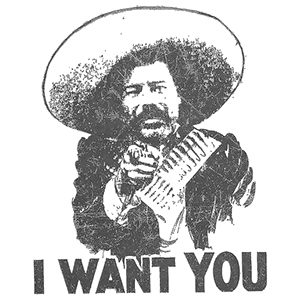
Gringo [gring-goh] is a term, mainly used in Spanish-speaking and in Portuguese-speaking countries, to refer to foreigners. In Spanish, gringo refers especially to someone from the United States. The word was originally used in Spain (although it’s mostly unused in the country nowadays) to denote any foreign, non-native speakers of Spanish.
The word was first recorded in a 1787 Castilian dictionary: “Gringos is what, in Malaga, they call foreigners who have a certain type of accent that prevents them from speaking Castilian easily and naturally; and in Madrid they give the same name, and for the same reason, in particular to the Irish.’ The dominant view among etymologists is that gringo is most likely a variant of ‘griego’ ‘Greek’ speech (cf. ‘Greek to me’).
read more »
Posted in Language, World |
Leave a Comment »
May 31, 2016
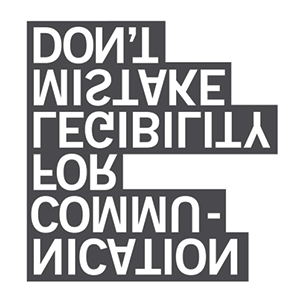
Typography is the art and technique of arranging type to make written language legible, readable, and appealing when displayed. The arrangement of type involves selecting typefaces, point size, line length, line-spacing (leading), letter-spacing (tracking), and adjusting the space within letters pairs (kerning). The term ‘typography’ is also applied to the style, arrangement, and appearance of the letters, numbers, and symbols created by the process.
In contemporary use, the practice and study of typography is very broad, covering all aspects of letter design and application, both mechanical (typesetting and typefaces) and manual (handwriting and calligraphy). Type design is a closely related craft, sometimes considered part of typography; most typographers do not design typefaces, and some type designers do not consider themselves typographers. Typography also may be used as a decorative device, unrelated to communication of information.
read more »
Posted in Art, Language, Technology |
Leave a Comment »
May 29, 2016
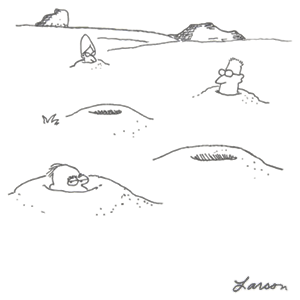
‘The Far Side‘ is a single-panel comic created by Gary Larson and syndicated by Universal Press Syndicate, which ran from January 1, 1980, to January 1, 1995. Its surrealistic humor is often based on uncomfortable social situations, improbable events, an anthropomorphic view of the world, logical fallacies, impending bizarre disasters, (often twisted) references to proverbs, or the search for meaning in life. Larson’s frequent use of animals and nature in the comic is popularly attributed to his background in biology. The series was preceded by a similar panel called ‘Nature’s Way,’ also by Larson.
Most of Larson’s comics relied on some combination of a visual and verbal gag, rather than just one or the other. Some recurring themes in the comic include people being stranded on desert islands, aliens, heaven, hell, and the life of cavemen. Many cartoons focused on animals, especially cows, bears, dogs, flies, and ducks. Notably, virtually all characters portrayed in the comic were overweight or obese, and usually wearing glasses. In addition, unless needed for a facial or comic expression, eyes are almost never drawn and characters usually show only a brow ridge.
Posted in Art, Humor, Language |
1 Comment »
April 27, 2016
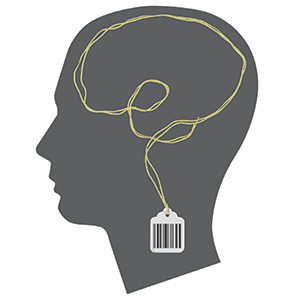
‘Buyology: Truth and Lies About Why We Buy’ (2008) is a bestselling book by Danish marketing expert Martin Lindstrom, in which he analyzes buying decisions. The author attempts to identify the factors that influence buyers’ decisions in a world cluttered with messages such as advertisements, slogans, jingles, and celebrity endorsements. Lindstrom, through a study of the human psyche, examines the subconscious mind and its role in deciding what the buyer will buy. He debunks some myths about advertising and promotion.
‘Buyology’ is claimed to be a result of the author’s three year neuromarketing study on 2,081 people to identify the effect of brands, logos, commercials, advertisements and products on them. Neuromarketing investigates the sensorimotor, cognitive, and affective response to marketing stimuli. The study was funded by seven corporations, including GlaxoSmithKline, Hakuhodo, Fremantle – and Lindstrom himself. The study evaluates the effectiveness of logos, product placement and subliminal advertising, the influence of our senses and the correlation between religion and branding.
Posted in Language, Money |
Leave a Comment »
April 8, 2016
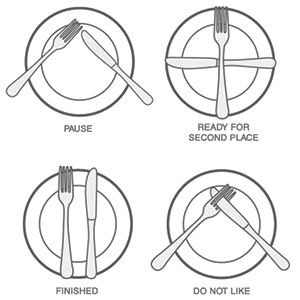
The silent service code is a way for a diner to ‘talk’ to servers during a meal without saying a word, mainly to tell them that the diner is finished. This will prevent any embarrassing situations where the server would take a meal prematurely.
To tell a server you have finished place your napkin to the left of your plate, and place all your utensils together in a ‘4-o’clock’ position on your plate. Utensils crossed on a plate signify that a diner is still eating. If you must leave during the meal, you should place the napkin on your chair to avoid any confusion. The code is almost always taught during business dining etiquette classes.
Posted in Food, Language |
Leave a Comment »
April 7, 2016

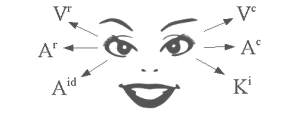
The term unsaid refers what is not explicitly stated, what is hidden or implied in the speech of an individual or a group of people. The unsaid may be the product of intimidation; of a mulling over of thought; or of bafflement in the face of the inexpressible. Sociolinguistics points out that in normal communication what is left unsaid is as important as what is actually said — that we expect our auditors regularly to fill in the social context/norms of our conversations as we proceed.
British sociologist Basil Bernstein described two types of speech: restricted and elaborated code. The former is suitable for insiders who share assumptions and understanding on the topic, whereas the latter is more explicit, more thorough, and does not require the listener to read between the lines.
read more »
Posted in Language |
Leave a Comment »
April 6, 2016

‘800-pound gorilla’ is an American English expression for a person or organization so powerful that it can act without regard to the rights of others or the law. The phrase is rooted in a joke riddle: ‘Where does an 800-lb. gorilla sit?’ The answer: ‘Anywhere it wants to.’
The term can describe a powerful geopolitical and military force, or, in business, a powerful corporate entity that has such a large majority percentage of whatever market they compete within that they can use that strength to crush would-be competitors. The metaphor has been mixed, on occasion, with the metaphor of the elephant in the room (an obvious truth that is going unaddressed).
Posted in Humor, Language |
1 Comment »



