July 8, 2011


Counterculture is a term used in psychology and sociology to describe a set of views that are not of the mainstream. It is a neologism attributed to American historian Theodore Roszak. Although distinct countercultural undercurrents have existed in many societies, here the term refers to a more significant, visible phenomenon that reaches critical mass and persists for a period of time.
A countercultural movement expresses the ethos, aspirations, and dreams of a specific population during an era—a social manifestation of zeitgeist. The term came to prominence in the news media, as it was used to refer to the social revolution that swept North America, Western Europe, Japan, Australia, and New Zealand during the 1960s and early 1970s.
read more »
Posted in Language, Politics, Sex |
Leave a Comment »
July 8, 2011
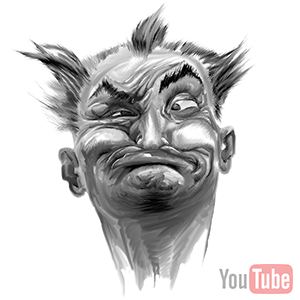
A gurn or chuck is a distorted facial expression, and a verb to describe the action. A typical gurn might involve projecting the lower jaw as far forward and up as possible, and covering the upper lip with the lower lip. Another common form of gurning is the ‘duck face’ which is characterized by outwardly splayed lips. Gurn has also been defined as ‘to snarl as a dog; to look savage; to distort the countenance.’ The derivation may originally be Scottish, related to ‘grin.’ In Northern Ireland, the verb ‘to gurn’ means ‘to cry,’ and crying is often referred to as ‘gurnin’.’
Gurning contests are a rural English tradition. By far the most notable is that held annually at the Egremont Crab Fair, which dates back to 1267 when King Henry III granted the fair a Royal Charter. The competitions are held regularly in some villages, with contestants traditionally framing their faces through a horse collar — known as ‘gurnin’ through a braffin’.’ The World Gurning Championship takes place annually at the same crab fair in Egremont, Cumbria. Those with the greatest gurn capabilities are often those with no teeth, as this provides greater room to move the jaw further up. In some cases, the elderly or otherwise toothless can be capable of spectacular gurns covering the entire nose.
Posted in Games, Humor, Language |
1 Comment »
July 5, 2011

The Maschinenmensch [muh-sheen-en-mench] (German: ‘machine-human’) from ‘Metropolis,’ is a gynoid played by German actress Brigitte Helm in both her robotic and human incarnations. The haunting blank face and pronounced female curves have been the subject of disgust and fascination alike. The Maschinenmensch has many names given her through the years : Parody, Ultima, Machina, Futura, and Robotrix. The Maschinenmensch’s back story is detailed in Thea von Harbou’s original 1927 novel. It is described as a very delicate, but faceless, transparent figure made of crystal flesh with silver bones and its eyes filled with an expression of calm madness. Futura is perfectly obedient and the ideal agent-provocateur, able to become any woman and tempt men to their doom.
The memorable transformation scene was an early miracle of special effects, using a series of matte cutouts of the robot’s silhouette and a number of circular neon lights. All effects were filmed directly into the camera rather than edited separately. As a result the film had to be rewound and exposed many tens of times over to include the plates showing the heart and circulatory systems as well as cuts between the robot form and Maria showing her gradual transformation. The Maschinenmensch is an archetypal example of the Frankenstein complex, where artificial creations turn against their creator and go on a rampage. Artificial beings with a malevolent nature were a popular theme at the time. Original designs by Ralph McQuarrie for C-3PO in Star Wars were largely based on the Maschinenmensch, albeit in a male version. The design was later refined, but retains clear Art Deco influences.
Posted in Art, Language, Technology |
1 Comment »
July 5, 2011

Anonymous is an Internet meme that originated in 2003 on the imageboard 4chan, representing the concept of many online community users simultaneously existing as an anarchic, digitized global hive mind. It is also generally considered to be a blanket term for members of certain Internet subcultures, a way to refer to the actions of people in an environment where their actual identities are not known.
In its early form, the concept has been adopted by a decentralized online community acting anonymously in a coordinated manner, usually toward a loosely self-agreed goal, and primarily focused on entertainment. Beginning with 2008, the Anonymous collective has become increasingly associated with collaborative, international hacktivism, undertaking protests and other actions, often with the goal of promoting internet freedom and freedom of speech. Actions credited to ‘Anonymous’ are undertaken by unidentified individuals who apply the Anonymous label to themselves as attribution.
read more »
Posted in Language, Politics, Technology |
Leave a Comment »
July 4, 2011
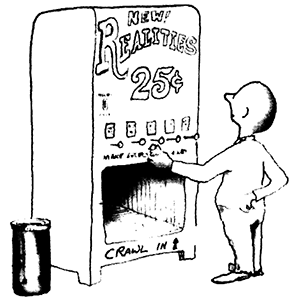

Robert Anton Wilson (1932 – 2007) was a futurist thinker, libertarian, and writer. He held a Ph.D in Psychology. At one time he was a writer for Playboy magazine. Wilson was the author of the ‘Schrödinger’s Cat’ trilogy (1979). He also co-wrote (with Robert Shea) the ‘Illuminatus!’ trilogy (1975), which took a humorous look at the American fear of conspiracies. These books mix true facts with fiction. In ‘The Cosmic Trigger’ (1976), he introduced Discordianism, Sufism, futurism, the Illuminati and other unusual subjects to the general public. He also worked with Timothy Leary to promote futurist ideas of space migration, life extension, and intelligence enhancement.
Recognized as an episkopos, pope, and saint of Discordianism, Wilson helped publicize the group. He described his work as an ‘attempt to break down conditioned associations, to look at the world in a new way, with many models recognized as models or maps, and no one model elevated to the truth.’ His goal being ‘to try to get people into a state of generalized agnosticism, not agnosticism about God alone but agnosticism about everything.’
read more »
Posted in Humor, Language, Philosophy |
Leave a Comment »
July 4, 2011


‘Keeping up with the Joneses’ is an idiom in many parts of the English-speaking world referring to the comparison to one’s neighbor as a benchmark for social caste or the accumulation of material goods. To fail to ‘keep up with the Joneses’ is perceived as demonstrating socio-economic or cultural inferiority. The phrase was popularized when a comic strip of the same name was created by cartoonist Arthur R. ‘Pop’ Momand. The strip debuted in 1913, and ran in American newspapers for 26 years, and was eventually adapted into books, films, and musical comedies. The ‘Joneses’ of the title were neighbors of the strip’s main characters, and were unseen characters spoken of but never actually seen in person.
The philosophy of ‘keeping up with the Joneses’ has widespread effects on some societies. According to this philosophy, conspicuous consumption occurs when people care about their standard of living in relation to their peers. The term was re-coined or re-introduced into US narrative in 1976 when a small article was written about current parenting style. Social status once depended on one’s family name; however, the rise of consumerism in the United States gave rise to social mobility. With the increasing availability of goods, people became more inclined to define themselves by what they possessed and the subtle quest for higher status accelerated. The upward mobility over the past few decades in America is due in part to the large number of women joining the labor force.
Posted in Language, Money |
Leave a Comment »
July 4, 2011

La Malinche (c. 1496 – 1529) was an indigenous woman from the Mexican Gulf Coast, who played a role in the Spanish conquest of Mexico, acting as interpreter, advisor, lover and intermediary for Hernán Cortés. She was one of twenty slaves given to Cortés by the natives of Tabasco in 1519. Later she became a mistress to Cortés and gave birth to his first son, Martín, who is considered one of the first Mestizos (people of mixed European and indigenous American ancestry).
The historical figure of Marina has been intermixed with Aztec legends. Her reputation has been altered over the years according to changing social and political perspectives, especially after the Mexican Revolution, when she was portrayed in dramas, novels, and paintings as an evil or scheming temptress. In Mexico today, La Malinche remains iconically potent. She is understood in various and often conflicting aspects, as the embodiment of treachery, the quintessential victim, or simply as symbolic mother of the new Mexican people. Her sexual relationship to Cortés gave rise to the pejorative term La Chingada (‘the fucked one’). The term ‘malinchista’ refers to a disloyal Mexican.
read more »
Posted in Language, Politics, World |
Leave a Comment »
July 4, 2011


Since the 1970s, cuteness, in Japanese the noun kawaisa (literally, ‘lovability,’ ‘cuteness’ or ‘adorableness’), has become a prominent aspect of Japanese popular culture, entertainment, clothing, food, toys, personal appearance, behavior, and mannerisms. The term kawaii has taken on the secondary meanings of ‘cool,’ ‘groovy,’ ‘charming,’ ‘non-threatening.’ As a cultural phenomenon, cuteness is increasingly accepted in Japan as a part of Japanese culture and national identity.
Japanese women who perform cute behaviors that could be viewed as forced or fake are called ‘burikko’ and this is considered a gender performance. In Japan, cuteness is expected of men and women. There is a trend of men shaving their legs to mimic the ‘asexual’ look. The original definition of kawaii came from Lady Murasaki’s ‘The Tale of Genji’ where it referred to pitiable qualities. During the Shogunate period under the ideology of neo-Confucianism, women came to be included under the term kawaii as the perception of women from being animalistic was replaced with the conception of women as docile.
read more »
Posted in Art, Language, World |
Leave a Comment »
July 4, 2011
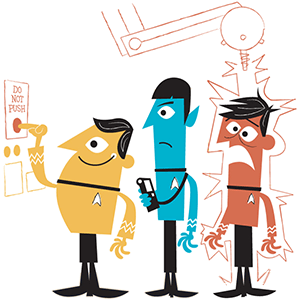
Redshirt is a term for a stock character in fiction who dies soon after being introduced. The term originated with fans of Star Trek, from the red shirts worn by Starfleet security officers who frequently die during episodes.
In many episodes of Star Trek, red-uniformed security officers and engineers accompanying the main characters on landing parties quickly die.
Posted in Art, Humor, Language |
1 Comment »
July 3, 2011

Manqué [mahng-key] (feminine, manquée) is a term used in reference to a person who has failed to live up to a specific expectation or ambition. It is usually used in combination with a profession: for example, a career civil servant with political prowess who nonetheless never attained political office might be described as a ‘politician manqué.’
It can also be used relative to a specific role model; a second-rate method actor might be referred to as a ‘Marlon Brando manqué.’ The term derives from the past participle of the French verb manquer (‘to miss’). In English, it is used in the manner of a French adjective: coming after the noun it is modifying instead of before.
Posted in Language, Politics, World |
Leave a Comment »
June 30, 2011


Action origami is origami that can be animated. The original traditional action model is the flapping bird. Typically models where the final assembly involves some special action, for instance blowing up a waterbomb, are also classed as action origami., More rarely models like paper plane and spinners which have no moving parts are included. Some traditional action origami involved cuts but modern models typically are built with no cuts.
Action toys include birds or butterflies with flapping wings, beaks that peck, and frogs that hop, as well as popular traditional models like the fortune teller. Bangers are models that make a nose when flicked down hard. Some models are far more complex than can be classed as toys. They are built to amaze and astonish. For instance Robert J. Lang’s ‘Bassist, Pianist, and Violinist’ is a set of action models where each one plays an instrument when pulled on appropriately.
Posted in Art, Games, Language |
Leave a Comment »
June 30, 2011

Tutting is a contemporary abstract interpretive street dance style modeled after Egyptian hieroglyphics. It is performed with attention to the musics’ rhythm by altering the position of the body and limbs in a synchronized, robotic manner. The size of poses, or tuts, varies from large body tuts to intricate finger tuts. The transitions between poses can be elaborate and expressive. Moreover, certain sub-styles have emerged such as boxing (creating and manipulating box-like or rectangular shapes predominantly with ones arms) and a liquid-influenced style that some tutters use to make the joints appear as hinges that can then be manipulated by another body part.
Both techniques are special applications of the mime concept ‘fixed point.’ Much as a mime conveys a wall by always keeping one hand on the wall, or shows a rope by always keeping one hand on the rope, a tutter shows a shape by always maintaining at least one side of the shape. To do this, a tutter will use his body parts to assemble a shape segment by segment and disassemble it in the same piecemeal fashion. The electronic dance community has played a large role in the increasing robustness of tutting due to the more abstract nature of its own predominant style, liquiding. Tutting is highly regarded in both the electronic and popping communities for its technical depth and distinctiveness.
Posted in Art, Games, Language |
Leave a Comment »



 The Daily Omnivore