July 13, 2011

A card sharp (or card shark) is a person who uses skill and deception to win at poker or other card games. The label is not always intended as pejorative, and is sometimes used to refer to practitioners of card tricks for entertainment purposes. The term has also taken on the meaning of ‘expert card gambler who takes advantage of less-skilled players,’ without implication of actual cheating at cards, in much the same way that ‘pool shark’ or ‘pool hustler’ can (especially when used by non-players) be intended to mean ‘skilled player’ rather than ‘swindler.’ A card sharp/shark may be a ’rounder’ who travels, seeking out high-stakes games in which to gamble.
Card sharps who cheat or perform tricks use methods to keep control of the order of the cards or sometimes to control one specific card. Most, if not all, of these methods employ sleight of hand. Essential skills are false shuffles and false cuts that appear to mix the deck but actually leave the cards in the same order. More advanced techniques include culling (manipulating desired cards to the top or bottom of the deck), and stacking (putting desired cards in position to be dealt). Dealing the cards can also be manipulated, by dealing either the bottom card from the deck or the second one from the top instead of the top card. These are called Bottom dealing and Second dealing, respectively. Dealing may also be done from the middle of the deck, known as the middle deal or center deal, but this is not as common.
Posted in Games, Humor, Language |
Leave a Comment »
July 13, 2011

Hustling is the deceptive act of disguising one’s skill in a sport or game with the intent of luring someone of lesser skill into gambling (or gambling for higher than current stakes) with the hustler, as a form of confidence trick. It is most commonly associated with pool, but also can be performed with regard to other sports and gambling activities. Hustlers may also engage in ‘sharking’ – distracting, disheartening, enraging or even threatening their opponents, to throw them off. Hustlers are thus often called ‘pool sharks.’
Professional and semi-pro hustlers sometimes work with a ‘stakehorse’ — a person who provides the money for the hustler to bet with (and who may assist in the hustling) — in exchange for a substantial portion of all winnings. Another form of hustling (often engaged in by the same hustlers who use the skill-disguising technique) is challenging ‘marks’ (swindle targets) to bet on trick shots that seem near-impossible but at which the hustler is exceptionally skilled.
read more »
Posted in Games, Language, Money |
Leave a Comment »
July 13, 2011

Hunter S. Thompson (1937 – 2005) was an American journalist and author. He is credited as the creator of Gonzo journalism, a style of reporting where reporters involve themselves in the action to such a degree that they become central figures of their stories.
He is known also for his unrepentant lifelong use of alcohol, LSD, mescaline, and cocaine (among other substances); his love of firearms; his inveterate hatred of Richard Nixon; and his iconoclastic contempt for authoritarianism. While suffering a bout of health problems, he committed suicide in 2005, at the age of 67.
read more »
Posted in Drugs, Humor, Language |
Leave a Comment »
July 13, 2011

Raoul Duke is the fictional character and antihero based on Hunter S. Thompson in his autobiographical novel ‘Fear and Loathing in Las Vegas.’ The book was originally written under the name Raoul Duke. He is the main character and narrator of many of Thompson’s stories, novels, and articles, often taking part of events in Thompson’s life in Thompson’s place.
He is portrayed as a cynical, eccentric hedonist. He is in a near-perpetual state of intoxication on whatever drugs happen to be available, ranging from marijuana to amyl nitrite to adrenochrome. He usually obtains and consumes these substances in the company of his attorney, Gonzo, a half-crazed 300 pound Samoan, whose drug-induced frenzies give even Duke pause. Thompson based Gonzo on his friend the civil rights lawyer Oscar Zeta Acosta.
read more »
Posted in Drugs, Humor, Language |
Leave a Comment »
July 12, 2011

Purple drank is a slang term for a recreational drug popular in the hip hop community in the southern United States, originating in Houston, Texas. Its main ingredient is prescription-strength cough syrup containing codeine and promethazine. Cough syrup is typically mixed with ingredients such as Sprite soft drink or Mountain Dew and pieces of Jolly Rancher candy. The purplish hue of purple drank comes from dyes in the cough syrup. Producer DJ Screw popularized the concoction in the 1990s, which is widely attributed as a source of inspiration for the ‘chopped and screwed’ style of hip hop music. However, musician Big Hawk claims it was consumed as early as the 1960s and 1970s.
DJ Screw died of a codeine-promethazine-alcohol overdose in 2000. Purple drank is confirmed or suspected to have caused the deaths of several prominent users. Respiratory depression is a potentially serious or fatal adverse drug reaction associated with the use of codeine, but mainly the danger lies in the much more potent and CNS-depressing phenothiazine-related antihistamine promethazine.
Posted in Drugs, Health, Language |
Leave a Comment »
July 12, 2011
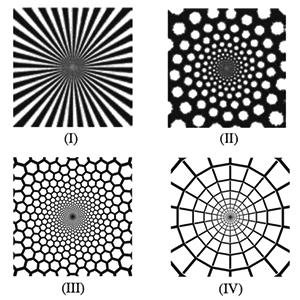
A phosphene [fos-feen] is an entoptic (visual) phenomenon characterized by the experience of seeing light without light actually entering the eye. The word phosphene comes from the Greek words ‘phos’ (‘light’) and ‘phainein’ (‘to show’). Phosphenes are flashes of light, often associated with optic neuritis, induced by movement or sound.
They can be directly induced by mechanical, electrical, or magnetic stimulation of the retina or visual cortex as well as by random firing of cells in the visual system. Phosphenes have also been reported by meditators (commonly called nimitta); people who go for long periods without visual stimulation (also known as the prisoner’s cinema); or those who are using psychedelic drugs.
read more »
Posted in Drugs, Health, Language |
1 Comment »
July 11, 2011

The Chinese typewriter was invented and patented by Dr. Lin Yutang in 1946. One of Lin’s intentions was to help modernize China. The typewriter was called ‘MingKwai’ (‘clear and quick’). Lin had a prototype machine custom built by the Carl E. Krum Company, a small engineering-design consulting firm with an office in New York City. That multilingual typewriter was the size of a conventional office typewriter of the 1940s. The typefaces fit on a drum. A ‘magic eye’ was mounted in the center of the keyboard which magnifies and allows the typist to review a selected character. Character selection is accomplished by first pressing two keys to choose a desired character, which is arranged according to a system Lin devised for his dictionary of the Chinese language. The selected Chinese character appeared in the magic eye for preview, the typist then pressed a ‘master’ key, similar to today’s computer function key.
The typewriter could create 90,000 distinct characters using either one or two of six character-containing rollers, which in combination has 7000 full characters and 1,400 character radicals or partial characters. The inspired aspect of the typewriter was the system Lin devised for a Chinese alphabet. It had thirty geometric shapes or strokes (somewhat analogous to the elements of a glyph). These became ‘letters’ by which to alphabetize Chinese characters. He broke tradition with the long-standing system of radicals and stroke order writing and categorizing of Chinese characters, inventing a new way of seeing and categorizing. The typewriter was not produced commercially. According Lin’s daughter, the day she was to demonstrate the machine to executives of the Remington Typewriter Company, they could not make it work. Although they did get the machine fixed for a press conference the next day, it was to no avail.
Posted in Language, Technology, World |
Leave a Comment »
July 9, 2011
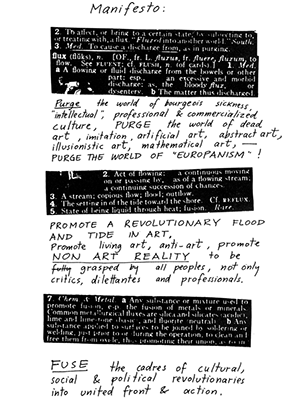
Fluxus—a name taken from a Latin word meaning ‘to flow’—is an international network of artists, composers and designers noted for blending different artistic media and disciplines in the 1960s. They have been active in Neo-Dada noise music and visual art as well as literature, urban planning, architecture, and design. Fluxus is sometimes described as intermedia.
The origins of Fluxus lie in many of the concepts explored by composer John Cage in his experimental music of the 1950s. Cage explored notions of indeterminacy in art, through works such as ‘4’ 33″,’ which influenced Lithuanian-born artist George Maciunas. Maciunas (1931–1978) organized the first Fluxus event in 1961 at the AG Gallery in New York City and the first Fluxus festivals in Europe in 1962.
read more »
Posted in Art, Language, Money |
Leave a Comment »
July 8, 2011

A perverse incentive is an incentive that has an unintended and undesirable result which is contrary to the interests of the incentive makers. Perverse incentives are a type of unintended consequences. For example, 19th century palaeontologists traveling to China used to pay peasants for each fragment of dinosaur bone (dinosaur fossils) that they produced. They later discovered that the peasants dug up the bones and then smashed them into many pieces, greatly reducing their scientific value, to maximise their payments. In Hanoi, under French colonial rule, a program paying people a bounty for each rat pelt handed in was intended to exterminate rats. Instead, it led to the farming of rats. Funding fire departments by the number of fire calls made is intended to reward the fire departments that do the most work. However, it may discourage them from fire-prevention activities, which reduce the number of fires.
In 1696, the English Parliament adopted a tax under which dwellings were to be assessed according their number of windows. Although the tax was intended to be progressive in that it exempted houses with fewer than ten windows from the bulk of the assessment, in operation it exacerbated the gap in living conditions between rich and poor as landlords were incentivized to brick up tenement windows to reduce their tax liability, leaving working-class tenants with insufficient light and ventilation. In 2007, the Bangkok, Thailand police switched to punitive pink armbands adorned with the cute Hello Kitty cartoon character when the tartan armbands that had been intended to be worn as a badge of shame for minor infractions were instead treated as collectibles by offending officers forced to wear them.
Posted in Language, Money, Politics |
Leave a Comment »
July 8, 2011
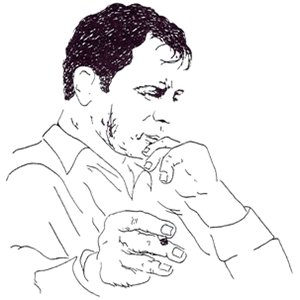
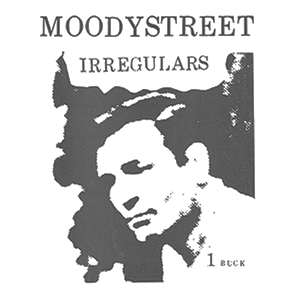
Moody Street Irregulars (subtitled ‘A Jack Kerouac Newsletter’) was an American publication dedicated to the history and the cultural influences of Jack Kerouac and the Beat Generation. Edited and published by Joy Walsh, it featured articles, memoirs, reviews and poetry. Published from Clarence Center, New York, it had a run of 28 issues from Winter 1978 to 1992. The title of the publication derives from the Baker Street Irregulars, a group of street urchins often employed by Sherlock Holmes in the novels by Sir Arthur Conan Doyle.
The magazine’s approach is indicated by the contents of issue number 9 (1981), a special ‘Vanity of Duluoz’ (Kerouac’s semi-autobiographical novel) issue including essays and articles by Gregory Stephenson, John Clellon Holmes, Carolyn Cassady, plus an interview with William S. Burroughs by Jennie Skerl. Issue number 11 (Spring/Summer 1982) was a special ‘French Connection’ issue, featuring articles and essays about Kerouac, his French-Canadian ancestry and his popularity in Quebec.
Posted in Art, Language |
Leave a Comment »
July 8, 2011
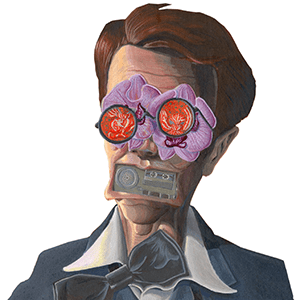
The Doors of Perception is a 1954 book by Aldous Huxley detailing his experiences when taking mescaline, a hallucinogen found naturally in the peyote cactus.
The book takes the form of Huxley’s recollection of a drug trip which took place over the course of an afternoon, and takes its title from William Blake’s poem ‘The Marriage of Heaven and Hell.’ Huxley recalls the insights he experienced, which range from the ‘purely aesthetic’ to ‘sacramental vision.’ He also incorporates later reflections on the experience and its meaning for art and religion.
read more »
Posted in Drugs, Language, Philosophy |
1 Comment »
July 8, 2011
Beatnik [beet-nik] was a media stereotype of the 1950s and early 1960s that displayed the more superficial aspects of the Beat Generation literary movement of the 1950s and violent film images, along with a cartoonish misrepresentation of the real-life people and the spirituality found in Jack Kerouac’s autobiographical fiction. Kerouac spoke out against this detour from his original concept.
Kerouac introduced the phrase ‘Beat Generation’ in 1948, generalizing from his social circle to characterize the underground, anti-conformist youth gathering in New York at that time. The name came up in conversation with the novelist John Clellon Holmes who published an early Beat Generation novel, ‘Go’ (1952), along with a manifesto in The New York Times Magazine: ‘This Is the Beat Generation.’
read more »
Posted in Language, Money, Politics |
Leave a Comment »




 The Daily Omnivore