June 17, 2011
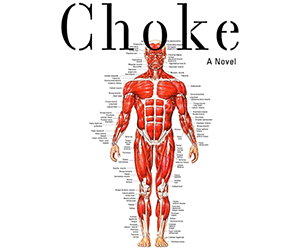

Chuck Palahniuk [pall-uh-nik] (b. 1962) is an American transgressional fiction novelist, a genre of literature that focuses on characters who feel confined by the norms and expectations of society and who break free of those confines in unusual and/or illicit ways. Because they are rebelling against the basic norms of society, protagonists of transgressional fiction may seem mentally ill, anti-social, or nihilistic. The genre deals extensively with taboo subject matters such as drugs, sex, violence, incest, pedophilia, and crime.
He is best known for the award-winning novel ‘Fight Club,’ which was later made into a film directed by David Fincher.
read more »
Posted in Art, Language |
Leave a Comment »
June 17, 2011
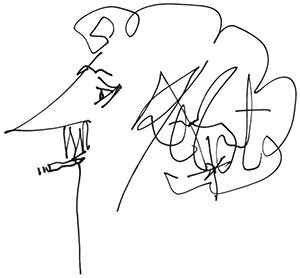

Kurt Vonnegut (1922 – 2007) was an American writer of the 20th century. He wrote such works as ‘Mother Night’ (1961), ‘Slaughterhouse-Five’ (1969), and ‘Breakfast of Champions’ (1973) blending satire, gallows humor, and science fiction. He was known for his humanist beliefs and was honorary president of the American Humanist Association. Vonnegut’s experience in WWII as a soldier and prisoner of war had a profound influence on his later work.
He was captured during the Battle of the Bulge. ‘The other American divisions on our flanks managed to pull out: We were obliged to stay and fight. Bayonets aren’t much good against tanks…’ Imprisoned in Dresden, Vonnegut was chosen as a leader of the POWs because he spoke some German. After telling the German guards ‘…just what I was going to do to them when the Russians came…’ he was beaten and had his position as leader taken away. While a prisoner, he witnessed the fire bombing of Dresden in February 1945 which destroyed most of the city.
read more »
Posted in Art, Humor, Language |
Leave a Comment »
June 15, 2011

Kief [keef] (from Arabic, meaning ‘well-being’ or ‘pleasure’) refers to the resin glands (or trichomes) of cannabis which may accumulate in containers or be sifted from loose dry cannabis buds with a mesh kiefing screen or sieve.
Kief contains a much higher concentration of desired psychoactive cannabinoids, such as THC, than other preparations of cannabis buds from which it is derived. Traditionally kief has been pressed and baked into cakes as hashish for convenience in storage and shipping, but can be vaporized or smoked in its powder form.
Posted in Drugs, Language |
Leave a Comment »
June 15, 2011

Aposiopesis [ap-uh-sahy-uh-pee-sis] (‘becoming silent’) is a rhetorical device wherein a sentence is deliberately broken off and left unfinished, the ending to be supplied by the imagination, giving an impression of unwillingness or inability to continue.
An example would be the threat ‘Get out, or else—!’ This device often portrays its users as overcome with passion (fear, anger, excitement) or modesty. To mark the occurrence of aposiopesis with punctuation an em dash or an ellipsis may be used.
Posted in Language |
1 Comment »
June 13, 2011

‘Art for art’s sake‘ is the usual English rendering of a French slogan, from the early 19th century, ‘l’art pour l’art,’ and expresses a philosophy that the intrinsic value of art, and the only ‘true’ art, is divorced from any didactic (educational), moral or utilitarian function.
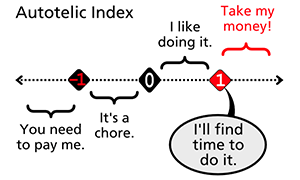
Such works are sometimes described as ‘autotelic,’ from the Greek ‘autoteles,’ ‘complete in itself,’ a concept that has been expanded to embrace ‘inner-directed’ or ‘self-motivated’ human beings. A Latin version of this phrase, ‘Ars gratia artis,’ is used as a slogan by Metro-Goldwyn-Mayer and appears in its logo.
read more »
Posted in Art, Language, Philosophy |
1 Comment »
June 13, 2011

Didacticism [dahy-dak-tuh-siz-uhm] is an artistic philosophy that emphasizes instructional and informative qualities in literature and other types of art. The primary intention of didactic art is not to entertain, but to teach. Didactic plays, for instance, teach the audience through the use of a moral or a theme. An example of didactic writing is Alexander Pope’s ‘An Essay on Criticism’ (1711), which offers a range of advice about critics and criticism. An example of didactism in music is the chant ‘Ut queant laxis,’ which was used by Guido of Arezzo to teach solfege syllables.
The term ‘didactic’ is also used as a criticism for work that appears to be overly burdened with instructive, factual, or otherwise educational information, to the detriment of the enjoyment of the reader. Edgar Allan Poe called didacticism the worst of ‘heresies’ in his essay ‘The Poetic Principle.’
Posted in Art, Games, Language |
Leave a Comment »
June 12, 2011

‘The Black Swan: The Impact of the Highly Improbable’ is a book by Lebanese American, philosopher Nassim Nicholas Taleb. The book focuses on the extreme impact of certain kinds of rare and unpredictable events (outliers) and humans’ tendency to find simplistic explanations for these events retrospectively, after the fact. This theory has since become known as the black swan theory. The book also covers subjects relating to knowledge, aesthetics, and ways of life, and uses elements of fiction in making its points.
Taleb, bestselling author of ‘Fooled by Randomness,’ treats uncertainty and randomness as a single idea. The main idea in Taleb’s book is not to attempt to predict Black Swan Events, but to build robustness into negative ones that occur and being able to exploit positive ones. Taleb contends that banks and trading firms are very vulnerable to hazardous Black Swan Events and are exposed to losses beyond those that are predicted by their defective models.
read more »
Posted in Language, Philosophy, Science |
Leave a Comment »
June 8, 2011

Behaviorism is the theory that all things organisms do should be seen as behavior. Behaviorism says that behavior can be studied scientifically, without knowing what the physiology of an event is, and without using theories such as that of the mind. According to behaviorism, all behavior can be observed. Behaviorists first argued that the study of behavior should be a natural science, such as chemistry or physics, without any reference to hypothetical inner states of organisms as causes for their behavior. From early psychology in the 19th century, the behaviorist school of thought ran concurrently and shared commonalities with the psychoanalytic and Gestalt movements in psychology into the 20th century; but also differed from the mental philosophy of the Gestalt psychologists in critical ways.
In the second half of the 20th century, behaviorism was largely eclipsed as a result of the cognitive revolution, which include the internal processes of the mind in its purview. While behaviorism and cognitive schools of psychological thought may not agree theoretically, they have complemented each other in practical therapeutic applications, such as in cognitive–behavioral therapy that has demonstrable utility in treating certain pathologies, such as simple phobias, PTSD, and addiction. People who influenced behaviorism include Ivan Pavlov, Edward Lee Thorndike, John B. Watson and B. F. Skinner. Pavlov investigated classical conditioning, but did not agree with Behaviorism or Behaviorists. Thorndike and Watson rejected introspective methods and wanted to restrict psychology to experimental methods. Skinner’s research focused on Operant conditioning.
read more »
Posted in Language, Science |
2 Comments »
June 8, 2011
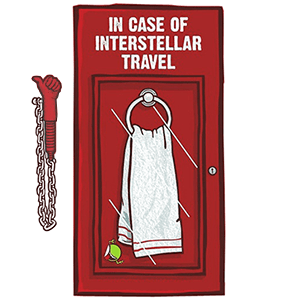
In ‘The Hitchhiker’s Guide to the Galaxy’ series, DON’T PANIC (always upper-case) is a phrase written on the cover of titular ‘The Hitchhiker’s Guide to the Galaxy.’ The novel explains that this was partly because the device ‘looked insanely complicated’ to operate, and partly to keep intergalactic travelers from panicking.
It is said that despite its many glaring (and occasionally fatal) inaccuracies, the Hitchhiker’s Guide to the Galaxy itself has outsold the Encyclopedia Galactica because it is slightly cheaper, and because it has the words ‘DON’T PANIC’ in large, friendly letters on the cover.
Posted in Art, Humor, Language |
Leave a Comment »
June 7, 2011

Glittering generalities are emotionally appealing words so closely associated with highly-valued concepts and beliefs that they carry conviction without supporting information or reason. Such highly-valued concepts attract general approval and acclaim. Their appeal is to emotions such as love of country and home, and desire for peace, freedom, glory, and honor. They ask for approval without examination of the reason. They are typically used by politicians and propagandists.
Words and phrases such as ‘common good,’ ‘reform,’ ‘courage,’ ‘democracy,’ ‘freedom,’ ‘hope,’ ‘patriotism,’ ‘strength,’ are terms with whom people all over the world have powerful associations, and they may have trouble disagreeing with them. However, these words are highly abstract and ambiguous, and meaningful differences exist regarding what they actually mean or should mean in the real world. George Orwell described such words at length in his essay ‘Politics and the English Language’
read more »
Posted in Language, Politics |
Leave a Comment »
May 25, 2011

The Shining is a 1977 horror novel by Stephen King. The title was inspired by the John Lennon song ‘Instant Karma!,’ which contained the line ‘We all shine on…’ It was King’s third published novel, and the success of the book firmly established him as a preeminent author in the horror genre. A film based upon the book, directed by Stanley Kubrick, was released in 1980.
After writing ‘Carrie’ and ‘Salem’s Lot,’ both of which are set in small towns in King’s home state of Maine, King was looking for a change of pace for the next book. He opened an atlas of the US on the kitchen table and randomly pointed to a location, which turned out to be Boulder, Colorado. So in early 1974, King and his wife, Tabitha, and their two children, Naomi and Joe, moved across the country to Colorado.
read more »
Posted in Art, Language |
Leave a Comment »
May 24, 2011

Daqin [da-chin] is the ancient Chinese name for the Roman Empire and, depending on context, the Near East, especially Syria. It literally means ‘Great Qin,’ Qin being the name of the founding dynasty of the Chinese Empire. Following the opening of the Silk Road in the 2nd century BCE, the Chinese thought of the Roman Empire as a civilized pendant to their own empire. The Romans occupied one extreme position on the trade route, with the Chinese located on the other. China never managed to reach the Roman Empire directly in antiquity, although general Ban Chao sent an envoy, Gan Ying, who left a detailed account of the Romans, but it is generally considered to have been based on second hand information:
‘Their kings are not permanent. They select and appoint the most worthy man. If there are unexpected calamities in the kingdom, such as frequent extraordinary winds or rains, he is unceremoniously rejected and replaced. The one who has been dismissed quietly accepts his demotion, and is not angry. The people of this country are all tall and honest. They resemble the people of the Middle Kingdom and that is why this kingdom is called Da Qin [literally, ‘Great China’]. This country produces plenty of gold [and] silver, [and of] rare and precious [things] they have luminous jade, ‘bright moon pearls,’ Haiji rhinoceroses, coral, yellow amber, opaque glass, whitish chalcedony, red cinnabar, green gemstones, gold-thread embroideries, woven gold-threaded net, delicate polychrome silks painted with gold, and asbestos cloth.’
Posted in Language, World |
Leave a Comment »



 The Daily Omnivore