May 20, 2011
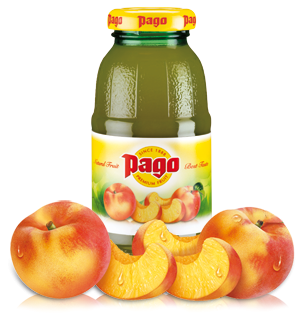
Nectars are a type of non-carbonated soft drink made with fruit juice. In some countries, the beverage industry distinguishes nectars from drinks labeled as juice. In the United States and the United Kingdom, the term ‘fruit juice’ is restricted to beverages that are 100% pure juice.
Nectar is generally accepted in the U.S. and in international trade for a diluted juice to denote a beverage that contains fruit juice and fruit puree. A juice or nectar including concentrate must state that it does. A blend of fruit juice(s) with other ingredients, such as high-fructose corn syrup, is called a juice cocktail or juice drink.
Posted in Food, Language, World |
Leave a Comment »
May 20, 2011

Desiderata [dih-sid-uh-rey-tuh] (Latin: ‘desired things’) is a 1927 poem by American writer Max Ehrmann (1872-1945).
The text was largely unknown in the author’s lifetime and became widely known after its use in a devotional in 1959 by a church in Baltimore. When Adlai Stevenson died in 1965, a guest in his home found the Desiderata near his bedside and discovered that Stevenson had planned to use it in his Christmas cards.
read more »
Posted in Art, Language, Philosophy |
Leave a Comment »
May 19, 2011

Malicious compliance is the behavior of a person who intentionally inflicts harm by strictly following the orders of management or following legal compulsions, knowing that compliance with the orders will cause a loss of some form resulting in damage to the manager’s business or reputation, or a loss to an employee or subordinate. In effect, it is a form of sabotage used to harm leadership or used by leadership to harm subordinates.
Work-to-rule is the expression of malicious compliance as an industrial action, in which rules are deliberately followed to the letter in an attempt to reduce employee productivity.
Posted in Humor, Language, Money |
Leave a Comment »
May 18, 2011


In the context of a work of fiction, the term canon denotes the material accepted as ‘official,’ in a fictional universe’s fan base. It is often contrasted with, or used as the basis for, works of fan fiction, which are not considered canonical. It is used in two slightly different meanings: first, it refers to the overall set of storylines, premises, settings, and characters offered by the source media text. In this sense, canon is the original work from which the fan fiction author borrows. Secondly, it is used as a descriptor of specific incidents, relationships, or story arcs that take place within the overall canon; thus certain incidents or relationships may be described as being canon or not.
The use of the word ‘canon’ in reference to a set of texts derives from Biblical canon, the set of books regarded as scripture. The term was first used in the context of fiction to refer to the Sherlock Holmes stories and novels, written by Sir Arthur Conan Doyle, to distinguish those works from subsequent pastiches by other authors. It has subsequently been applied to many media franchises. Among these are science fiction franchises such as Star Trek, Star Wars, and Doctor Who, in which many stories have been told in different media, some of which contradict or appear to contradict each other.
Posted in Art, Language |
Leave a Comment »
May 18, 2011

The chupacabra (literally ‘goat sucker’) is a legendary cryptid rumored to inhabit parts of the Americas. The name comes from the animal’s reported habit of attacking and drinking the blood of livestock, especially goats.
The most common description of chupacabras is a reptile-like being, appearing to have leathery or scaly greenish-gray skin and sharp spines or quills running down its back. Approximately 3 to 4 feet (1 to 1.2 m) high, it stands and hops in a similar fashion to a kangaroo.
Posted in Humor, Language, World |
Leave a Comment »
May 18, 2011

Tartanry [tahr-tn-ree] is a word used to describe the kitsch elements of Scottish culture that have been overemphasized or superimposed on the country first by the emergent Scottish tourist industry in the 18th and 19th centuries, and later by an American film industry. The earliest use of the word ‘tartanry’ itself is said to have been in 1976.
It refers to often misrepresented or invented aspects of Scotland such as clan tartans, kilts, bagpipes, Scottish Gaelic and Highland culture more generally.
Posted in Language, Money, World |
Leave a Comment »
May 18, 2011


Tartan [tahr-tn] is a pattern consisting of criss-crossed horizontal and vertical bands in multiple colors that originated in Scotland. Scottish kilts almost always have tartan patterns. Tartan is also known as ‘plaid’ in North America, but in Scotland, a plaid is a tartan cloth slung over the shoulder, or a blanket. The Dress Act of 1746 attempted to bring the warrior clans under government control by banning the tartan and other aspects of Gaelic culture. When the law was repealed in 1782, it was no longer ordinary Highland dress, but was adopted instead as the symbolic national dress of Scotland. It is generally stated that the most popular tartans today are the Black Watch (also known as Old Campbell, Grant Hunting, Universal, Government) and Royal Stewart.
Tartan is made with alternating bands of colored (pre-dyed) threads woven as both warp and weft at right angles to each other. The weft is woven in a simple twill, two over – two under the warp, advancing one thread each pass. This forms visible diagonal lines where different colors cross, which give the appearance of new colors blended from the original ones. The resulting blocks of color repeat vertically and horizontally in a distinctive pattern of squares and lines known as a sett.
Posted in Art, Language, World |
Leave a Comment »
May 18, 2011

In weaving cloth, the warp is the set of lengthwise yarns that are held in tension on a frame or loom. The yarn that is inserted over-and-under the warp threads is called the weft, woof, or filler. Each individual warp thread in a fabric is called a warp end or end. Warp means ‘that which is thrown across in Old English.’ Because the warp is held under extreme tension during the entire process of weaving, warp yarn must be strong.
Traditional fibers for warping are wool, linen and silk. With the improvements in spinning technology during the Industrial Revolution, it became possible to make cotton yarn of sufficient strength to be used as the warp in mechanized weaving. Later, artificial or man-made fibers such as nylon or rayon were employed.
Posted in Language, Technology |
Leave a Comment »
May 17, 2011


Barbecue [bahr-bi-kyoo] (BBQ; ‘barbie’ in Australia and New Zealand; ‘braai’ in South Africa) is a special type of grill. It is also a way to prepare meat which is then cooked with that instrument. Barbecue cooking means to cook very slowly. It is not as hot or fast as standard grilling. Some meats must be cooked slowly to be tender, and easy to chew. Sometimes, meat may be slowly cooked for 8 to 24 hours in a barbecue. People in the United States barbecue chicken, beef and pork, depending on the part of the country.
Barbecuing is very popular in the Central and Southern U.S., especially in Texas with beef and Kansas City with pork. In the United States barbecued meat is usually covered in barbecue sauce, a type of thick, dark red sauce that often contains spices, tomatoes, and honey. Very often, American barbecue grills get heat from hickory wood. In California, it was common to barbecue beef in a hole in the ground rather than a grill. This is called a ‘pit barbecue.’
read more »
Posted in Food, Language, World |
Leave a Comment »
May 17, 2011
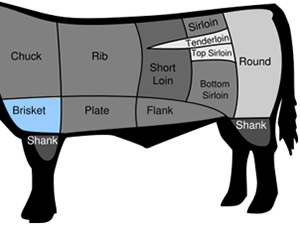

Brisket [bris-kit] is a cut of meat from the breast or lower chest of a cow. The beef brisket is one of the eight beef primal cuts. The brisket muscles include the superficial and deep pectorals. As cattle do not have collar bones, these muscles support about 60% of the body weight of standing/moving cattle. This requires a significant amount of connective tissue, so the resulting meat must be cooked thoroughly to tenderize the connective tissue.
The term derives from Old Norse ‘brjósk,’ meaning cartilage. The cut overlies the sternum, ribs and connecting costal cartilages. Popular brisket recipes in the Southern United States include rubbing with a spice rub or marinating the meat, then cooking slowly over indirect heat from charcoal or wood. This is a form of smoking the meat. Additional basting of the meat is often done during the cooking process.
read more »
Posted in Food, Language, World |
1 Comment »
May 17, 2011

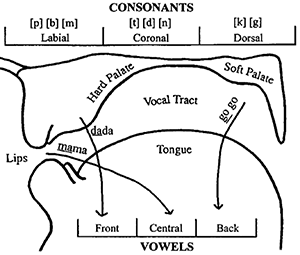
The International Phonetic Alphabet (IPA) is an alphabetic system of phonetic notation based primarily on the Latin alphabet. It was devised as a standardized representation of the sounds of all spoken languages. The IPA is designed to represent only those qualities of speech that are distinctive in spoken language: phonemes (‘a sound uttered,’ the smallest segmental unit of sound – e.g. the ‘k’ sound in ‘kite’), intonation (variation of pitch while speaking which is not used to distinguish words, unlike tone, which is), and the separation of words and syllables.
To represent additional qualities of speech such as tooth gnashing, lisping, and sounds made with a cleft palate, an extended set of symbols called the Extensions to the IPA may be used. The IPA currently contains 107 letters derived from thousands of languages.
Posted in Language, Science |
Leave a Comment »
May 16, 2011

Wheatpaste (also known as Marxist glue) is a liquid adhesive made from vegetable starch and water. It has been used since ancient times for various arts and crafts such as bookbinding and papier mache. It is also made for the purpose of adhering paper posters to walls and other surfaces (often in graffiti). Closely resembling wallpaper paste, it is often made by mixing roughly equal portions of flour and water and heating it until it thickens, or by smearing cooked rice into a paste.
The words paste, pasta, and pastry have a common heritage, deriving from the Late Latin pasta (dough or pastry cake), itself deriving from the ancient Greek pasta, meaning ‘barley porridge.’ In English, paste is used as would be ‘dough’ in the 12th century, or ‘glue’ in the 15th century.
read more »
Posted in Art, Language, Money |
Leave a Comment »