April 11, 2011


A macaroni [mak-uh-roh-nee] in mid-18th century England, was a fashionable fellow who dressed and spoke in an outlandishly affected and effeminate manner.
The term pejoratively referred to a man who ‘exceeded the ordinary bounds of fashion’ in terms of clothes, fastidious eating and gambling.
read more »
Posted in Art, Humor, Language |
Leave a Comment »
April 11, 2011
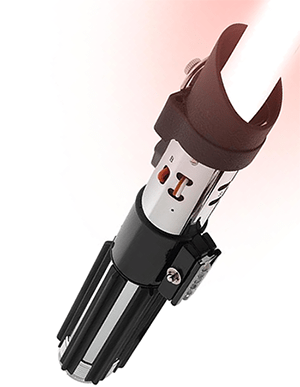
Mike Alder is an Australian mathematician and philosopher known for his popular writing, such as sardonic articles about the lack of basic arithmetic skills in young adults. ‘Newton’s flaming laser sword’ is a philosophical razor devised by Alder in 2004 on the conflicting positions of scientists and philosophers on epistemology (the study of knowledge).
The razor is humorously named after Isaac Newton, as it is inspired by Newtonian thought, and is ‘much sharper and more dangerous than Occam’s Razor.’
read more »
Posted in Language, Philosophy, Science |
Leave a Comment »
April 9, 2011

The term intuition is used to describe ‘thoughts and preferences that come to mind quickly and without much reflection.’ “The word ‘intuition’ comes from the Latin word ‘intueri,’ which is often roughly translated as meaning ‘to look inside’ or ‘to contemplate.’ Intuition provides us with beliefs that we cannot necessarily justify. For this reason, it has been the subject of study in psychology, as well as a topic of interest in the supernatural. The ‘right brain’ is popularly associated with intuitive processes such as artistic abilities.
Some scientists have contended that intuition is associated with innovation in scientific discovery. Intuition is also a common subject of New Age writings. In Carl Jung’s theory of the ego intuition was an ‘irrational function,’ opposed most directly by sensation, and opposed less strongly by the ‘rational functions’ of thinking and feeling. Jung defined intuition as ‘perception via the unconscious.’ Bringing forth ideas, images, possibilities, ways out of a blocked situation, by a process that is mostly unconscious.
read more »
Posted in Language, Philosophy |
Leave a Comment »
April 7, 2011
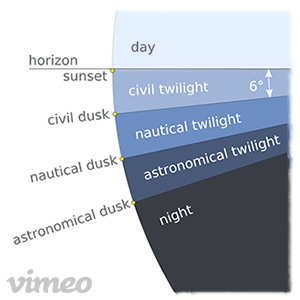
The Belt of Venus or Venus’s Girdle is the Victorian-era name for an atmospheric phenomenon seen at sunrise and sunset. Shortly after sunset or shortly before sunrise, the observer is, or is very nearly, surrounded by a pinkish glow or antitwilight arch that extends roughly 10°–20° above the horizon.
Often, the glow is separated from the horizon by a dark layer, the Earth’s shadow or ‘dark segment.’ The Arch’s light rose (pink) color is due to backscattering of reddened light from the rising or setting Sun. A very similar effect can be seen during a total solar eclipse.
Posted in Language, Science |
Leave a Comment »
April 7, 2011

The blue hour comes from the French expression l’heure bleue, which refers to the period of twilight each morning and evening where there is neither full daylight nor complete darkness. The time is considered special because of the quality of the light at this time of day. The phrase is also used to refer to Paris immediately prior to World War I, which was considered to be a time of relative innocence.
In English culture the term was used to describe the period of inactivity and uselessness a drinker encounters when Pubs and other licensed premises have closed after the lunch-time session (typically 15:30 hrs) and will not open for the evening session until (typically 18:30 hrs).
Posted in Art, Drugs, Language |
Leave a Comment »
April 7, 2011

In photography and cinematography, the golden or magic hour, is the first and last hour of sunlight during the day, when a specific photographic effect is achieved due to the quality of the light. Typically, lighting is softer (more diffuse) and warmer in hue. When the Sun is near the horizon, sunlight travels through more of the atmosphere, reducing the intensity of the direct light, so that more of the illumination comes from indirect light from the sky.
More blue light is scattered, so that light from the Sun appears more reddish. In addition, the Sun’s small angle with the horizon produces longer shadows. In the middle of the day, the bright overhead Sun can create too-bright highlights and dark shadows. Because the contrast is less during the golden hour, shadows are less dark, and highlights are less likely to be overexposed.
Posted in Art, Language, Science |
Leave a Comment »
April 7, 2011

The Martini is a cocktail made with gin (or vodka) and vermouth. All ingredients are poured into a mixer with ice cubes. The ingredients are mixed then strained and served ‘straight up’ (without ice) in a chilled cocktail glass and garnished with either a green olive or a twist of lemon (a strip of the peel, usually squeezed or twisted to express volatile oils onto the surface of the drink).
Garnishing with a pickled onion instead makes it a Gibson. The dryness of a martini refers to the amount of vermouth used in the drink, with a very dry Martini having little or no Vermouth.
read more »
Posted in Drugs, Food, Language |
Leave a Comment »
April 6, 2011

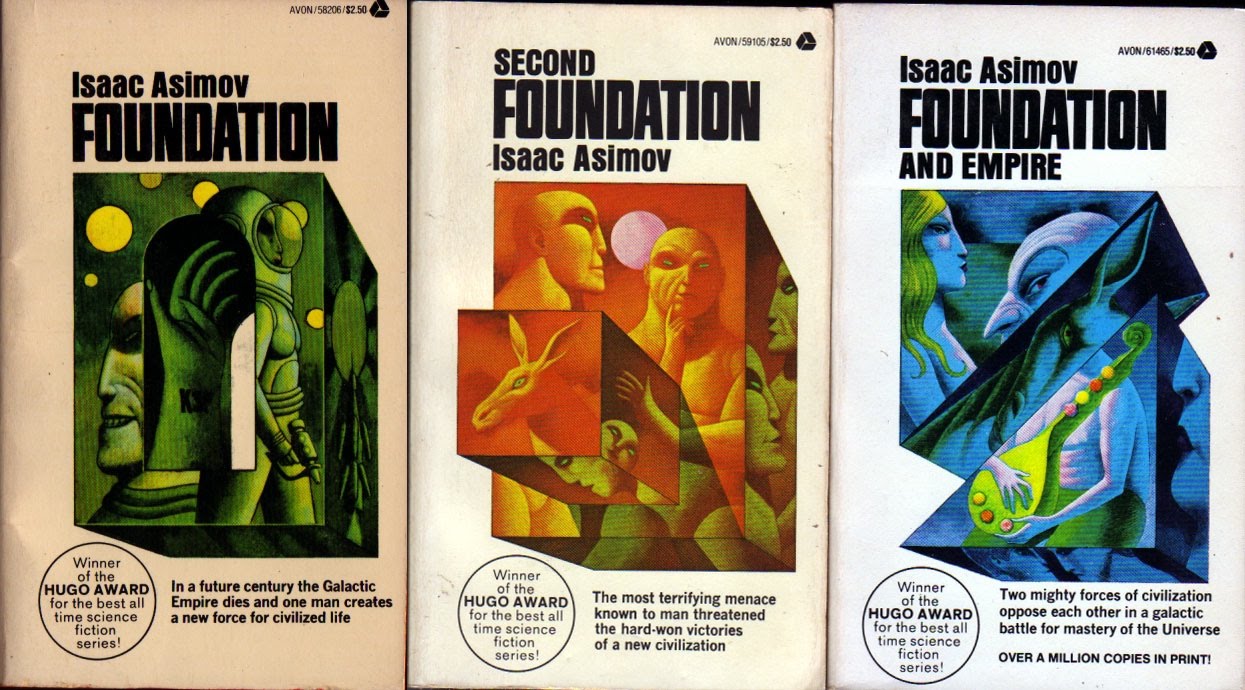
Foundation is the first book in Isaac Asimov’s Foundation Trilogy (and later Foundation Series). Foundation is a collection of five short stories, which were first published together as a book in 1951. It also appeared in 1955 under the title ‘The 1,000-Year Plan.’ The novel tells the story of a group of scientists who seek to preserve knowledge as the civilizations around them begin to regress. The first story is set on Trantor, the capital planet of the 12,000-year-old Galactic Empire. Whilst the empire gives the appearance of stability, beneath this façade it is suffering a slow decay. Hari Seldon, a mathematician, has developed ‘psychohistory,’ which equates all possibilities in large societies to mathematics, allowing predictable long term outcomes.
Seldon discovers a horrifying truth to the Empire’s decay, but his results are considered treasonable. On trial, Seldon shares the discoveries made through psychohistory, such as the collapse of the Empire within 500 years, followed by a 30,000-year period of barbarism. Seldon proposes an alternative to this future; one that would not avert the collapse but shorten the interregnum period to a mere 1000 years. But this plan would require a large group of people to develop a compendium of all human knowledge, titled the Encyclopedia Galactica. A still skeptical commission, not wanting to make a martyr of Seldon, exile him and his group of ‘Encyclopedists’ to a remote planet Terminus. There, they will carry out the Plan under an imperial decree, while Seldon would remain barred from returning to Trantor.
Posted in Art, Language, Technology |
Leave a Comment »
April 6, 2011

Isaac Asimov (b. 1920 – 1992) was an American author and professor of biochemistry at Boston University, best known for his works of science fiction and for his popular science books. Asimov was one of the most prolific writers of all time, having written or edited more than 500 books. His works have been published in nine of the ten major categories of the Dewey Decimal System (The sole exception being the 100s: philosophy and psychology). Isaac Asimov is widely considered a master of hard science fiction and, along with Robert A. Heinlein and Arthur C. Clarke, he was considered one of the ‘Big Three’ science fiction writers during his lifetime. Asimov’s most famous works are the ‘Foundation’ and ‘Robot’ series.
The prolific Asimov also wrote mysteries and fantasy, as well as much non-fiction. Most of his popular science books explain scientific concepts in a historical way, going as far back as possible to a time when the science in question was at its simplest stage. He often provides nationalities, birth dates, and death dates for the scientists he mentions, as well as etymologies and pronunciation guides for technical terms. Examples include his ‘Guide to Science,’ the three volume set ‘Understanding Physics,’ ‘Asimov’s Chronology of Science and Discovery,’ as well as numerous works on astronomy, chemistry, mathematics, the Bible, and William Shakespeare’s works.
Posted in Art, Language, Science |
Leave a Comment »
April 6, 2011
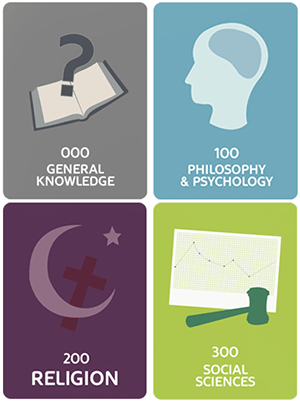
The Dewey Decimal System is a way to sort books. It’s usually used in public libraries and schools. It sorts the books by subject using numbers from 000 to 999. Each subject is broken up into 10 smaller, more specific categories, and has its own set of numbers. The system was created by American librarian Melvil Dewey in 1876.
Posted in Education, Language, Science |
Leave a Comment »
April 5, 2011

Purely Obsessional Obsessive-Compulsive Disorder (Pure O) is a lesser-known form or manifestation of OCD. There are usually no observable compulsions (checking, counting, hand-washing, etc.). While ritualizing and neutralizing behaviors do take place, they are almost entirely in the form of excessive mental rumination. The nature and type of Purely Obsessional OCD varies greatly, but the central theme for all sufferers is the emergence of a disturbing intrusive thought or question, an unwanted/inappropriate mental image, or a frightening impulse that causes the person extreme anxiety because it is antithetical to closely-held religious beliefs, morals, or societal mores.
Neurotypicals instinctively respond to bizarre intrusive thoughts or impulses as insignificant and part of a normal variance in the human mind. Someone with Purely Obsessional OCD will respond with profound alarm followed by an intense attempt to neutralize the thought or avoid having it again. The person begins to ask themselves constantly ‘Am I really capable of something like that?’ or ‘Could that really happen?’ or ‘Is that really me?’ (even though they usually realize that their fear is irrational, which causes them further distress) and put tremendous effort into escaping or resolving the unwanted thought. They then end up in a vicious cycle of mentally searching for reassurance and trying to get a definitive answer.
Posted in Health, Language, Science |
Leave a Comment »
April 5, 2011
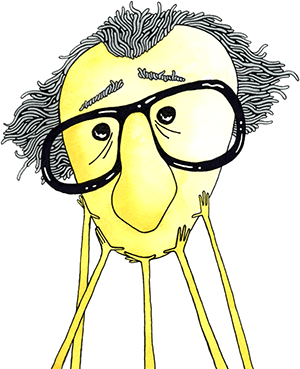

Neuroticism [noo-rot-uh-siz-uhm] is a fundamental personality trait in the study of psychology. It is an enduring tendency to experience negative emotional states. Individuals who score high on neuroticism are more likely than the average to experience such feelings as anxiety, anger, guilt, and depressed mood.
Neuroticism, along with other personality traits, has been mapped across states in the USA. People in eastern states such as New York, New Jersey, West Virginia, and Mississippi tend to score high on neuroticism, whereas people in many western states, such as Utah, Colorado, South Dakota, Oregon, and Arizona score lower on average. People in states that are higher in neuroticism also tend to have higher rates of heart disease and lower life expectancy.
read more »
Posted in Health, Language, Science |
Leave a Comment »




 The Daily Omnivore