April 11, 2011

‘Thinking outside the box‘ is to think differently, unconventionally or from a new perspective. This is sometimes called a process of lateral thought. As catchphrase, or cliché, it has become widely used in business environments, especially by management consultants and executive coaches, and has spawned a number of advertising slogans. To think outside the box is to look further and to try not thinking of the obvious things, but to try thinking beyond them.
The origins of the phrase are obscure; but it was popularized in part because of a nine-dot puzzle, which British author, John Adair claims to have introduced in 1969. The puzzle proposed an intellectual challenge—to connect the dots by drawing four straight, continuous lines that pass through each of the nine dots, and never lifting the pencil from the paper. The conundrum is easily resolved, but only if you draw the lines outside the confines of the square area defined by the nine dots themselves.
Posted in Games, Language, Money |
Leave a Comment »
April 8, 2011


Tyler, the Creator (b. 1991) is an American rapper and record producer from Los Angeles, California. He is the leader of the hip hop collective OFWGKTA. He has rapped on, and produced for, nearly every OFWGKTA release.
Posted in Art, Money |
Leave a Comment »
April 7, 2011

The Criterion Collection is a video-distribution company selling ‘important classic and contemporary films’ to cinema aficionados founded in 1984. Criterion Collection releases were the first to provide several features that have become standard.
The 1984 Criterion Laserdisc release of King Kong included the world’s first optional commentary audio track. The Criterion series is noted for helping to standardize the letterbox ratio, bonus features, and special editions. They are also known for taking great lengths to restore and clean all movies released on their label.
read more »
Posted in Art, Money |
Leave a Comment »
April 7, 2011
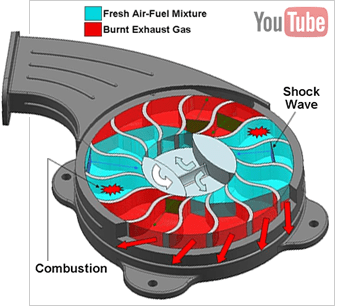
A wave-disk engine is an innovative internal combustion engine design being worked on by teams at Michigan State University and Warsaw Institute of Technology led by Norbert Müller. The first prototype was demonstrated in March 2011. The wave-disk engine has no valves, pistons or gear trains but utilizes a rotating disk to produce shock waves that compress an air fuel mixture. As the burning mixture expands it pushes against curved blades set into the rotor disk causing it to spin. The turning of the disk itself opens and closes inlet and outlet ports at appropriate times to introduce the air/fuel mixture and exhaust the combustion products.
It potentially shows savings in weight and better energy efficincy compared to normal internal combustion engine designs. Combustion engines are not very efficient, turning only 15% to 20% of the gasoline into propulsion. The rest of the energy in the gasoline is lost as waste heat. Wave disk engines promises to be 3.5x more efficient, 20% lighter, 30% cheaper to manufacture, and reduce emissions by 90 percent.
Posted in Money, Technology |
Leave a Comment »
April 7, 2011

A virtual retinal display (VRD) is a display technology that draws a raster display (like a television) directly onto the retina of the eye. The user sees what appears to be a conventional display floating in space in front of them.
To create an image with the VRD a photon source (or three sources in the case of a color display) is used to generate a coherent beam of light (such as a laser diode). The resulting modulated beam is then scanned to place each image point, or pixel, at the proper position on the retina.
Posted in Money, Technology |
Leave a Comment »
April 7, 2011

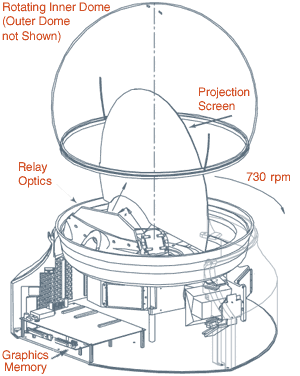
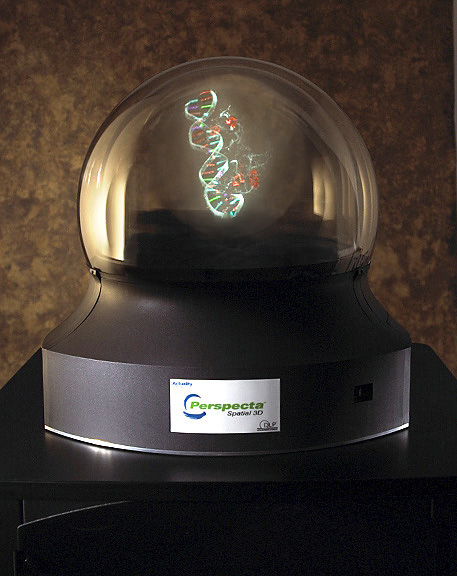
A volumetric [vol-yuh-me-trik] display is a device that forms a visual representation of an object in three physical dimensions, as opposed to the planar image of traditional screens that simulate depth through a number of different visual effects. One definition offered by pioneers in the field is that volumetric displays create 3-D imagery via the emission, scattering, or relaying of illumination from well-defined regions in (x,y,z) space. Though there is no consensus among researchers in the field, it may be reasonable to admit holographic and highly multiview displays to the volumetric display family if they do a reasonable job of projecting a three-dimensional light field within a volume.
Although first postulated in 1912, and a staple of science fiction, volumetric displays are still under development, and have yet to reach the general population. With a variety of systems proposed and in use in small quantities — mostly in academia and various research labs — volumetric displays remain accessible only to academics, corporations, and the military.
Posted in Money, Technology |
Leave a Comment »
April 7, 2011

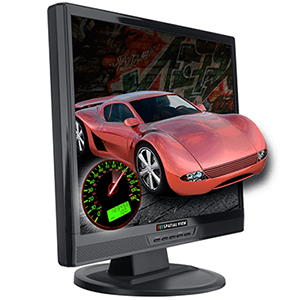
Autostereoscopy [aw-toh-ster-ee-os-kuh-pee] is any method of adding the perception of 3D depth without the use of special glasses on the part of the viewer. Because headgear is not required, it is also called ‘glasses-free 3D.’
The technology also includes two broad approaches used in some of them to accommodate motion parallax (the perceived change in location of an object seen from two different places) and wider viewing angles: those that use eye-tracking, and those that display multiple views so that the display does not need to sense where the viewers’ eyes are located. Examples of autostereoscopic displays include parallax barrier, lenticular, volumetric, electro-holographic, and light field displays.
read more »
Posted in Money, Technology |
Leave a Comment »
April 6, 2011

The P/E ratio (price-to-earnings ratio) of a stock (also called its ‘multiple’) is a measure of the price paid for a share relative to the annual net income or profit earned by the firm per share. P/E is a financial ratio used for valuation: a higher P/E ratio means that investors are paying more for each unit of net income. P/E ratio shows current investor demand for a company share.
A P/E of 0-10 indicates stocks that are undervalued or where the company’s earnings are thought to be in decline. Alternatively, current earnings may be substantially above historic trends or the company may have profited from selling assets. A P/E of 10-17 is considered fair value. The average U.S. equity P/E ratio from 1900 to 2005 is 14. A P/E of 17-25 indicates that the stock is overvalued or that the company’s earnings have increased since the last earnings figure was published. The stock may also be a growth stock with earnings expected to increase substantially in the future. A company whose shares have a high P/E (over 25) may have high expected future growth in earnings or the stock may be the subject of a speculative bubble.
Posted in Money |
Leave a Comment »
April 6, 2011

Laurence Tureau, known as Mr. T (b. 1951), is an American actor known for his roles as B. A. Baracus in the 1980s television series The A-Team, as boxer Clubber Lang in the 1982 film Rocky III.
Mr. T is known for his trademark African Mandinka warrior hairstyle, his gold jewelry, and his tough-guy image. In 2006 he starred in the reality show ‘I Pity the Fool,’ shown on TV Land, the title of which comes from his catchphrase from the film Rocky III.
read more »
Posted in Art, Money |
Leave a Comment »
April 5, 2011
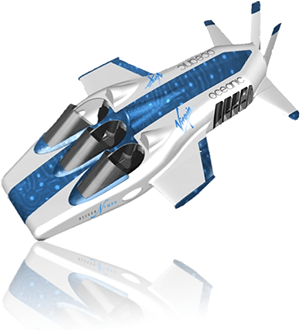
Virgin Oceanic, formerly Virgin Aquatic is a proposed undersea leisure venture of Sir Richard Branson’s Virgin Group. Currently the offering is limited to shallow water craft such as the Deep Flight Merlin (an open cockpit, three person submersible), named ‘Necker Nymph’ after Branson’s private island in the British Virgin Islands. Virgin plans to launch a deep sea version to carry passengers to extreme ocean depths.
Posted in Games, Money, Technology |
Leave a Comment »
April 4, 2011
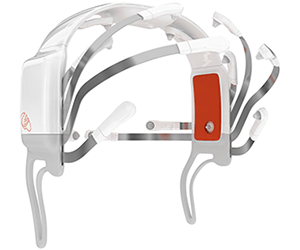
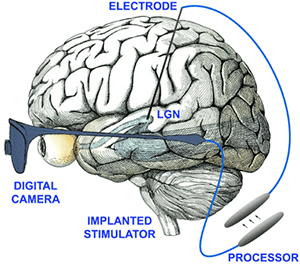
A brain–computer interface (BCI) is a direct communication pathway between the brain and an external device. BCIs are often aimed at assisting, augmenting or repairing human cognitive or sensory-motor functions. Research on BCIs began in the 1970s at UCLA under a grant from the National Science Foundation, followed by a contract from DARPA.
The field has since focused primarily on neuroprosthetics applications that aim at restoring damaged hearing, sight and movement. Thanks to the remarkable cortical plasticity of the brain, signals from implanted prostheses can, after adaptation, be handled by the brain like natural sensor or effector channels.
Posted in Health, Money, Technology |
Leave a Comment »
April 4, 2011


Gorillaz is a musical project created in 1998 by Damon Albarn of Blur and Jamie Hewlett, co-creator of ‘Tank Girl.’ The Gorillaz have an extensive fictional universe depicting a ‘virtual band’ of cartoon characters composed of four animated members: 2D (lead vocalist, keyboard), Murdoc Niccals (bass guitar), Noodle (guitar, keyboard, and occasional vocals) and Russel Hobbs (drums and percussion). The music is a collaboration between various musicians, Albarn being the only permanent contributor.
Their style is a composition of multiple musical genres, with a large number of influences including: dub, hip hop, alternative rock, electronic and pop music. The trio of musicians behind Gorillaz’ first incarnation included Damon Albarn, Del the Funkee Homosapien, and Dan the Automator, who had previously worked together on the track ‘Time Keeps on Slipping’ for Deltron 3030’s eponymous debut album. The song can be seen as the genesis of the musical style that continued into Gorillaz’ first album.
Posted in Art, Humor, Money |
Leave a Comment »





 The Daily Omnivore