March 31, 2011

Sound from ultrasound refers to ultrasound (sound pressure with a frequency greater than the upper limit of human hearing, approx. 20 kilohertz) that has been modulated and demodulated. Ultrasound has wavelengths much smaller than audible sound and thus can be aimed in a much tighter narrow beam than any traditional audible loudspeaker system. A narrow beam of modulated ultrasound changes the speed of sound in the air that it passes through. The air within the beam extracts the signal from the ultrasound, resulting in sound that can be heard only along the path of the beam, or that appears to radiate from any surface that the beam strikes.
The practical effect of this technology is that a beam of sound can be projected over a long distance to be heard only in a small well-defined area. A listener outside the beam hears nothing. Anyone or anything that disrupts the path of the beam will interrupt the progression of the beam, like interrupting the illumination of a spotlight. For this reason, most systems are mounted overhead, like lighting. This technology was originally developed by the US Navy and Soviet Navy for underwater sonar in the mid-1960s, and was briefly investigated by Japanese researchers in the early 1980s, but these efforts were abandoned due to extremely poor sound quality (high distortion) and substantial system cost.
Posted in Money, Technology |
Leave a Comment »
March 30, 2011

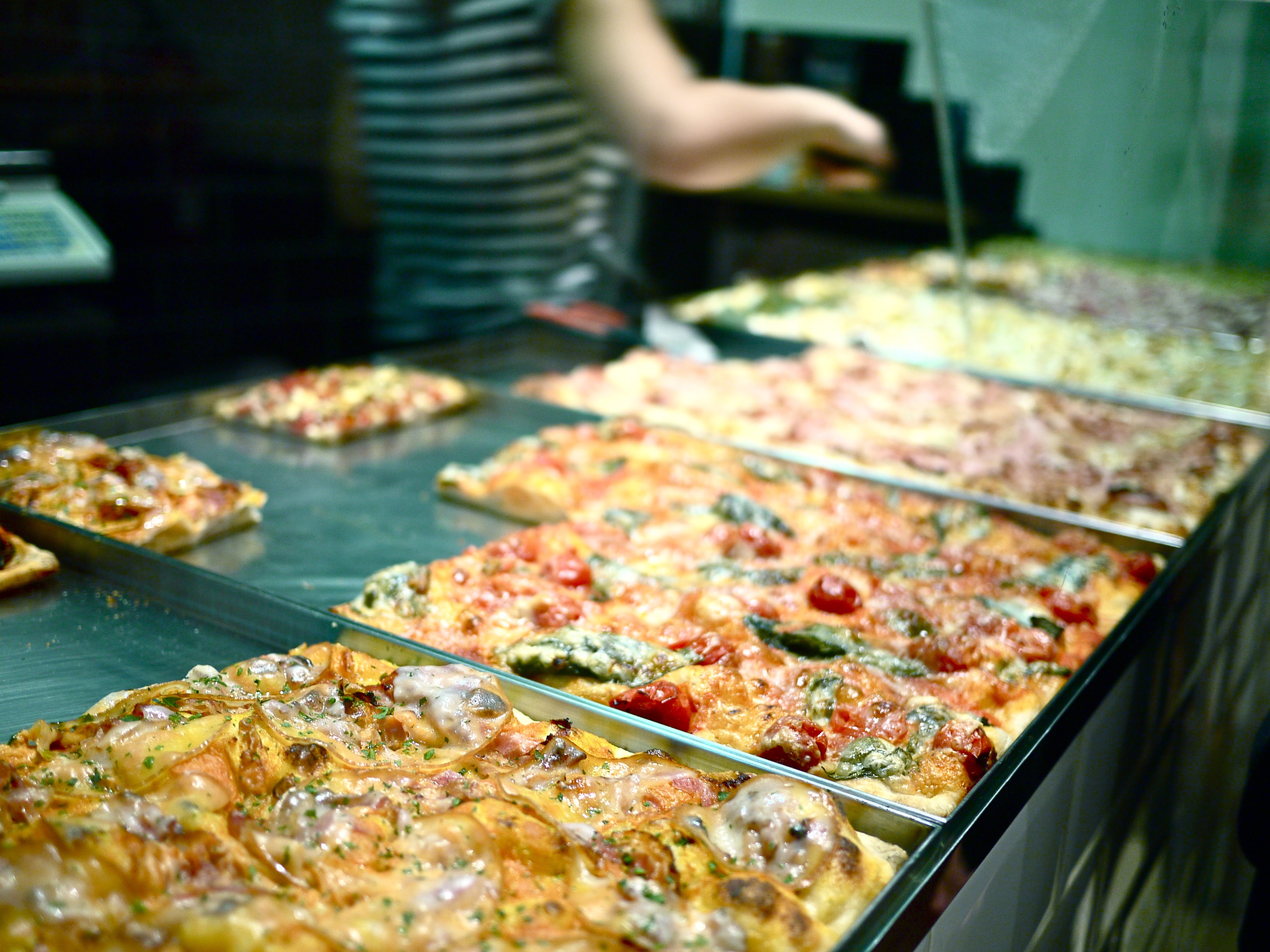
In Italy, pizza al taglio (‘by the cut’) is a variety of pizza baked in large rectangular trays, and generally sold in rectangular slices by weight, with prices marked per kilogram. The simplest varieties include Pizza Margherita (tomato sauce and cheese), Pizza bianca (olive oil & salt), and Pizza rossa (tomato sauce only). Other typical toppings include artichokes, asparagus, eggplant, ground meat and onions, potatoes, prosciutto, salami, sausage, ground truffles, zucchini, olive oil sundried tomatoes, rocket, gorgonzola, anchovies, and black olives.
Posted in Food, Money, World |
Leave a Comment »
March 30, 2011

Velotype is the old trademark for a type of keyboard for typing text known as a syllabic chord keyboard, an invention of the Dutchmen Nico Berkelmans and Marius den Outer. The current tradename is Veyboard. Contrary to traditional QWERTY type keyboards, on which a typist usually presses one key at a time to create one character at a time, a Veyboard requires the user to press several keys simultaneously, producing syllables rather than letters.
A practiced ‘veyboarder’ can produce more text than on a traditional keyboard, as much as 200 words per minute, double the rate of a fast traditional typist. Because of this, Veyboards are often used for live applications, such as subtitling for television and for the hearing impaired. The keyboard is an orthographic chord keyboard, very different from chorded phonetic keyboards used for verbatim transcription, like the Stenotype.
Posted in Money, Technology, World |
Leave a Comment »
March 30, 2011

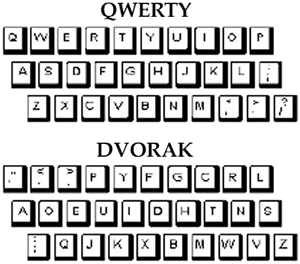
QWERTY is the most common modern-day keyboard layout. The name comes from the first six letters (keys) appearing in the top letter row of the keyboard, read left to right: Q-W-E-R-T-Y. The QWERTY design is based on a layout created by Christopher Latham Sholes in 1873 in Milwaukee, Wisconsin for the Sholes and Glidden typewriter and sold to Remington in the same year. The first model constructed by Sholes used a piano-like keyboard with two rows of characters arranged alphabetically.
The machine jammed at high typing speeds, so Sholes moved the keys he believed were most away from each other, to slow typists down. Several alternatives to QWERTY have been developed over the years, claimed by their designers and users to be more efficient, intuitive and ergonomic. Nevertheless, none has seen widespread adoption, due partly to the sheer dominance of available keyboards and training. The most widely used such alternative is the Dvorak Simplified Keyboard.
Posted in Language, Money, Technology |
Leave a Comment »
March 30, 2011

Mark Mothersbaugh (b. 1950) is an American musician; he is the co-founder of the new wave band Devo and has been its lead singer since 1972. Mothersbaugh attended Kent State as an art student, where he met Devo co-founders Jerry Casale and Bob Lewis. In early 1970, Lewis and Casale formed the idea of the ‘devolution’ of the human race; Mothersbaugh, intrigued by the concept, joined them, building upon it with elements of early poststructuralist ideas and oddball arcana, most notably unearthing the infamous ‘Jocko-Homo Heavenbound’ pamphlet (the basis for the song).
Since Devo, Mothersbaugh developed a successful career writing musical scores for film and television. In film, he has worked frequently with filmmaker Wes Anderson, and scored many of his feature films (‘Bottle Rocket,’ ‘Rushmore,’ ‘The Royal Tenenbaums,’ and ‘The Life Aquatic with Steve Zissou’). His music has been a staple of the children’s television shows ‘Rugrats,’ ‘Beakman’s World,’ and ‘Clifford the Big Red Dog.’ He also wrote some music for ‘Pee-Wee’s Playhouse’ in 1990. His commercial work is often performed with Mutato Muzika, the music production company he formed with several other former members of Devo including his brother, Bob Mothersbaugh.
Posted in Art, Humor, Money |
1 Comment »
March 29, 2011

Affluenza [af-loo-en-zuh], a portmanteau of the words affluence and influenza, is a term used by critics of capitalism and consumerism, defined as: a painful, contagious, socially transmitted condition of overload, debt, anxiety and waste resulting from the dogged pursuit of more. Proponents of the term consider that the prizing of endless increases in material wealth may lead to feelings of worthlessness and dissatisfaction rather than experiences of a ‘better life,’ and that these symptoms may be usefully captured with the metaphor of a disease.
They claim some or even many of those who become wealthy will find the economic success leaving them unfulfilled and hungry only for more wealth, finding that they are unable to get pleasure from the things they buy and that increasingly material things may come to dominate their time and thoughts to the detriment of personal relationships and to feelings of happiness. The condition is considered particularly acute amongst those with inherited wealth, who are often said to experience guilt, lack of purpose and dissolute behavior, as well as obsession with holding on to the wealth.
Posted in Health, Money, Philosophy |
Leave a Comment »
March 29, 2011

Minuteman Salsa was a brand of salsa made in the United States. The brand was founded by Ryan Lambert, along with four associates during the summer of 2006 in reference to the illegal immigration debate. According to the company’s Web site, it is America’s only 100% United States-made salsa. Minuteman Salsa donates a portion of its profits to the Minuteman Project, a group of American citizens whose goal is to deter illegal crossings of the United States–Mexico border. The salsa’s slogan was ‘Deport Bad Taste.’
Posted in Food, Money, Politics |
Leave a Comment »
March 29, 2011

Groupthink is a type of thought within a deeply cohesive group whose members try to minimize conflict and reach consensus without critically testing, analyzing, and evaluating ideas. Research psychologist, Irving Janis studied a number of ‘disasters’ in American foreign policy, such as failure to anticipate the Japanese attack on Pearl Harbor (1941), the Bay of Pigs fiasco (1961), and the prosecution of the Vietnam War (1964–67) by President Lyndon Johnson. He concluded that in each of these cases, the decisions were made largely due to the cohesive nature of the committees which made them. Moreover, that cohesiveness prevented contradictory views from being expressed and subsequently evaluated.
Individual creativity, uniqueness, and independent thinking are lost in the pursuit of group cohesiveness, as are the advantages of reasonable balance in choice and thought that might normally be obtained by making decisions as a group. Members of the group avoid promoting viewpoints outside the comfort zone of consensus thinking to avoid being seen as foolish, or to avoid embarrassing or angering other members of the group. Groupthink may cause groups to make hasty, irrational decisions, where individual doubts are set aside, for fear of upsetting the group’s balance. The term is frequently used pejoratively, in hindsight, and was coined by journalist William H. Whyte in a 1952 ‘Fortune’ magazine article.
Posted in Money, Politics, Science |
Leave a Comment »
March 29, 2011

The Abilene paradox is a paradox in which a group of people collectively decide on a course of action that is counter to the preferences of any of the individuals in the group. It involves a common breakdown of group communication in which each member mistakenly believes that their own preferences are counter to the group’s and, therefore, does not raise objections. A common phrase relating to the Abilene paradox is a desire to not ‘rock the boat.’
read more »
Posted in Money, Science |
Leave a Comment »
March 29, 2011

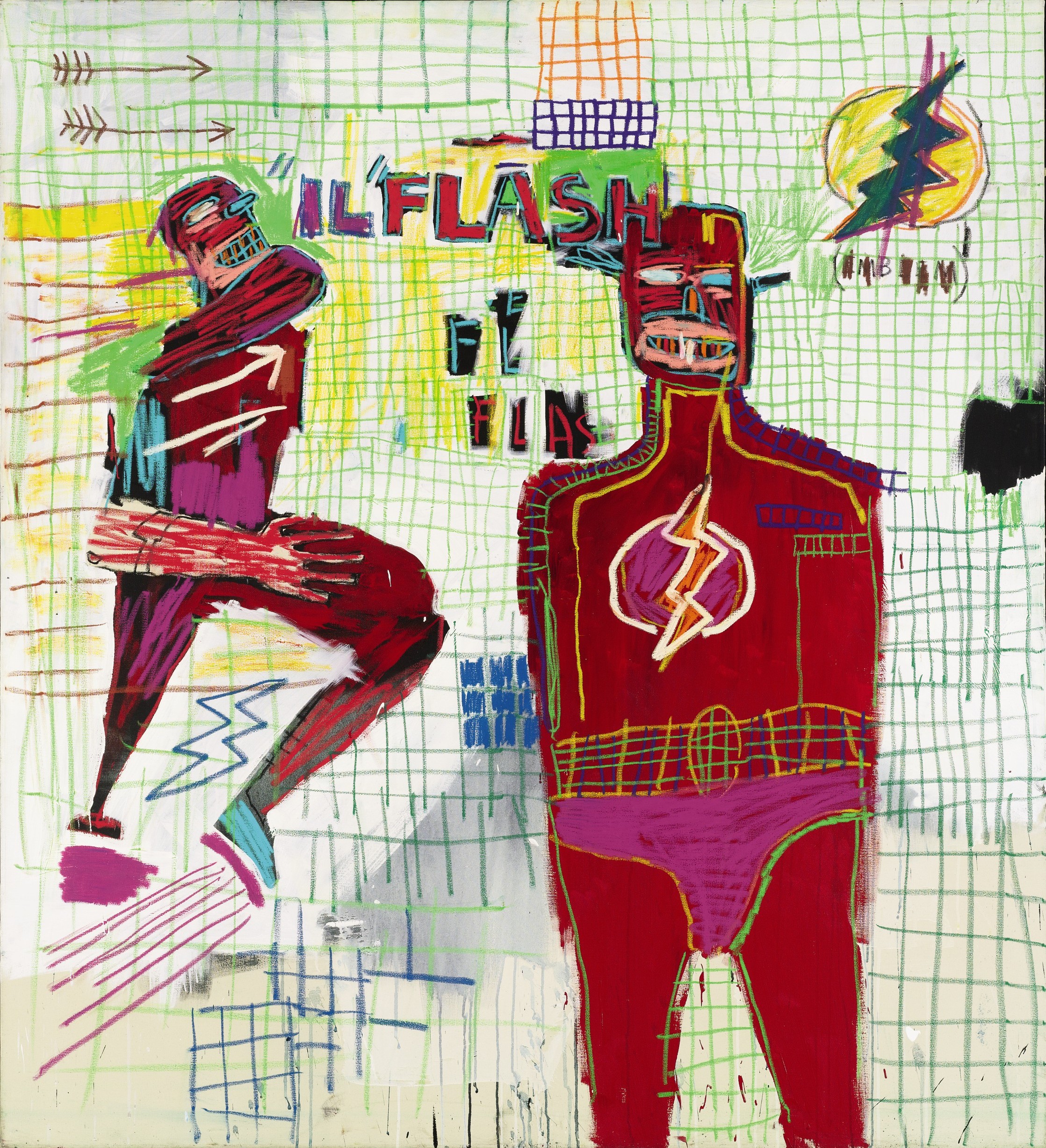
Jean-Michel Basquiat [bah-skee-ott] (1960 – 1988) was a Neo-expressionist painter who got his start as a graffiti artist in NYC in the late 1970s. He died of a heroin overdose at the age of 27. In 1976, Basquiat and friend Al Diaz began spray-painting political-poetical graffiti on buildings in Lower Manhattan, working under the pseudonym SAMO. In 1979, he formed the noise rock band Gray with Vincent Gallo. In 1983-84 he was a frequent collaborator with Andy Warhol. The record price for a Basquiat painting is $14.6 million, paid in 2007 for an untitled 1981 piece. In keeping with his street art roots, Basquiat often incorporated words into his paintings.
He would often draw on random objects and surfaces. A major reference source throughout his career was ‘Gray’s Anatomy,’ which his mother gave to him while in the hospital at age seven. It remained influential in his depictions of internal human anatomy, and in its mixture of image and text. Other reference sources were Henry Dreyfuss’ ‘Symbol Sourcebook,’ Da Vinci’s notebooks, and Brentjes’ ‘African Rock Art.’ Basquiat doodled often, and some of his later pieces, done mostly with colored pencils on paper, exhibit this, often with a loose, spontaneous, and dirty style much like his paintings.
Posted in Art, Money |
Leave a Comment »
March 29, 2011
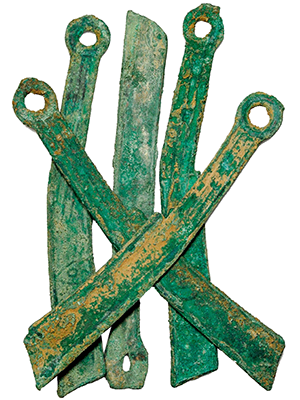
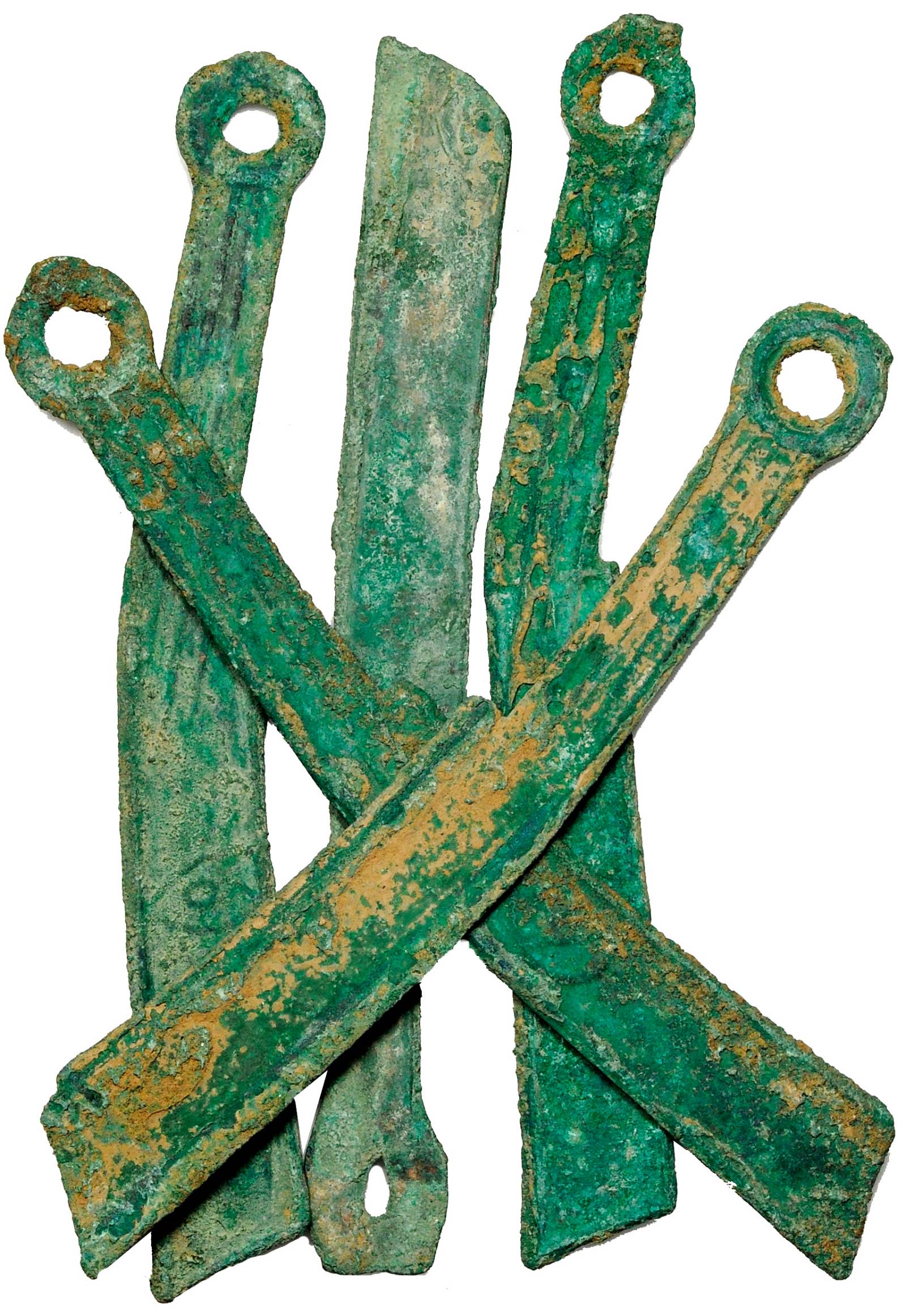
Knife money refers to large, cast, bronze, knife-shaped coins produced by Ancient Chinese governments and kingdoms approximately 2500 years ago. They had holes on the end to be easily strapped onto belts or rings. Known as ‘jin cuo dao’ in Chinese, knife money circulated in China between 600 to 200 BCE during the Zhou dynasty. There are several stories that attempt to explain how knife money was introduced but it is not certain if any or all are true.
In one story a prince who was running low on money to pay his troops allowed them to use their knives as a form of currency to barter with villagers and the medium became so popular that it became generally accepted. In another story, the same prince began accepting knives as payment for small fines in the place of the current legal ring currency. Knife money may also have been brought in by sea traders from the Indian Ocean. Over time, the currency slowly shrank until only the ring of the handle was produced as a symbol of the knife that it represented.
Posted in Money, World |
Leave a Comment »
March 28, 2011

Red Hot Organization (RHO) is an international not-for-profit organization dedicated to fighting AIDS through pop culture. Since its inception in 1989, over 400 artists, producers and directors have contributed to over 15 compilation albums, related television programs and media events to raise donations totaling more than 10 million dollars for HIV / AIDS relief and awareness around the world.
First founded as King Cole, Inc. by Leigh Blake and John Carlin, Red Hot was established in response to the devastation wrought by AIDS on a generation of New York artists and intellectuals. Carlin had an ‘improbable dream: to create an AIDS charity album with pop stars singing Cole Porter songs.’ In 1990 the dream was realized when ‘Red Hot + Blue’ was released, featuring David Byrne, Annie Lennox, Tom Waits, U2, and Erasure.
read more »
Posted in Art, Health, Money |
Leave a Comment »



 The Daily Omnivore