April 1, 2011

Homies are a series of 2-inch figurines loosely based upon Chicano (Mexican American) characters in the life of artist David Gonzalez. First created in 1998, these plastic figurines were initially sold via vending machines typically positioned in supermarkets. Homies have become a highly collectible item among fans of the line, and many imitation toys have sprung up. The figures caused controversy after their initial release as members of the Los Angeles Police Department, argued that the figures glorified gang life. Many stores stopped selling the toys after the complaint.
Gonzales then created a story for each of the Homies’ characters, each of which had a positive view of the characters. Some became former jail mates who went on to educate children about how to avoid prison. Mainstream stores, such as Walmart, quickly returned the Homies to their stacks, and the toy branched out to include a line of diecast cars, among other things. By 2005, the Homies character line had women, as well as Filipino, Japanese and Puerto Rican, and even Evil Clown characters. The Puerto Ricans set, which includes twelve of the Homies, are nicknamed Los Boricuas.
Posted in Art, Games, Money |
Leave a Comment »
April 1, 2011

Gashapon [gosh-uh-pone] is a Bandai brand trademark widely used throughout the world for their capsule toys.
‘Gashapon’ is a Japanese onomatopoeia, made up of two sounds: ‘gasha’ for the turning of a crank on a toy vending machine, and ‘pon’ for the sound of the toy capsule dropping into the receptacle. It is used to describe both the machines themselves, and any toy obtained from them.
read more »
Posted in Art, Games, Money |
Leave a Comment »
April 1, 2011

Disney Vinylmation is a brand of vinyl toys sold at Disney theme parks and other locations. The toys all have a common shape (that of Mickey Mouse) but have different themed markings, colors and patterns.
The first figures were introduced in November 2008. The figures are sold in sealed packaging. The purchaser does not know which figure they are buying until they have opened it.
Posted in Art, Games, Money |
Leave a Comment »
April 1, 2011
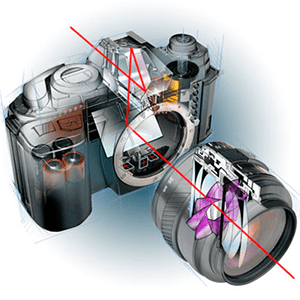
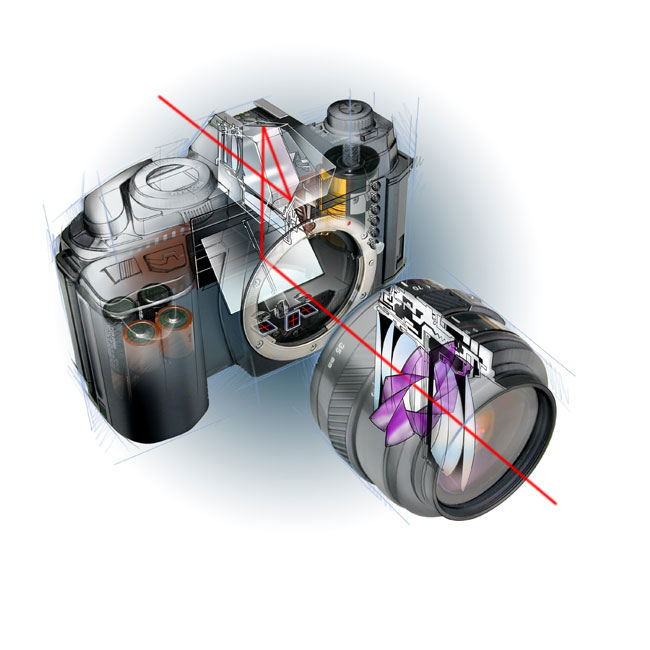
Digital single-lens reflex cameras (DSLR) are cameras that use a mechanical mirror system and pentaprism to direct light from the lens to an optical viewfinder on the back of the camera. The basic operation of a DSLR is as follows: for viewing purposes, the mirror reflects the light coming through the attached lens upwards at a 90 degree angle. It is then reflected three times by the roof pentaprism, rectifying it for the photographer’s eye.
During exposure, the mirror assembly swings upward, the aperture narrows (if stopped down, or set smaller than wide open), and a shutter opens, allowing the lens to project light onto the image sensor. A second shutter then covers the sensor, ending the exposure, and the mirror lowers while the shutter resets. All of this happens automatically over a period of milliseconds, with cameras designed to do this 3–10 times per second.
Posted in Money, Technology |
Leave a Comment »
April 1, 2011
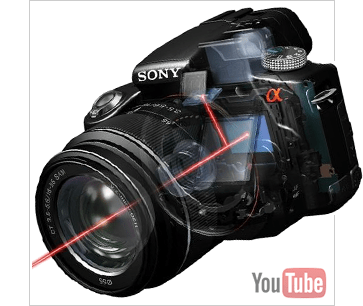
A Single-Lens Translucent (SLT) camera is similar to a Digital Single-Lens Relex (DSLR) but uses a beam splitter instead of a solid mirror. Unlike DSLRs SLT cameras do not have an optical viewfinder, instead they rely on an electronic viewfinder, using the image collected by the sensor. A DSLR mirror allows the user to directly view the image that is passing through the lens; in a SLT the mirror is only used for focusing.
A semi-translucent mirror allows the majority of the light to pass through to the sensor while reflecting a portion of the light onto a phase-detection autofocus sensor in the top of the camera, allowing the camera to take photos without any mirror movement (and associated vibrations), as well as full time auto focus. Since the autofocus array is constantly receiving light, SLT cameras are able to use phase-detection autofocus during video recording, while DSLR’s and other interchangeable lens cameras have to use slower contrast detect autofocus for video and live view.
Posted in Money, Technology |
Leave a Comment »
April 1, 2011


A mirrorless interchangeable lens camera is an emerging class of digital system cameras, intermediate between compact digital cameras and digital single-lens reflex cameras (DSLRs).
They are characterized by large sensors (the same size as entry-level DSLRs), no mirror, and interchangeable lenses, as the name suggests, and provide DSLR-quality pictures in a significantly smaller camera.
Posted in Money, Technology |
Leave a Comment »
April 1, 2011

A molten salt reactor (MSR) is a type of nuclear fission reactor in which the primary coolant is a molten salt mixture, which can run at high temperatures (for higher thermodynamic efficiency) while staying at low vapor pressure for reduced mechanical stress and increased safety, and is less reactive than molten sodium coolant.
The nuclear fuel may be solid fuel rods, or dissolved in the coolant itself, which eliminates fuel fabrication, simplifies reactor structure, equalizes burnup, and allows online reprocessing. One kind of proposed MSR is a liquid fluoride thorium reactor (LFTR). Thorium is a naturally occurring radioactive chemical element estimated to be about three to four times more abundant than uranium in the Earth’s crust.
Posted in Money, Technology |
Leave a Comment »
March 31, 2011

Sound from ultrasound refers to ultrasound (sound pressure with a frequency greater than the upper limit of human hearing, approx. 20 kilohertz) that has been modulated and demodulated. Ultrasound has wavelengths much smaller than audible sound and thus can be aimed in a much tighter narrow beam than any traditional audible loudspeaker system. A narrow beam of modulated ultrasound changes the speed of sound in the air that it passes through. The air within the beam extracts the signal from the ultrasound, resulting in sound that can be heard only along the path of the beam, or that appears to radiate from any surface that the beam strikes.
The practical effect of this technology is that a beam of sound can be projected over a long distance to be heard only in a small well-defined area. A listener outside the beam hears nothing. Anyone or anything that disrupts the path of the beam will interrupt the progression of the beam, like interrupting the illumination of a spotlight. For this reason, most systems are mounted overhead, like lighting. This technology was originally developed by the US Navy and Soviet Navy for underwater sonar in the mid-1960s, and was briefly investigated by Japanese researchers in the early 1980s, but these efforts were abandoned due to extremely poor sound quality (high distortion) and substantial system cost.
Posted in Money, Technology |
Leave a Comment »
March 30, 2011

In Italy, pizza al taglio (‘by the cut’) is a variety of pizza baked in large rectangular trays, and generally sold in rectangular slices by weight, with prices marked per kilogram. The simplest varieties include Pizza Margherita (tomato sauce and cheese), Pizza bianca (olive oil & salt), and Pizza rossa (tomato sauce only). Other typical toppings include artichokes, asparagus, eggplant, ground meat and onions, potatoes, prosciutto, salami, sausage, ground truffles, zucchini, olive oil sundried tomatoes, rocket, gorgonzola, anchovies, and black olives.
Posted in Food, Money, World |
Leave a Comment »
March 30, 2011

Velotype is the old trademark for a type of keyboard for typing text known as a syllabic chord keyboard, an invention of the Dutchmen Nico Berkelmans and Marius den Outer. The current tradename is Veyboard. Contrary to traditional QWERTY type keyboards, on which a typist usually presses one key at a time to create one character at a time, a Veyboard requires the user to press several keys simultaneously, producing syllables rather than letters.
A practiced ‘veyboarder’ can produce more text than on a traditional keyboard, as much as 200 words per minute, double the rate of a fast traditional typist. Because of this, Veyboards are often used for live applications, such as subtitling for television and for the hearing impaired. The keyboard is an orthographic chord keyboard, very different from chorded phonetic keyboards used for verbatim transcription, like the Stenotype.
Posted in Money, Technology, World |
Leave a Comment »
March 30, 2011

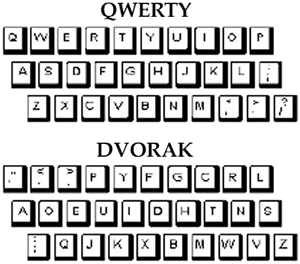
QWERTY is the most common modern-day keyboard layout. The name comes from the first six letters (keys) appearing in the top letter row of the keyboard, read left to right: Q-W-E-R-T-Y. The QWERTY design is based on a layout created by Christopher Latham Sholes in 1873 in Milwaukee, Wisconsin for the Sholes and Glidden typewriter and sold to Remington in the same year. The first model constructed by Sholes used a piano-like keyboard with two rows of characters arranged alphabetically.
The machine jammed at high typing speeds, so Sholes moved the keys he believed were most away from each other, to slow typists down. Several alternatives to QWERTY have been developed over the years, claimed by their designers and users to be more efficient, intuitive and ergonomic. Nevertheless, none has seen widespread adoption, due partly to the sheer dominance of available keyboards and training. The most widely used such alternative is the Dvorak Simplified Keyboard.
Posted in Language, Money, Technology |
Leave a Comment »
March 30, 2011

Mark Mothersbaugh (b. 1950) is an American musician; he is the co-founder of the new wave band Devo and has been its lead singer since 1972. Mothersbaugh attended Kent State as an art student, where he met Devo co-founders Jerry Casale and Bob Lewis. In early 1970, Lewis and Casale formed the idea of the ‘devolution’ of the human race; Mothersbaugh, intrigued by the concept, joined them, building upon it with elements of early poststructuralist ideas and oddball arcana, most notably unearthing the infamous ‘Jocko-Homo Heavenbound’ pamphlet (the basis for the song).
Since Devo, Mothersbaugh developed a successful career writing musical scores for film and television. In film, he has worked frequently with filmmaker Wes Anderson, and scored many of his feature films (‘Bottle Rocket,’ ‘Rushmore,’ ‘The Royal Tenenbaums,’ and ‘The Life Aquatic with Steve Zissou’). His music has been a staple of the children’s television shows ‘Rugrats,’ ‘Beakman’s World,’ and ‘Clifford the Big Red Dog.’ He also wrote some music for ‘Pee-Wee’s Playhouse’ in 1990. His commercial work is often performed with Mutato Muzika, the music production company he formed with several other former members of Devo including his brother, Bob Mothersbaugh.
Posted in Art, Humor, Money |
1 Comment »