March 23, 2011

The lottery of birth is a philosophical argument that states: since no one chooses where they are born, they should not be held responsible for something that is beyond their control (e.g. being rich, being poor, etc.). The lottery of birth argument was sometimes used by philosophers such as John Locke, Thomas Hobbes, and Jean-Jacques Rousseau. More modern day uses have been prompted by political theorists such as John Rawls, who explores the subject more in depth in his book ‘A Theory of Justice.’
Posted in Money, Philosophy |
Leave a Comment »
March 23, 2011

Tetra Pak is a multinational food processing and packaging company of Swedish origin. It was founded in 1951 in Lund, Sweden, by Ruben Rausing and Erik Åkerlund. Erik Wallenberg invented the original tetrahedral package in 1952, today known as ‘Tetra Classic.’ Ruben Rausing’s sons Hans and Gad Rausing ran Tetra Pak from 1954 until 1985, taking the company from a seven-person concern to one of Sweden’s largest corporations. At his death in 1983, Ruben Rausing was Sweden’s richest person.
Tetra Pak’s innovation is in the area of aseptic processing liquid food packaging which, when combined with ultra-high-temperature processing, allows liquid food to be packaged and stored under room temperature conditions for up to a year. In 1963 the company introduced ‘Tetra Brik,’ a rectangular cuboid carton. Later, it launched other formats such as ‘Tetra Wedge’ (wedge-shaped), ‘Tetra Prisma’ (round octagonal), and ‘Tetra Fino’ (pouch-shaped). Recent innovations have seen the introduction of laminated paper boxes for vegetables as an alternative to canned goods (‘Tetra Recart’).
Posted in Food, Money, Technology |
Leave a Comment »
March 23, 2011


Conveyor belt sushi (kaiten-zushi) is the popular English translation for Japanese fast-food sushi sometimes called a ‘sushi-g0-round.’ In Australia, it is known as ‘sushi train’ In South Korea, conveyor belt sushi has become popular and is known as ‘revolving sushi.’
Plates with the sushi are placed on a rotating conveyor belt that winds through the restaurant and moves past every table and counter seat. Customers may place special orders, but most simply pick their selections from a steady stream of fresh sushi moving along the conveyor belt. The final bill is based on the number and type of plates of the consumed sushi.
read more »
Posted in Food, Money, Technology |
Leave a Comment »
March 23, 2011

Dragon Skin a bulletproof vest made by Pinnacle Armor of California. Its characteristic two-inch-wide circular discs overlap like scale armor, creating a flexible vest that allows a good range of motion and can allegedly absorb a high number of hits compared with other military body armor.
The discs are composed of silicon carbide ceramic matrices and laminates, much like the larger ceramic plates in other types of bullet resistant vests. This armor has been known to withstand grenade blasts, and up to 40 rounds of ammo.
Posted in Money, Technology, War |
Leave a Comment »
March 23, 2011

The Bocuse d’Or [bo-kyewz dor] is a biennial world chef championship. Named for the chef Paul Bocuse, the event takes place during two days near the end of January in Lyon, France, and is frequently referred to as the culinary equivalent of the Olympic Games. The initial competition took place in 1987.
The audience atmosphere of the Bocuse d’Or evolved in 1997 when the support for the Mexican candidate included a mariachi band, foghorns, cowbells, cheering and yelling from the stands, marking the beginning of a tradition of noisy spectator presence. Originally the reigning champion nation was not permitted to participate in the following contest, but that rule was removed after the 1999 event when France was competing and did not win gold for the first time.
Posted in Food, Games, Money |
Leave a Comment »
March 23, 2011

Auguste Escoffier [es-kaw-fyey] (1846 – 1935) was a French chef, restaurateur and culinary writer who popularized and updated traditional French cooking methods. He is a legendary figure among chefs and gourmands, and was one of the most important leaders in the development of modern French cuisine.
Much of Escoffier’s technique was based on that of Antoine Carême, one of the codifiers of French haute cuisine, but Escoffier’s achievement was to simplify and modernize Carême’s elaborate and ornate style. Referred to by the French press as ‘roi des cuisiniers et cuisinier des rois’ (‘king of chefs and chef of kings’ —though this had also been previously said of Carême), Escoffier was France’s pre-eminent chef in the early part of the 20th century.
read more »
Posted in Food, Money |
Leave a Comment »
March 22, 2011


Kenneth Robert Howard (1929 – 1992), also known as Von Dutch, was a motorcycle mechanic, artist, pinstriper, metal fabricator, knifemaker and gunsmith. His father, Wally Howard, was a Los Angeles sign painter, and by the age of ten Kenny was able to paint and letter at a professional level. Some of his famous works include the flying eyeball and a custom Kenford truck.
Among many custom car and motorcycle enthusiasts, he is thought of as one of the fathers of Kustom Kulture (an aesthetic born out of the hot rod culture of Southern California of the 1960s). Dutch’s lifelong alcoholism led to major medical issues later in life, and he died from alcohol related complications. His daughters sold the ‘Von Dutch’ name to Michael Cassel and Robert Vaughn, who used it to form a clothing brand.
Posted in Art, Money, Technology |
Leave a Comment »
March 22, 2011
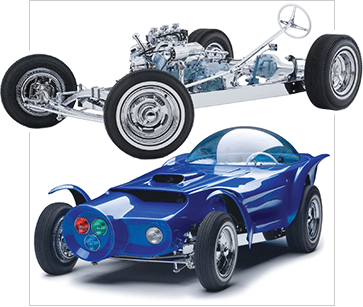
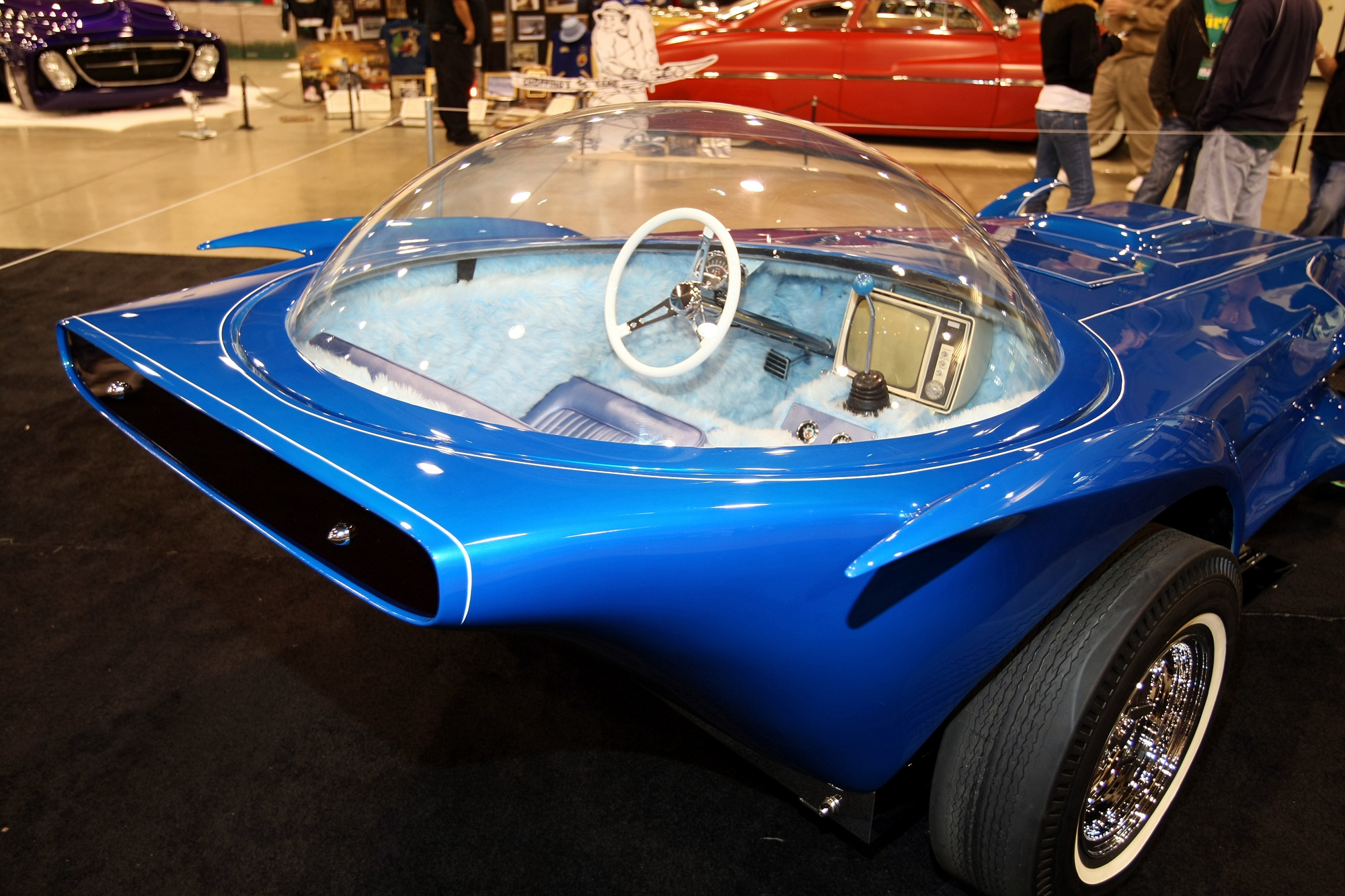
The Orbitron is a custom car built by Ed Roth and feared lost until its rediscovery in Mexico in 2007. Built in 1964, the vehicle was powered by a 1955 or 1956 Chevrolet V8 and was backed by a Powerglide automatic transmission. The body was hand-laid fiberglass which actually hid Roth’s extensive chrome work to the chassis.
The cockpit, set at the extreme rear of the vehicle in the manner of a dragster, was lined with fake fur and featured a General Electric portable television inserted in the console. Topping the cockpit was a custom-made, hydraulically operated plexiglass bubble top. One of a series of ordinary doorbell switches atop the hood activated the top from the outside.
read more »
Posted in Art, Money, Technology |
Leave a Comment »
March 22, 2011

‘Big Daddy‘ Ed Roth (1932 – 2001) was an artist and cartoonist who created the hot-rod icon ‘Rat Fink.’ As a custom car builder, Roth was a key figure in Southern California’s Kustom Kulture and hot-rod movement of the 1960s. He grew up in Bell, California, attending Bell High School, where his classes included auto shop and art. Roth is best known for his grotesque caricatures — typified by Rat Fink — depicting imaginative, out-sized monstrosities driving representations of the hot rods that he and his contemporaries built.
Although Detroit native Stanley Mouse is credited with creating the so-called ‘Monster Hot Rod’ art form, Roth is the individual who popularized it. Roth is also well known for his innovative work in turning hot rodding from crude backyard engineering, where performance was the bottom line, into a refined art form where aesthetics were equally important, breaking new ground with fiberglass bodywork.
Posted in Art, Humor, Money |
Leave a Comment »
March 21, 2011

Virgin Galactic is a company within Richard Branson’s Virgin Group which plans to provide sub-orbital spaceflights to the paying public, along with suborbital space science missions and orbital launches of small satellites. Further in the future Virgin Galactic hopes to offer orbital human spaceflights as well. Tickets are priced at $200,000 per person with a $20,000 deposit. The vehicle is a six passenger, two pilot craft. Test launches are planned to take place from the Mojave Spaceport, where Scaled Composites is constructing the spacecraft.
The spacecraft, SpaceShipTwo, will be carried to about 16 kilometers or 52000 ft by a carrier aircraft, White Knight II. At that point, when the carrier aircraft reaches its maximum height, the SpaceShipTwo vehicle will separate and continue to over 100 km (the Kármán line, a common definition of where ‘space’ begins). The time from liftoff of the White Knight booster carrying SpaceShipTwo until the touchdown of SpaceShipTwo after the sub-orbital flight will be about 3.5 hours. The sub-orbital flight itself will only be a small fraction of that time. The weightlessness will last approximately 6 minutes.
Posted in Money, Technology |
Leave a Comment »
March 21, 2011

Colin Stetson, born in Ann Arbor, Michigan, is a bass saxophone player and touring member of Arcade Fire and Bell Orchestre. In addition to saxophone, he plays clarinet, bass clarinet, french horn, flute, and cornet.
Stetson has worked with dozens of artists, including David Byrne, Tom Waits, TV on the Radio, Sinéad O’Connor, and LCD Soundsystem. His solo album New History Warfare, Vol 1. was released in 2008. The follow up, New History Warfare, Vol. 2: Judges was released in 2011.
Posted in Art, Money |
Leave a Comment »
March 21, 2011

Hefty Records is an independent record label based in Chicago, founded in 1995 by John Hughes III (aka Slicker). The label has established itself as a home for innovative electronica, releasing post-rock, IDM, downtempo, nu jazz, experimental music, and hip-hop. The label was formed by Hughes (as well as Bill Ding and Dan Snazelle) as a way of releasing his own music from his Ohio University dorm room in 1995. Soon afterwards a demo was given to Hughes from Scott Herren who was added to the roster under the name Savath and Savalas.
Hefty released the ‘Immediate Action’ series in 2000, a limited collection of six vinyl records from various electronic artists. All the records were hand pressed by Hughes, with sleeves created by the Brooklyn graphics company Graphic Havoc (now known as GHAVA), which used a stencil and spray painting technique to create each album; with different stickers to tell them apart.
Posted in Art, Money |
Leave a Comment »



 The Daily Omnivore