April 29, 2014

An unconditional basic income (also called basic income, basic income guarantee, universal basic income, universal demogrant, or citizen’s income) is a proposed system of social security in which all citizens or residents of a country regularly receive an unconditional sum of money, either from a government or some other public institution, in addition to any income received from elsewhere.
A basic income is typically intended to be only enough for a person to survive on, so as to encourage people to engage in economic activity. A basic income of any amount less than the social minimum is sometimes referred to as a ‘partial basic income.’ On the other hand, it should be high enough so as to facilitate any socially useful activity someone could not afford to engage in if dependent on working for money to earn a living.
read more »
Posted in Money, Politics, World |
1 Comment »
April 28, 2014
A wealth tax is a levy based on the aggregate value of all household assets (e.g. owner-occupied housing; cash, bank deposits, money funds, and savings in insurance and pension plans; investment in real estate and unincorporated businesses; and corporate stock, financial securities, and personal trusts). A wealth tax is a tax on the accumulated stock of purchasing power, in contrast to income tax, which is a tax on the flow of assets (a change in stock).
Some governments require declaration of the taxpayer’s balance sheet (assets and liabilities), and from that ask for a tax on net worth (assets minus liabilities), as a percentage of the net worth, or a percentage of the net worth exceeding a certain level. The tax is in place for both natural persons and, in some cases, legal persons such as corporations. In France, the net worth tax on natural persons is called the ‘solidarity tax on wealth.’ In other places, the tax may be called a ‘capital tax,’ an ‘equity tax,’ a ‘net worth tax,’ a ‘net wealth tax,’ or just a ‘wealth tax.’
read more »
Posted in Money, Politics, World |
Leave a Comment »
April 1, 2014
The Robin Hood tax commonly refers to a package of financial transaction taxes (FTT) proposed by a campaigning group of civil society non-governmental organizations (NGOs). Campaigners have suggested the tax could be implemented globally, regionally or unilaterally by individual nations.
Conceptually similar to the Tobin tax (a small tax on spot currency conversions), it would affect a wider range of asset classes including the purchase and sale of stocks, bonds, commodities, unit trusts, mutual funds, and derivatives such as futures and options. The Tobin tax was proposed for foreign currency exchange only.
read more »
Posted in Money, Politics, Technology |
Leave a Comment »
April 1, 2014
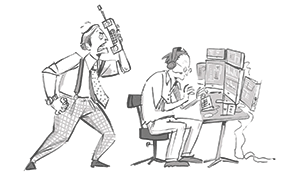
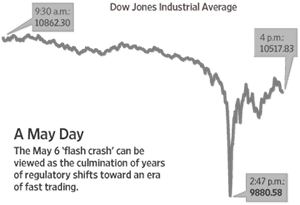
Flash trading, otherwise known as a flash order, is defined by industry trade publication ‘Traders Magazine’ as ‘a marketable order sent to a market center that is not quoting the industry’s best price or that cannot fill that order in its entirety. The order is then flashed to recipients of the venue’s proprietary data feed to see if any of those firms wants to take the other side of the order. This practice enables the market center to try to keep the trade.’ Under an exception to Rule 602 of Regulation NMS, flash orders are currently legal.
Bloomberg states: ‘Flash systems trace their roots as far back as 1978 to efforts by exchanges to electronically replicate how a trader might yell an order to floor brokers before entering it into the system that displays all bids and offers. Markets have evolved since the days of floor brokers’ dominance, with computer algorithms now buying and selling shares 1,000 times faster than the blink of an eye.’
read more »
Posted in Money, Politics, Technology |
Leave a Comment »
March 19, 2014
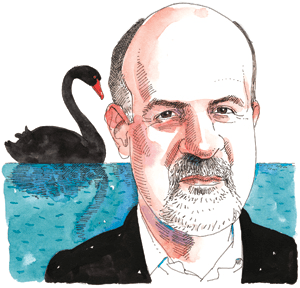
The black swan theory or theory of black swan events is a metaphor that describes an event that comes as a surprise, has a major effect, and is often inappropriately rationalized after the fact with the benefit of hindsight.
The theory was developed by Lebanese American statistician Nassim Nicholas Taleb to explain the disproportionate role of high-profile, hard-to-predict, and rare events that are beyond the realm of normal expectations in history, science, finance, and technology. It further examined the non-computability of the probability of the consequential rare events using scientific methods (owing to the very nature of small probabilities), and the psychological biases that make people individually and collectively blind to uncertainty and unaware of the massive role of the rare event in historical affairs.
read more »
Posted in Money, Philosophy, Science |
Leave a Comment »
March 13, 2014

Satoshi Nakamoto is the person or group that created the Bitcoin protocol and reference software, Bitcoin-Qt. It is not known whether the name is real or a pseudonym. In 2008, Nakamoto published a paper on ‘The Cryptography Mailing’ list at metzdowd.com describing his digital currency. In 2009, he released the first Bitcoin software that launched the network and the first units currency, called bitcoins. Nakamoto is said to have continued to contribute to his Bitcoin software release with other developers until contact with his team and the community gradually began to fade in mid-2010.
Near this time, he handed over control of the source code repository and alert key functions of the software to Gavin Andresen, chief scientist at the Bitcoin Foundation (a non-profit founded in 2012 to promote Bitcoin). Also around this same time, he handed over control of the Bitcoin.org domain and several other domains to various prominent members of the Bitcoin community. Nakamoto is believed to be in possession of roughly one million bitcoins. At one point in December 2013, this was the equivalent of US$1.1 billion.
read more »
Posted in Money, Politics, Technology |
Leave a Comment »
February 26, 2014

The Discreet Charm of the Bourgeoisie (‘Le Charme discret de la bourgeoisie’) is a 1972 surrealist film directed by Luis Buñuel and written by Jean-Claude Carrière in collaboration with the director. The narrative concerns a group of upper-middle-class people attempting — despite continual interruptions — to dine together.
The film consists of several thematically linked scenes: five gatherings of a group of bourgeois friends, and the four dreams of different characters. The beginning of the film focuses on the gatherings, while the latter part focuses on the dreams, but both types of scenes are intertwined. There are also scenes involving other characters, such as two involving a Latin American female terrorist from the fictitious Republic of Miranda. The film’s world is not logical: the bizarre events are accepted by the characters, even if they are impossible or contradictory.
read more »
Posted in Art, Money, World |
Leave a Comment »
February 24, 2014

Gregory Clark (b. 1957) is an economic historian at UC, Davis. His grandfathers were migrants to Scotland from Ireland, and he was born in Bellshill, Scotland. In 1974 he and a fellow pupil won the ‘Scottish Daily Express’ school debate competition. After school he earned his B.A. in economics and philosophy at King’s College, Cambridge in 1979 and his Ph.D. at Harvard in 1985. He has also taught as an Assistant Professor at Stanford and the University of Michigan. At Davis his areas of research are long term economic growth, the wealth of nations, and the economic history of England and India.
Clark is most well known for his book, ‘A Farewell to Alms: A Brief Economic History of the World.’ He argued that the current divide between rich and poor nations came about as a result of the Industrial Revolution originating in Britain. Prior to 1790, Clark asserts, man faced a Malthusian trap: new technology enabled greater productivity and more food, but was quickly gobbled up by higher populations. In Britain, however, as disease continually killed off poorer members of society, their positions in society were taken over by the sons of the wealthy.
read more »
Posted in Money, Science |
Leave a Comment »
February 21, 2014

A backup singer (also known as a backing vocalist, background singer, or harmony vocalist) is a singer who provides vocal harmony with the lead vocalist or other backing vocalists. In some cases, a backing singer may sing alone as a lead-in to the main vocalist’s entry or a counter-melody. Solo artists may employ professional backing vocalists in studio recording sessions as well as during concerts and other live performance routines.
Working as a backup singer can give a vocalist the onstage experience and vocal training they need to develop into a lead vocalist. A number of lead vocalists such as Ace Frehley, Mariah Carey, Cher, Gwen Stefani, Pink, Whitney Houston, Phil Collins, Sheryl Crow, Trisha Yearwood, Dave Grohl, and Elton John, learned their craft as backup singers, or singing backup vocals as part of a choir.
read more »
Posted in Art, Money |
Leave a Comment »
February 17, 2014
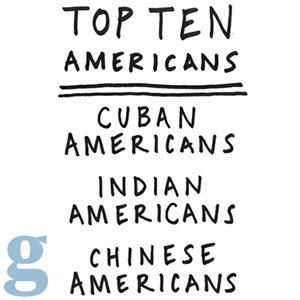
Middleman minority (also known as market-dominant minorities) is any minority population that, while subject to discrimination, does not hold an ‘extreme subordinate’ status in society. There are numerous examples of such groups gaining eventual prosperity in their adopted country despite discrimination. Often, they will take on roles between producer and consumer, such as trading and moneylending.
Famous examples such as Jews throughout Europe even at times when the discrimination against them was at their peak such as during World War II they still had great success in some parts of Europe, Chinese throughout Southeast Asia, Parsis in India, Igbos in Nigeria, Indians in East Africa, people from the Soviet Blocs in the USA during the Cold War, and many others.
read more »
Posted in Money, Politics, World |
Leave a Comment »
February 13, 2014

The phrase Potemkin [poh-tem-kin] villages was originally used to describe a fake village, built only to impress. According to the story, Russian statesman Grigory Potemkin erected fake settlements along the banks of the Dnieper River in order to fool Empress Catherine II during her visit to Crimea in 1787.
The phrase is now used, typically in politics and economics, to describe any construction (literal or figurative) built solely to deceive others into thinking that some situation is better than it really is. Some modern historians claim the original story is exaggerated.
read more »
Posted in Money, Politics, World |
Leave a Comment »
January 25, 2014

People of Walmart is an entertainment website founded in 2009 by brothers Andrew and Adam Kipple of Harrison City, PA featuring user-submitted photos of socially awkward or undesirable Walmart shoppers.
The brothers and their friend Luke Wherry started the site after seeing a woman in a t-shirt that read ‘go f*** yourself’ with a 2 year old in a harness and a man with a beard reminiscent of those worn by ZZ Top at a South Carolina Walmart. They created the website to share what they find truly remarkable, ignoring more stereotypical redneck or mullets. In addition to avoiding the ordinary, the trio refuse to post photos of people who are disabled or working Walmart employees.
Posted in Humor, Money |
Leave a Comment »


 The Daily Omnivore