October 1, 2014

A fan edit is a version of a film modified by a viewer, that removes, reorders, or adds material in order to create a new interpretation of the source material. This includes the removal of scenes or dialogue, replacement of audio and/or visual elements, and adding material from sources such as deleted scenes or even other films. The field was popularized by an individual calling himself the ‘Phantom Editor’ (later revealed as professional editor Mike J. Nichols). He removed elements from George Lucas’ ‘The Phantom Menace’ that he felt detracted from the film, and made minor changes in dialogue, languages, and subtitles to give the film’s villains a more menacing tone.
There were a total of 18 minutes cut from the original film, reducing the run time from 136 minutes to 118 minutes. The end result became known as ‘The Phantom Edit,’ which circulated Hollywood studios on VHS in 2000. It was the first unauthorized re-edit of a major film to receive publicity and acclaim and inspired dozens of other edits to surface on the internet. Lucasfilm, the production company of series creator George Lucas, condoned the edit, and did not pursue legal action against its distributors.
read more »
Posted in Art, Money |
1 Comment »
September 12, 2014
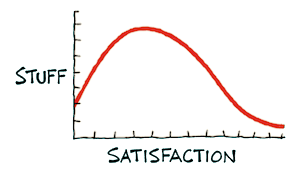

In economics, ‘utility’ is the amount of satisfaction received from consuming (using) goods and services, and ‘marginal’ refers to a small change, starting from some baseline level. Marginal utility describes the change in utility from consuming more or less of a product. Economists sometimes speak of a law of ‘diminishing marginal utility,’ meaning that consuming the first unit usually has a higher utility than every other unit. When the number of units that are consumed increases, their marginal utility decreases (and vice versa).
As 20th century English economist Philip Wicksteed explained the term, ‘Marginal considerations are considerations which concern a slight increase or diminution of the stock of anything which we possess or are considering.’ ‘Marginal cost’ is the cost of producing one more unit of a good. The ‘marginal decision rule’ states that a good or service should be consumed at a quantity at which the marginal utility is equal to the marginal cost (i.e. at a cost that justifies the satisfaction derived from the product).
read more »
Posted in Money, Politics |
Leave a Comment »
September 10, 2014


Liebeck v. McDonald’s Restaurants, also known as the McDonald’s coffee case, was a 1994 product liability lawsuit that became a flash point in the tort reform debate in the US. A New Mexico civil jury awarded $2.86 million to plaintiff Stella Liebeck, a 79-year-old woman who suffered third-degree burns in her pelvic region when she accidentally spilled hot coffee in her lap after purchasing it from a McDonald’s restaurant. Liebeck was hospitalized for eight days while she underwent skin grafting, followed by two years of medical treatment.
Liebeck’s attorneys argued that at 180–190 °F coffee was defective, claiming it was too hot and more likely to cause serious injury than coffee served at any other establishment. The jury damages included $160,000 to cover medical expenses and $2.7 million in punitive damages. The trial judge reduced the final verdict to $640,000, and the parties settled for a confidential amount before an appeal was decided. The case was said by some to be an example of frivolous litigation; ABC News called it, ‘the poster child of excessive lawsuits,’ while legal scholar Jonathan Turley said it was ‘a meaningful and worthy lawsuit.’
read more »
Posted in Food, Money, Politics |
Leave a Comment »
August 18, 2014


A visiting card, also known as a calling card, is a small paper card with one’s name printed on it, and often bearing an artistic design. In 18th century Europe the footmen of aristocrats and royalty would deliver these first European visiting cards to the servants of their prospective hosts solemnly introducing the arrival of their owners.
Visiting cards became an indispensable tool of etiquette, with sophisticated rules governing their use. The essential convention was that one person would not expect to see another person in her own home (unless invited or introduced) without first leaving his visiting card for the person at her home. Upon leaving the card, he would not expect to be admitted at first, but might receive a card at his own home in response. This would serve as a signal that a personal visit and meeting at home would be welcome. On the other hand, if no card were forthcoming, or if a card were sent in an envelope, a personal visit was thereby discouraged.
read more »
Posted in Language, Money, World |
Leave a Comment »
August 11, 2014

Edible bird’s nests are among the most expensive animal products consumed by humans, with an average nest selling for $2,500 per kilo for end-consumers in Asia. The nests have been used in Chinese cooking for over 400 years, most often as bird’s nest soup. Legend has it that shipwrecked sailors scavenging for food cleaned and cooked the nests and found the resulting stew so invigorating they were able to sail home to inform the emperor of their new discovery.
The Chinese name for edible bird’s nest, ‘yàn wō,’ translates literally as ‘swiftlet nest’ (swiftlets, common to asia, are superficially similar to swallows and known for building nests of solidified saliva). The most famous use for the nests is bird’s nest soup, a delicacy in Chinese cuisine. When dissolved in water, the swiftlet nests have a gelatinous texture used for soup or sweet tong sui (a Cantonese custard).
read more »
Posted in Food, Money, World |
1 Comment »
August 6, 2014

Imelda Marcos (b. 1929) is the widow of former Philippine President Ferdinand Marcos. In popular culture, she is remembered for her collection of more than a thousand pairs of shoes. She began her career as a local singer and model in Manila before meeting her husband. After the declaration of martial law in 1972, Imelda began holding positions in the national government that allowed her to travel the world and accumulate artwork and real estate. The couple consolidated their power allowing them to transport funds from the Philippine treasury into offshore accounts, such as banks in Switzerland.
President Marcos was accused of the assassination of Benigno Aquino, Jr., leading to the People Power Revolution which forced the Marcoses out of office and into exile in Hawaii. After the death of Ferdinand, Imelda and her family were given amnesty by then President Corazon Aquino, Benigno Jr’s widow. Her return to the Philippines has since allowed her to restore her political dynasty. Despite numerous cases involving alleged corruption, she has not been imprisoned and continues to wield influence. Her ability to survive upheavals in her life has led her to be called the ‘Steel Butterfly.’
read more »
Posted in Money, Politics, World |
Leave a Comment »
August 4, 2014

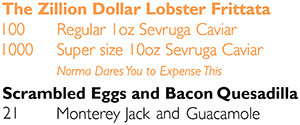
Anchoring or focalism is a cognitive bias that describes the common human tendency to rely too heavily on the first piece of information offered (the ‘anchor’) when making decisions. Once an anchor is set, other judgments are made by adjusting away from that anchor, and there is a bias toward interpreting other information around the anchor. For example, the initial price offered for a used car sets the standard for the rest of the negotiations, so that prices lower than the initial price seem more reasonable even if they are still higher than what the car is really worth.
Anchoring is also called the focusing effect (or focusing illusion) because it occurs when people place too much importance on one aspect of an event, causing an error in accurately predicting the utility of a future outcome. Individuals tend to focus on notable differences, excluding those that are less conspicuous, when making predictions about happiness or convenience.
read more »
Posted in Health, Money, Science |
Leave a Comment »
July 30, 2014

The Monobloc [mon-uh-blok] chair is a lightweight stackable polypropylene chair, often described as the world’s most common plastic chair. Based on original designs by the Italian designer Vico Magistretti in 1967, variants of the one-piece plastic chair went into production with Allibert Group and Grossfillex Group in the 1970s. Since then, millions have been manufactured globally. Many design variants of the basic idea exist.
The Monobloc chair is so named because it is injection molded from thermoplastic polypropylene, the granules being heated to about 220 degrees Celsius, and the melt injected into a mold. The gate of the mold is usually located in the seat to ensure smooth flow to all parts of the tool. The chairs cost approximately $3 to produce, making them affordable across the world. Social theorist Ethan Zuckerman describes them as having achieved a global ubiquity: ‘The Monobloc is one of the few objects I can think of that is free of any specific context. Seeing a white plastic chair in a photograph offers you no clues about where or when you are.’
Posted in Money, Technology, World |
Leave a Comment »
July 17, 2014
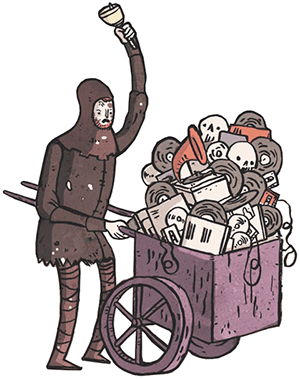
The Album Era was a period in English-language popular music from the mid 1960s to the mid 2000s in which the album was the dominant form of recorded music expression and consumption. It was primarily driven by three successive music recording formats, the 331⁄3 rpm phonograph record (1931), the audiocassette (1964), and the compact disc (1982).
In 1999, peer-to-peer file sharing application Napster was released, popularizing digital copies of music. The ease of downloading individual songs facilitated by it and later networks is often credited with ushering in the end of the Album Era in popular music.
read more »
Posted in Art, Money, Technology |
2 Comments »
July 16, 2014

Napster was a peer-to-peer (P2P) music sharing application first developed in 1999 by Shawn Fanning at Northeastern University. The original program was available for three years before being shut down by a court order for copyright violations. The company’s brand and other assets was subsequently acquired at a bankruptcy proceeding by Roxio, maker of CD burning software. In its second incarnation Napster became an online music store until it was bought by music streaming site Rhapsody in late 2011.
Fanning lead the original company along with his uncle John Fanning and entrepreneur Sean Parker (who would go on to make billions as an early employee of Facebook). Later companies and projects successfully followed its P2P file sharing example such as Gnutella, Freenet, and many others. Some services, like LimeWire, Grokster, Madster and the original eDonkey network, were brought down or changed due to similar circumstances.
read more »
Posted in Money, Politics, Technology |
Leave a Comment »
July 11, 2014


Open-source economics is an economic platform (a two-sided market with two distinct user groups that provide each other with network benefits) based on open collaboration for the production of software, services, or other products. First applied to the open-source software industry, this economic model may be applied to a wide range of enterprises. The system requires work or investment to be carried out without an expressed expectation of return; products or services are produced through collaboration between users and developers; there is no direct individual ownership of the enterprise itself.
The structure of open source is based on user participation. According to technology law professor Yochai Benkler, ‘networked environment makes possible a new modality of organizing production: radically decentralized, collaborative, and non-proprietary; based on sharing resources and outputs among widely distributed, loosely connected individuals who cooperate with each other without relying on either market signals or managerial commands.’
read more »
Posted in Money, Politics, Technology |
1 Comment »
July 1, 2014

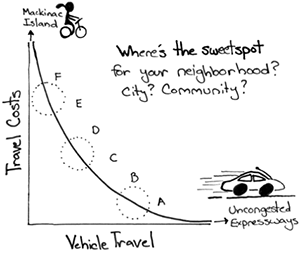
Induced demand, or latent demand, refers to the phenomenon that after supply increases, more of a good is consumed. This is entirely consistent with the economic theory of supply and demand; however, the idea has become important in the debate over the expansion of transportation systems, and is often used as an argument against widening roads, such as major commuter roads. It is considered by some to be a contributing factor to urban sprawl.
Latent demand has been recognized by road traffic professionals for many decades. J. J. Leeming, a British road-traffic engineer and county surveyor between 1924 and 1964, described the phenomenon is his 1969 book: ‘Motorways and bypasses generate traffic, that is, produce extra traffic, partly by inducing people to travel who would not otherwise have done so by making the new route more convenient than the old, partly by people who go out of their direct route to enjoy the greater convenience of the new road, and partly by people who use the towns bypassed because they are more convenient for shopping and visits when through traffic has been removed.’
read more »
Posted in Money, Politics, Technology |
Leave a Comment »




