June 24, 2014


Antipatterns are common practices that initially appear to be beneficial, but ultimately result in bad consequences that outweigh hoped-for advantages. The term, coined in 1995 by programmer Andrew Koenig, was inspired by a book, ‘Design Patterns,’ in which the authors highlighted a number of practices in software development that they considered to be highly reliable and effective.
The term was popularized three years later by the book ‘AntiPatterns,’ which extended its use beyond the field of software design and into general social interaction and may be used informally to refer to any commonly reinvented but bad solution to a problem. Examples include analysis paralysis (over-analyzing a situation while indefinitely delaying making a decision), cargo cult programming (the ritual inclusion of code that serves no real purpose), death march (pressing ahead on a project members feel is destined to fail), groupthink (a desire for harmony in the group results in an irrational decision-making outcome), and vendor lock-in (preventing customers from seeking alternatives).
read more »
Posted in Money, Technology |
Leave a Comment »
June 23, 2014
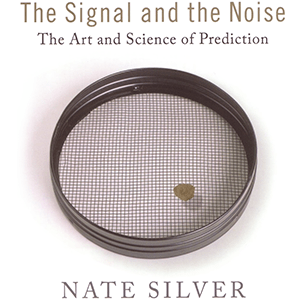

The term wet bias refers to weather forecasters deliberately reporting a higher probability of rain than their predictive models show. The Weather Channel has been empirically shown, and has also admitted, to having a wet bias in the case of low probability of precipitation (for instance, a 5% probability may be reported as a 20% probability) but not at higher probabilities (a 60% probability will likely be reported accurately). Blogger Dan Allan noted that the channel is also biased at the upper end (a probability of 90% or higher will be rounded up to 100%). Local weather stations have been shown to have a significantly greater wet bias, with some reporting a probability as low as 70% as a certainty.
In 2002, computer scientist Eric Floehr started analyzing historical weather prediction data on a website called ForecastWatch. He found that the commercial forecasts were biased and the National Weather Service forecasts weren’t. His findings, though known within the meteorology community for some time, was first popularized in Nate Silver’s 2012 book ‘The Signal and the Noise.’ According to Silver, the phenomenon is due to skewed incentives: if the correct low probability of precipitation is given, viewers may interpret the forecast as if there were no probability of rain, and then be upset if it does rain. Forecasters are compensating for the fact that people have greater loss aversion than they think they do (and are especially prone to miscalculate their cost-loss ratio when it is low). Silver quotes Dr. Rose of The Weather Channel as saying, ‘If the forecast was objective, if it has zero bias in precipitation, we are in trouble.’
Posted in Money, Science |
1 Comment »
May 14, 2014
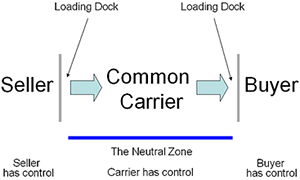
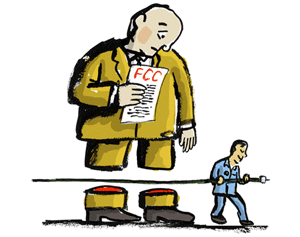
Common carrier is a legal term for a company that transports goods or people and is responsible for any loss in transit. Such services are offered to the general public under license or authority provided by a regulatory body, which may create, interpret, and enforce its regulations upon the common carrier (subject to judicial review) with independence and finality, as long as it acts within the bounds of the enabling legislation.
A common carrier is distinguished from a contract carrier, which transports goods for only a certain number of clients and that can refuse to transport goods for anyone else, and from a private carrier (a company that transports only their own goods). A common carrier holds itself out to provide service to the general public without discrimination (to meet the needs of the regulator’s quasi judicial role of impartiality toward the public’s interest) for the ‘public convenience and necessity.’
read more »
Posted in Money, Politics, Technology |
Leave a Comment »
May 4, 2014

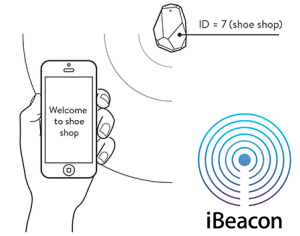
An indoor positioning system (IPS, or micromapping) is a network of devices that wirelessly locate objects or people inside a building. Instead of using satellites like GPS, it relies on nearby anchors (nodes with a known position), which either actively locate tags or provide ambient location or environmental context for devices. Systems use optical, radio, or even acoustic technologies. Integration of data from several navigation systems with different physical principles can increase the accuracy and robustness of the overall solution.
Wireless transmission indoors faces several obstacles including signal attenuation caused by construction materials, multiple reflections at surfaces causing transmission errors, and interference with devices that emit or receive electromagnetic waves (e.g. microwave ovens, cellular phones). Error correction systems that don’t rely on wireless signals are being used to compensate for these shortcomings, such as Inertial Measurement Units (reports velocity, orientation, and gravitational forces using accelerometers and gyroscopes), and Simultaneous Localization and Mapping (SLAM, a technique used by robots and autonomous vehicles to build up a map within an unknown environment).
Posted in Money, Technology |
Leave a Comment »
May 3, 2014
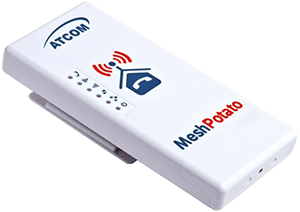

A wireless mesh network (WMN) is a communications network made up of radio nodes organized in a mesh topology; each node is connected to one or more other nodes, and information is passed from one node to the next, until it reaches its target destination. As in most cases, there is more than one path from one node to another, making such networks very reliable. When a node fails, the data will simply take another route. This type of infrastructure can be decentralized (with no central server) or centrally managed (with a central server).
The coverage area of the radio nodes working as a single network is sometimes called a mesh cloud. Mesh architecture sustains signal strength by breaking long distances into a series of shorter hops. Intermediate nodes not only boost the signal, but cooperatively make forwarding decisions based on their knowledge of the network, i.e. perform routing. Such an architecture may with careful design provide high bandwidth, spectral efficiency, and economic advantage over the coverage area.
read more »
Posted in Money, Technology |
Leave a Comment »
May 1, 2014

A barber’s pole is a type of sign used by barbers to signify the place or shop where they perform their craft. The trade sign is, by a tradition dating back to the Middle Ages, a staff or pole with a helix of colored stripes (often red and white in many countries, but usually red, white, and blue in the US). The pole may be stationary or may revolve, often with the aid of an electric motor.
The origin of the red and white barber pole is associated with the service of bloodletting and was historically a representation of bloody bandages wrapped around a pole. During medieval times, barbers performed surgery on customers, as well as tooth extractions. The original pole had a brass wash basin at the top (representing the vessel in which leeches were kept) and bottom (representing the basin that received the blood). The pole itself represents the staff that the patient gripped during the procedure to encourage blood flow.
read more »
Posted in Health, Money, Sex |
Leave a Comment »
April 29, 2014

An unconditional basic income (also called basic income, basic income guarantee, universal basic income, universal demogrant, or citizen’s income) is a proposed system of social security in which all citizens or residents of a country regularly receive an unconditional sum of money, either from a government or some other public institution, in addition to any income received from elsewhere.
A basic income is typically intended to be only enough for a person to survive on, so as to encourage people to engage in economic activity. A basic income of any amount less than the social minimum is sometimes referred to as a ‘partial basic income.’ On the other hand, it should be high enough so as to facilitate any socially useful activity someone could not afford to engage in if dependent on working for money to earn a living.
read more »
Posted in Money, Politics, World |
1 Comment »
April 28, 2014
A wealth tax is a levy based on the aggregate value of all household assets (e.g. owner-occupied housing; cash, bank deposits, money funds, and savings in insurance and pension plans; investment in real estate and unincorporated businesses; and corporate stock, financial securities, and personal trusts). A wealth tax is a tax on the accumulated stock of purchasing power, in contrast to income tax, which is a tax on the flow of assets (a change in stock).
Some governments require declaration of the taxpayer’s balance sheet (assets and liabilities), and from that ask for a tax on net worth (assets minus liabilities), as a percentage of the net worth, or a percentage of the net worth exceeding a certain level. The tax is in place for both natural persons and, in some cases, legal persons such as corporations. In France, the net worth tax on natural persons is called the ‘solidarity tax on wealth.’ In other places, the tax may be called a ‘capital tax,’ an ‘equity tax,’ a ‘net worth tax,’ a ‘net wealth tax,’ or just a ‘wealth tax.’
read more »
Posted in Money, Politics, World |
Leave a Comment »
April 1, 2014

The Robin Hood tax commonly refers to a package of financial transaction taxes (FTT) proposed by a campaigning group of civil society non-governmental organizations (NGOs). Campaigners have suggested the tax could be implemented globally, regionally or unilaterally by individual nations.
Conceptually similar to the Tobin tax (a small tax on spot currency conversions), it would affect a wider range of asset classes including the purchase and sale of stocks, bonds, commodities, unit trusts, mutual funds, and derivatives such as futures and options. The Tobin tax was proposed for foreign currency exchange only.
read more »
Posted in Money, Politics, Technology |
Leave a Comment »
April 1, 2014

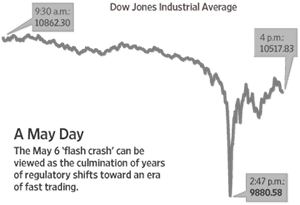
Flash trading, otherwise known as a flash order, is defined by industry trade publication ‘Traders Magazine’ as ‘a marketable order sent to a market center that is not quoting the industry’s best price or that cannot fill that order in its entirety. The order is then flashed to recipients of the venue’s proprietary data feed to see if any of those firms wants to take the other side of the order. This practice enables the market center to try to keep the trade.’ Under an exception to Rule 602 of Regulation NMS, flash orders are currently legal.
Bloomberg states: ‘Flash systems trace their roots as far back as 1978 to efforts by exchanges to electronically replicate how a trader might yell an order to floor brokers before entering it into the system that displays all bids and offers. Markets have evolved since the days of floor brokers’ dominance, with computer algorithms now buying and selling shares 1,000 times faster than the blink of an eye.’
read more »
Posted in Money, Politics, Technology |
Leave a Comment »
March 19, 2014

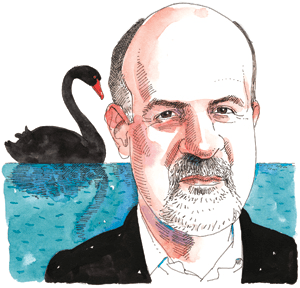
The black swan theory or theory of black swan events is a metaphor that describes an event that comes as a surprise, has a major effect, and is often inappropriately rationalized after the fact with the benefit of hindsight.
The theory was developed by Lebanese American statistician Nassim Nicholas Taleb to explain the disproportionate role of high-profile, hard-to-predict, and rare events that are beyond the realm of normal expectations in history, science, finance, and technology. It further examined the non-computability of the probability of the consequential rare events using scientific methods (owing to the very nature of small probabilities), and the psychological biases that make people individually and collectively blind to uncertainty and unaware of the massive role of the rare event in historical affairs.
read more »
Posted in Money, Philosophy, Science |
Leave a Comment »
March 13, 2014

Satoshi Nakamoto is the person or group that created the Bitcoin protocol and reference software, Bitcoin-Qt. It is not known whether the name is real or a pseudonym. In 2008, Nakamoto published a paper on ‘The Cryptography Mailing’ list at metzdowd.com describing his digital currency. In 2009, he released the first Bitcoin software that launched the network and the first units currency, called bitcoins. Nakamoto is said to have continued to contribute to his Bitcoin software release with other developers until contact with his team and the community gradually began to fade in mid-2010.
Near this time, he handed over control of the source code repository and alert key functions of the software to Gavin Andresen, chief scientist at the Bitcoin Foundation (a non-profit founded in 2012 to promote Bitcoin). Also around this same time, he handed over control of the Bitcoin.org domain and several other domains to various prominent members of the Bitcoin community. Nakamoto is believed to be in possession of roughly one million bitcoins. At one point in December 2013, this was the equivalent of US$1.1 billion.
read more »
Posted in Money, Politics, Technology |
Leave a Comment »



