October 9, 2013

Victor Papanek (1923 – 1998) was a designer and educator who became a strong advocate of the socially and ecologically responsible design of products, tools, and community infrastructures. He disapproved of manufactured products that were unsafe, showy, maladapted, or essentially useless. Papanek was a philosopher of design and as such he was an untiring, eloquent promoter of design aims and approaches that would be sensitive to social and ecological considerations.
He wrote that ‘design has become the most powerful tool with which man shapes his tools and environments (and, by extension, society and himself).’ With his interest in all aspects of design and how they affected people and the environment, Papanek felt that much of what was manufactured in the U.S. was inconvenient, often frivolous and even unsafe.
read more »
Posted in Money, Technology |
Leave a Comment »
October 2, 2013

‘The Pentagon Wars‘ is a 1998 HBO film, directed by Richard Benjamin, based on a book of the same name (subtitled: ‘Reformers Challenge the Old Guard’) by Colonel James G. Burton, USAF (retired).
Starring Kelsey Grammer, Cary Elwes and Richard Schiff, the film is a dark comedy describing the development of the M2 Bradley fighting vehicle.
read more »
Posted in Humor, Money, War |
Leave a Comment »
October 2, 2013

Feature creep (also known as ‘creeping featurism’ or ‘featuritis’) is the unchecked expansion or addition of new features in a product. Such features go beyond the basic function of the product and so can result in over-complication rather than simple design. The most common cause of feature creep is the desire to provide the consumer with a more useful or desirable product, in order to increase sales or distribution.
However, once the product reaches the point at which it does everything that it is designed to do, the manufacturer is left with the choice of adding unneeded functions, sometimes at the cost of efficiency, or sticking with the old version, at the cost of a perceived lack of improvement. Another major cause of feature creep might be a compromise from a committee which decides to implement multiple, different viewpoints in the same product. Then, as more features are added to support each viewpoint, it might be necessary to have cross-conversion features between the multiple viewpoints, further complicating the total features.
read more »
Posted in Money, Technology |
1 Comment »
October 1, 2013
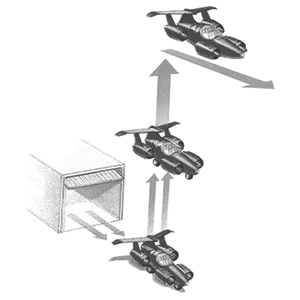
The Moller Skycar is a prototype personal VTOL (vertical take-off and landing) aircraft invented by Paul Moller who has been attempting to develop such vehicles for fifty years (with limited success).
The craft said to be currently under development, the M400, is purported to transport four people. It is described as a car since it is aimed at being a popular means of transport for anyone who can drive, incorporating automated flight controls, with the driver only inputting direction and speed required with a cruising speed of 305 mph.
read more »
Posted in Money, Technology |
1 Comment »
September 30, 2013

‘The Design of Business: Why Design Thinking is the Next Competitive Advantage’ is a book published in 2009 by Roger Martin, Dean of the University of Toronto’s Rotman School of Management. The book describes the concept of design thinking, and how companies can incorporate it into their organizational structure for long term innovation and results.
Martin introduces the ‘knowledge funnel’ as the process followed by leading businesses to innovate more consistently and successfully by eliminating mysteries and developing heuristics (shortcuts and workarounds) and eventually algorithms (forumas). The mystery stage comprises the exploration of the problem, this transitions to the rule of thumb (heuristic) stage, where a rule of thumb is generated to narrow work to a manageable size. In the algorithm stage the general heuristic is converted to a fixed formula, taking the problem from complexity to simplicity.
read more »
Posted in Money |
1 Comment »
September 29, 2013

Bridge and tunnel (B&T) is a pejorative term for people who travel to Manhattan Island from surrounding communities, a commute that requires passing over a bridge and/or through a tunnel. Though the term originates from the Triborough Bridge and Tunnel Authority, which services the five boroughs that comprise New York City, it has come to encompass all people who originate commute from outside of Manhattan, including the four other boroughs, Connecticut, Long Island, New Jersey, and northern counties, such as Orange, Rockland, and Westchester.
As the Oxford Dictionaries explains: a bridge-and-tunnel person is one who lives in the suburbs and is perceived as unsophisticated.
read more »
Posted in Language, Money, World |
Leave a Comment »
September 27, 2013

Ding zui [ding zoo-ee] is the Chinese practice of hiring impostors or body doubles to stand trial and receive punishment in one’s place. The term translates as ‘substitute criminal,’ and is reported to be a relatively common practice among China’s wealthy elite.
Accusations of ding zui surfaced in 2012 during the trial of Gu Kailai. The term ‘body double’ quickly became popular on Chinese Internet fora, and Chinese authorities attempted to censor related messages. Similar allegations had arisen in 2009 after the trial Hu Bin.
Posted in Money, Politics, World |
1 Comment »
September 23, 2013

‘NBA Jam‘ is an arcade game first developed by Midway in 1993 by programmer and game designer Mark Turmell. The game featured 2-on-2 basketball and is one of the first sports games to offer NBA-licensed teams and players, and their real digitized likenesses. Midway had previously released such sports games as ‘Arch Rivals’ in 1989 (another 2-on-2 basketball game, on which NBA Jam’s gameplay is based), ‘High Impact’ in 1990, and ‘Super High Impact’ in 1991, but ‘NBA Jam’ was the company’s first major hit.
The game became exceptionally popular, and generated a significant amount of money for arcades after its release, creating revenue of $1 billion in quarters. Its success gave rise to a new genre of sports games which were based around fast, action-packed gameplay and exaggerated realism, a formula which Midway would also later apply to the sports of football (‘NFL Blitz’), and hockey (‘2 on 2 Open Ice Challenge’).
read more »
Posted in Games, Money, Technology |
1 Comment »
September 18, 2013

The I-V-vi-IV progression (the pop-punk chord progression) is a common chord progression popular across several genres of music. It involves the I, V, vi, and IV chords; for example, in the key of C major, this would be: C-G-Am-F. The V is often replaced by iii (‘Price Tag’), III (‘If We Ever Meet Again’ chorus), ii (‘Halo’), I (‘Doesn’t Mean Anything’), bVII (‘Firework’ first verse), II (‘Try Too Hard’ by P!nk), IV (‘I Gotta Feeling’).
It can also be used in the form vi-IV-I-V, which was dubbed the ‘sensitive female chord progression’ by Boston Globe Columnist Marc Hirsh. In C major this would be Am-F-C-G (Am-F-C-G/B voicing is very common in modern pop music). Hirsh first noticed the chord progression in the song ‘One of Us’ by Joan Osborne. He claimed it was used by many members of the Lilith Fair in the late 1990s.
Posted in Art, Humor, Money |
1 Comment »
September 16, 2013

Moral Mazes is a 1988 book from sociologist Robert Jackall that documents an investigation into the world of corporate managers in the United States. In the introduction, Jackall writes that he ‘went into these organizations to study how bureaucracy – the prevailing organizational form of our society – shapes moral consciousness.’ He called the book, ‘an interpretive sociological account of how managers think the world works.’
Jackall describes the ‘fundamental rules of corporate life’: ‘(1) You never go around your boss. (2) You tell your boss what he wants to hear, even when your boss claims that he wants dissenting views. (3) If your boss wants something dropped, you drop it. (4) You are sensitive to your boss’s wishes so that you anticipate what he wants; you don’t force him, in other words, to act as a boss. (5) Your job is not to report something that your boss does not want reported, but rather to cover it up. You do your job and you keep your mouth shut.’
read more »
Posted in Language, Money, Politics |
2 Comments »
September 6, 2013

Julian L. Simon and Paul Ehrlich entered in a famous scientific wager in 1980, betting on a mutually agreed-upon measure of resource scarcity over the decade leading up to 1990. Simon had Ehrlich choose five commodity metals. Copper, chromium, nickel, tin, and tungsten were chosen and Simon bet that their prices would decrease, while Ehrlich bet they would increase. Ehrlich lost the bet, as all five commodities that were bet on declined in price from 1980 through 1990, the wager period.
In 1968, Ehrlich published ‘The Population Bomb,’ which argued that mankind was facing a demographic catastrophe with the rate of population growth quickly outstripping growth in the supply of food and resources. Simon was highly skeptical of such claims, so proposed a wager, telling Ehrlich to select any raw material he wanted and select ‘any date more than a year away,’ and Simon would bet that the commodity’s price on that date would be lower than what it was at the time of the wager.
read more »
Posted in Money, Science, World |
Leave a Comment »
September 6, 2013

‘The Ultimate Resource‘ is a 1981 book written by Julian Lincoln Simon challenging the notion that humanity was running out of natural resources. It was revised in 1996 as ‘The Ultimate Resource 2.’
The overarching thesis is that there is no resource crisis because as a particular resource becomes more scarce, its price rises, creating an incentive for people to discover more of the resource, ration and recycle it and, eventually, develop substitutes. The ‘ultimate resource’ is not any particular physical object but the capacity for humans to invent and adapt.
read more »
Posted in Language, Money, World |
1 Comment »


 The Daily Omnivore