September 27, 2013

Ding zui [ding zoo-ee] is the Chinese practice of hiring impostors or body doubles to stand trial and receive punishment in one’s place. The term translates as ‘substitute criminal,’ and is reported to be a relatively common practice among China’s wealthy elite.
Accusations of ding zui surfaced in 2012 during the trial of Gu Kailai. The term ‘body double’ quickly became popular on Chinese Internet fora, and Chinese authorities attempted to censor related messages. Similar allegations had arisen in 2009 after the trial Hu Bin.
Posted in Money, Politics, World |
1 Comment »
September 23, 2013

‘NBA Jam‘ is an arcade game first developed by Midway in 1993 by programmer and game designer Mark Turmell. The game featured 2-on-2 basketball and is one of the first sports games to offer NBA-licensed teams and players, and their real digitized likenesses. Midway had previously released such sports games as ‘Arch Rivals’ in 1989 (another 2-on-2 basketball game, on which NBA Jam’s gameplay is based), ‘High Impact’ in 1990, and ‘Super High Impact’ in 1991, but ‘NBA Jam’ was the company’s first major hit.
The game became exceptionally popular, and generated a significant amount of money for arcades after its release, creating revenue of $1 billion in quarters. Its success gave rise to a new genre of sports games which were based around fast, action-packed gameplay and exaggerated realism, a formula which Midway would also later apply to the sports of football (‘NFL Blitz’), and hockey (‘2 on 2 Open Ice Challenge’).
read more »
Posted in Games, Money, Technology |
1 Comment »
September 18, 2013

The I-V-vi-IV progression (the pop-punk chord progression) is a common chord progression popular across several genres of music. It involves the I, V, vi, and IV chords; for example, in the key of C major, this would be: C-G-Am-F. The V is often replaced by iii (‘Price Tag’), III (‘If We Ever Meet Again’ chorus), ii (‘Halo’), I (‘Doesn’t Mean Anything’), bVII (‘Firework’ first verse), II (‘Try Too Hard’ by P!nk), IV (‘I Gotta Feeling’).
It can also be used in the form vi-IV-I-V, which was dubbed the ‘sensitive female chord progression’ by Boston Globe Columnist Marc Hirsh. In C major this would be Am-F-C-G (Am-F-C-G/B voicing is very common in modern pop music). Hirsh first noticed the chord progression in the song ‘One of Us’ by Joan Osborne. He claimed it was used by many members of the Lilith Fair in the late 1990s.
Posted in Art, Humor, Money |
1 Comment »
September 16, 2013

Moral Mazes is a 1988 book from sociologist Robert Jackall that documents an investigation into the world of corporate managers in the United States. In the introduction, Jackall writes that he ‘went into these organizations to study how bureaucracy – the prevailing organizational form of our society – shapes moral consciousness.’ He called the book, ‘an interpretive sociological account of how managers think the world works.’
Jackall describes the ‘fundamental rules of corporate life’: ‘(1) You never go around your boss. (2) You tell your boss what he wants to hear, even when your boss claims that he wants dissenting views. (3) If your boss wants something dropped, you drop it. (4) You are sensitive to your boss’s wishes so that you anticipate what he wants; you don’t force him, in other words, to act as a boss. (5) Your job is not to report something that your boss does not want reported, but rather to cover it up. You do your job and you keep your mouth shut.’
read more »
Posted in Language, Money, Politics |
2 Comments »
September 6, 2013
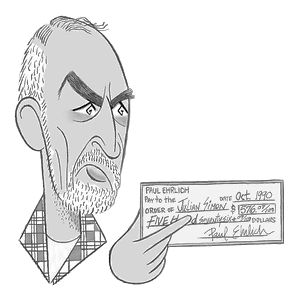
Julian L. Simon and Paul Ehrlich entered in a famous scientific wager in 1980, betting on a mutually agreed-upon measure of resource scarcity over the decade leading up to 1990. Simon had Ehrlich choose five commodity metals. Copper, chromium, nickel, tin, and tungsten were chosen and Simon bet that their prices would decrease, while Ehrlich bet they would increase. Ehrlich lost the bet, as all five commodities that were bet on declined in price from 1980 through 1990, the wager period.
In 1968, Ehrlich published ‘The Population Bomb,’ which argued that mankind was facing a demographic catastrophe with the rate of population growth quickly outstripping growth in the supply of food and resources. Simon was highly skeptical of such claims, so proposed a wager, telling Ehrlich to select any raw material he wanted and select ‘any date more than a year away,’ and Simon would bet that the commodity’s price on that date would be lower than what it was at the time of the wager.
read more »
Posted in Money, Science, World |
Leave a Comment »
September 6, 2013

‘The Ultimate Resource‘ is a 1981 book written by Julian Lincoln Simon challenging the notion that humanity was running out of natural resources. It was revised in 1996 as ‘The Ultimate Resource 2.’
The overarching thesis is that there is no resource crisis because as a particular resource becomes more scarce, its price rises, creating an incentive for people to discover more of the resource, ration and recycle it and, eventually, develop substitutes. The ‘ultimate resource’ is not any particular physical object but the capacity for humans to invent and adapt.
read more »
Posted in Language, Money, World |
1 Comment »
September 3, 2013
Left-libertarianism is a school of political thought that stresses equally both individual freedom and social justice. There are three overlapping subgroups within left-libertarianism:
1) Anti-authoritarian, anti-propertarian varieties of left-wing politics, and in particular of the socialist movement. 2) The Steiner–Vallentyne school, a political philosophy in the liberal tradition which embraces egalitarian views concerning natural resources, holding that it is not legitimate for someone to claim private ownership of such resources to the detriment of others. 3) Left-wing market anarchism, which stresses the socially transformative potential of non-aggression and free markets.
read more »
Posted in Money, Philosophy, Politics |
1 Comment »
August 28, 2013

Gil Gunderson, a.k.a. Ol’ Gil, is a character on ‘The Simpsons’ voiced by Dan Castellaneta that first appeared in the ninth season episode ‘Realty Bites’ as a real estate agent with Lionel Hutz’s Red Blazer Realty. He is a spoof of actor Jack Lemmon’s portrayal of Shelley Levene in the 1992 film adaptation of the play ‘Glengarry Glen Ross.’ (Lemmon himself voiced a character similar to Levene in the eighth season episode ‘The Twisted World of Marge Simpson’). Show runner Mike Scully said that the writers thought that Gil would be ‘a one-shot thing’ ‘Dan Castellaneta was so funny at the table read doing the character,’ Scully elaborated, ‘we kept making up excuses in subsequent episodes to put him in.’
Writer Dan Greaney said that it was a great take-off on Levene to make Gil more desperate than he was. Even so, the writers like to write Gil with ‘a little bit of the old sparkle’ left in him. With the retirement of the character Lionel Hutz (after voice actor Phil Hartman’s death), Gil has been working as the Simpsons’ lawyer in later episodes. He had several jobs but inevitably fails at any endeavour, often tragically. For example, he was shot on his first day as a security guard in the bank. As revealed in ‘Natural Born Kissers,’ he lives in a balloon..
Posted in Art, Humor, Money |
Leave a Comment »
August 28, 2013

Glengarry Glen Ross is a 1992 American drama, adapted by David Mamet from his 1984 Pulitzer Prize- and Tony-winning play of the same name. The film depicts two days in the lives of four real estate salesmen and how they become desperate when the corporate office sends a trainer to ‘motivate’ them by announcing that, in one week, all except the top two salesmen will be fired. The film, like the play, is notorious for its use of profanity, leading the cast to jokingly refer to the film as ‘Death of a Fuckin’ Salesman.’ The title of the film comes from the names of two of the real estate developments being peddled by the salesmen characters: Glengarry Highlands and Glen Ross Farms.
The film was not a commercial success, making only $10.7 million in North America, just below its $12.5 million budget. Al Pacino was nominated for an Academy Award for Best Supporting Actor for his work in the film.
read more »
Posted in Art, Language, Money |
Leave a Comment »
August 25, 2013
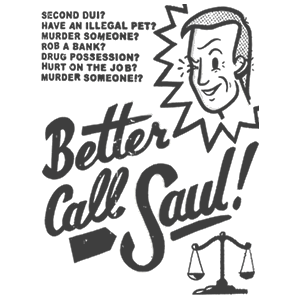
Saul McGill, known almost exclusively by his professional alias Saul Goodman, was a character on the TV show ‘Breaking Bad’ on AMC. He was portrayed by comedian Bob Odenkirk and was created by Peter Gould, a writer of the series. Saul is a criminal lawyer and can be easily found in the yellow pages of Albuquerque.
His made up surname ‘Goodman’ is a play on words to better attract clients: ”S’all good, man!’ becomes ‘Saul Goodman.’ (Additionally, he claims his clients feel more comfortable with a Jewish lawyer instead of a generic white guy.) He is also known for his low-budget commercials in Albuquerque, where he advertises mainly under the tagline ‘Better Call Saul!’
read more »
Posted in Humor, Money, Politics |
1 Comment »
August 25, 2013

A shyster [shahy-ster] is a slang word for someone who acts in a disreputable, unethical, or unscrupulous way, especially in the practice of law, politics or business. The etymology of the word is not generally agreed upon. The Merriam-Webster Dictionary says it is based on the German ‘Scheißer’ (literally ‘defecator’ but also used to refer to deceivers), but the Oxford English Dictionary describes it as ‘of obscure origin,’ possibly deriving from a historical sense of ‘shy’ meaning disreputable. Various false etymologies have suggested an anti-Semitic origin, but there is no proof for that. One source claims that the term originated in Philadelphia in 1843 from a disreputable attorney named ‘Schuster.’
Notable ‘shysters’ of fiction include Sylvester Shyster (a Walt Disney cartoon character introduced in 1930), a disbarred attorney who schemes to deprive Minnie Mouse of her inheritance; and Dave Kleinfeld, a mob lawyer in ‘Carlito’s Way’ (1993) who was parodied in ‘Grand Theft Auto: Vice City’ as Ken Rosenberg.
Posted in Language, Money, Politics |
1 Comment »
August 25, 2013
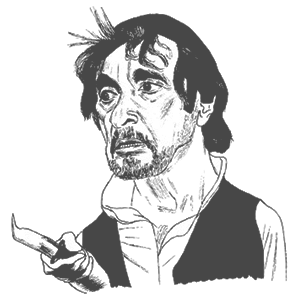
Shylock [shahy-lok] is a fictional Jewish moneylender in Shakespeare’s ‘The Merchant of Venice’ who lends money to his Christian rival, Antonio, setting the security at a pound of Antonio’s flesh. When a bankrupt Antonio defaults on the loan, Shylock demands the pound of flesh as revenge for Antonio having previously insulted and spat on him.
Meanwhile, Shylock’s daughter, Jessica, elopes with Antonio’s friend Lorenzo and becomes a Christian, further fuelling his rage. She also takes money and jewels from Shylock. During Shakespeare’s day, money lending was a fairly common occupation among Jews because usury, charging interest on a loan, was a sin for Christians at the time.
read more »
Posted in Money, Philosophy, Politics |
1 Comment »



