June 10, 2013

‘Going Clear: Scientology, Hollywood, and the Prison of Belief’ is a 2013 non-fiction book about Scientology written by American journalist Lawrence Wright. The book contains interviews from current and former Scientologists, the history of founder L. Ron Hubbard and current leader David Miscavige, and analysis of the relationships of Tom Cruise and John Travolta to the organization.
In an interview with the ‘New York Times’ Wright said that ‘There are a lot of people out there who were very high up in the church and know a lot about it who have become outspoken…I’m very lucky to come along at a time when a lot of these people are ready to talk.’ Wright also disclosed that he has received ‘innumerable’ letters threatening legal action from lawyers representing the church and celebrities who belong to it.
read more »
Posted in Language, Money, Philosophy |
Leave a Comment »
June 10, 2013

Recruiting Scientologist celebrities and getting them to endorse Scientology to the public at large has always been very important to the Church of Scientology. According to founder L. Ron Hubbard: ‘Celebrities are very Special people and have a very distinct line of dissemination. They have comm[unication] lines that others do not have and many medias [sic] to get their dissemination through.’
Scientology has had a written program governing celebrity recruitment since at least 1955, when Hubbard created ‘Project Celebrity,’ offering rewards to Scientologists who recruited targeted celebrities. Early interested parties included former silent-screen star Gloria Swanson and jazz pianist Dave Brubeck. A Scientology policy letter of 1976 states that ‘rehabilitation of celebrities who are just beyond or just approaching their prime’ enables the ‘rapid dissemination’ of Scientology.
read more »
Posted in Money, Philosophy |
1 Comment »
June 10, 2013

Celebrity Centres are Church of Scientology facilities that are open to the public but serve mostly artists and celebrities and other ‘professionals, leaders and promising new-comers in the fields of the arts, sports, management and government,’ as ‘those are the people who are sculpting the present into the future.’ The Celebrity Centre International was established in Hollywood, California, in 1969 by Yvonne Gillham, a Sea Org member who worked with L. Ron Hubbard. Since then, other centres have been established in New York, London, Paris and a number of other cities across the world.
The Church often quotes L. Ron Hubbard saying that, ‘A culture is only as great as its dreams and its dreams are dreamed by artists,’ citing this as the reason that Celebrity Centres were established — to create a good environment for ‘artists.’ Critics of Scientology point to Hubbard’s launch of ‘Project Celebrity’ in 1955 to recruit celebrities into the church, and that the centres were established as an extension of this initial purpose. The church denies the existence of policy to actively recruit high-ranking celebrities.
Posted in Health, Money, Philosophy |
Leave a Comment »
June 6, 2013


In economics and decision theory, loss aversion refers to people’s tendency to strongly prefer avoiding losses to acquiring gains. Most studies suggest that losses are twice as powerful, psychologically, as gains. The concept was first demonstrated by psychologists Amos Tversky and Daniel Kahneman. John List, Chairman of the University of Chicagos’ department of economics has said: ‘It’s a deeply ingrained behavioral trait. .. that all human beings have — this underlying phenomenon that ‘I really, really dislike losses, and I will do all I can to avoid losing something.’
Loss aversion leads to risk aversion when people evaluate an outcome comprising similar gains and losses; since people prefer avoiding losses to making gains. Loss aversion may also explain sunk cost effects, where people justify increased investment in a decision, based on the cumulative prior investment, despite new evidence suggesting that the cost, starting today, of continuing the decision outweighs the expected benefit.
read more »
Posted in Money, Science |
Leave a Comment »
June 6, 2013
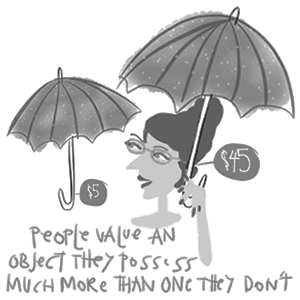
In behavioral economics, the endowment effect (also known as divestiture aversion) is the hypothesis that a person’s willingness to accept (WTA) compensation for a good is greater than their willingness to pay (WTP) for it once their property right to it has been established. People will pay more to retain something they own than to obtain something owned by someone else—even when there is no cause for attachment, or even if the item was only obtained minutes ago. This is due to the fact that once you own the item, foregoing it feels like a loss, and humans are loss-averse.
The endowment effect contradicts the Coase theorem (a theory of economic efficiency), and was described as inconsistent with standard economic theory which asserts that a person’s willingness to pay (WTP) for a good should be equal to their willingness to accept (WTA) compensation to be deprived of the good, a hypothesis which underlies consumer theory and indifference curves.
read more »
Posted in Money, Politics, Science |
1 Comment »
June 6, 2013

HeadOn is the brand name of a homeopathic product claimed to relieve headaches. It achieved widespread notoriety in 2006 as a result of a repetitive commercial, consisting only of the tagline ‘HeadOn. Apply directly to the forehead,’ stated three times in succession, accompanied by a video of a model using the product without ever directly stating the product’s purpose.
Focus groups recalled the ads much more than with any other method, although many people considered the ads annoying. Manufacturer Miralus Healthcare decided not to include any factual claims about the product in the spots after the National Advertising Division of the Better Business Bureau objected to the claim that HeadOn provided ‘fast, safe, effective’ headache relief made in an earlier spot.
Posted in Health, Money |
1 Comment »
June 5, 2013

‘Juicy‘ is a single by American hip hop artist The Notorious B.I.G. and his solo debut single from his 1994 debut album ‘Ready to Die.’ It was produced by Poke of Trackmasters & Sean ‘Puffy’ Combs. It is a sample of Mtume’s ‘Juicy Fruit,’ but samples from the song’s ‘Fruity Instrumental’ mix, and has an alternative chorus sung by girl group Total.
The song is considered one of the greatest hip hop songs of all time. After the death of The Notorious B.I.G. in 1997, a tribute version of this song was made in his honor by the R&B musical group Next with new lyrics.
read more »
Posted in Art, Language, Money |
Leave a Comment »
June 5, 2013

‘Born Rich‘ is a 2003 documentary film about growing up in the world’s richest families. It was created by Jamie Johnson, an heir to the Johnson & Johnson fortune. It consists primarily of Johnson interviewing his friends and peers about living life free of financial constraints. These interviews are offset by Johnson’s exploration of his own experience and family.
Interviewees include: Georgina Bloomberg, Stephanie Ercklentz (born to New York lawyer Enno W. Ercklentz Jr.), Christina Floyd (born to golfer Raymond Floyd), Juliet Hartford (born to A&P heir Huntington Hartford), Josiah Cheston Hornblower (born into Vanderbilt-Whitney lineage), S.I. Newhouse IV, Ivanka Trump, Cody Franchetti (heir to Milliken & Co), and Carlo von Zeitschel (German baron and Italian viscount, great grandson of Kaiser Wilhelm). Luke Weil (born to Scientific Games CEO A. Lorne Weil) sued unsuccessfully to remove his segments from the film.
Posted in Money, Politics |
Leave a Comment »
June 4, 2013

Patent monetization refers to the generation of revenue or the attempt to generate revenue by a person or company by selling or licensing the patents it owns.
The so-called patent trolls—which is a pejorative term—attempt to generate revenue by buying and enforcing patents against one or more alleged infringers in a manner considered by the target or observers as unduly aggressive or opportunistic, often with no intention to further develop, manufacture or market the patented invention. Other persons or companies, which are not regarded as patent trolls, also try to make money from patents on inventions they develop, manufacture or market.
Posted in Money, Politics, Technology |
Leave a Comment »
June 4, 2013

Nathan Myhrvold (b. 1959), formerly Chief Technology Officer at Microsoft, is co-founder and 40% owner of Intellectual Ventures, a patent portfolio holding company.
Myhrvold, usually with coinventors, holds 17 U.S. patents assigned to Microsoft and has applied for more than 500 patents. In addition, Myhrvold and coinventors hold 115 U.S. patents assigned mostly to The Invention Science Fund I, LLC.
read more »
Posted in Food, Money, Technology |
Leave a Comment »
June 4, 2013

Intellectual Ventures is a private company notable for being one of the top-five owners of U.S. patents, as of 2011. Its business model has a focus on buying patents and aggregating them into a large patent portfolio and licensing this ‘IV’ portfolio to companies.
Publicly, it states that a major goal is to assist small inventors against corporations. In practice, the vast majority of IV’s revenue comes from buying patents, aggregating them into a large portfolio and licensing this portfolio to other companies or filing lawsuits for infringement of patents, a controversial practice known as patent trolling.
read more »
Posted in Money, Politics, Technology |
Leave a Comment »
May 29, 2013
Cosmetic surgery of female genitalia, known as elective genitoplasty, has become pejoratively known as ‘designer vagina.’ Labiaplasty [ley-bee-uh-plas-tee] is a plastic surgery procedure for altering the labia minora (inner labia) and the labia majora (outer labia), the folds of skin surrounding the human vulva (external female genitals).
There are two main categories of women seeking cosmetic genital surgery: those with congenital conditions such as intersex, and those with no underlying condition. The size, color, and shape of labia vary significantly, and may change as a result of childbirth, aging, and other events. In a male-to-female sexual reassignment vaginoplasty is used for the creation of a neovagina, and labiaplasty creates labia where once there were none.
read more »
Posted in Health, Money, Sex |
Leave a Comment »


 The Daily Omnivore