March 31, 2013
‘Fully Flared‘ is a street skateboarding video by the Lakai footwear company, featuring video parts from its team riders. The film is directed by Ty Evans, Spike Jonze, and Cory Weincheque. The introduction features the skateboarders performing tricks in a vacant urban space, consisting of obstacles, blocks, and stair sets, while explosions occur. Presented in slow motion, the introduction feature is accompanied by a soundtrack from electronic music group, M83. Originally, Evans, Jonze, and Howard played with different ideas that were significantly more dangerous than what was eventually featured.
The main group filming was Aaron Meza and Chris Ray. In Europe, an Italian filmmaker named Fedrico Vitetta – who’d been living with Oliver Barton in Spain for a year – took on the role. Then was conceptual help from Rick Howard and Spike Jonze. Finally, Johannes Gamble helped with all the effects work.
Posted in Art, Money |
Leave a Comment »
March 31, 2013
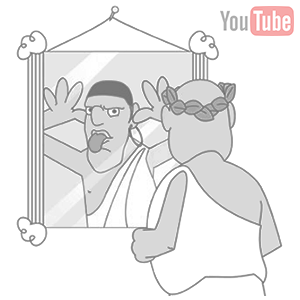
‘Pirates and Emperors, Old and New: International Terrorism in the Real World’ is a book by political theorist Noam Chomsky, titled after an observation by St. Augustine in ‘City of God,’ proposing that what governments coin as ‘terrorism’ in the small simply reflects what governments utilize as ‘warfare’ in the large. Yet, governments coerce their populations to denounce the former while embracing the latter.
In the ‘City of God,’ St. Augustine tells the story of a pirate captured by Alexander the Great, who asked him ‘how dare he molest the sea.’ ‘How dare you molest the whole world’ the pirate replied. ‘Because I do it with a little ship only, I am called a thief; you, doing it with a great navy, are called an emperor.’ The book inspired a humorous short web animation titled ‘Pirates & Emperors (or, Size Does Matter),’ illustrating Chomsky’s thesis.
Posted in Money, Politics, War |
Leave a Comment »
March 29, 2013
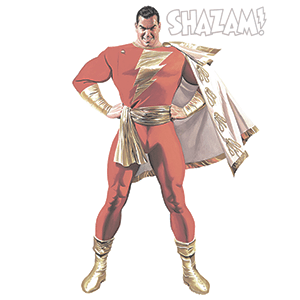
Captain Marvel, also known as ‘Shazam,’ is a fictional comic book superhero, originally published by Fawcett Comics and later by DC. Created in 1939 by artist C. C. Beck and writer Bill Parker, the character first appeared in 1940 in ‘Whiz Comics’ #2. With a premise that taps adolescent fantasy, Captain Marvel is the alter ego of Billy Batson, a youth who works as a radio news reporter and was chosen to be a champion of good by the wizard Shazam.
Whenever Billy speaks the wizard’s name, he is struck by a magic lightning bolt that transforms him into an adult superhero empowered with the abilities of six archetypal, historical figures. Several friends and family members, most notably Marvel Family cohorts Mary Marvel and Captain Marvel Jr., can share Billy’s power and become ‘Marvels’ themselves.
read more »
Posted in Art, Money |
1 Comment »
March 29, 2013
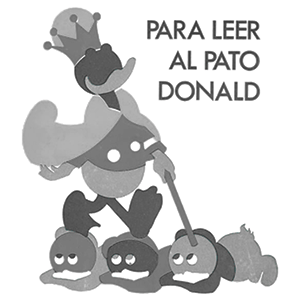
How to Read Donald Duck (‘Para leer al Pato Donald’) is a political analysis by Chilean activists Ariel Dorfman and Armand Mattelart, published in 1972. It is a pioneering work on cultural imperialism. Written in the form of essay (or, in the authors’ words, a ‘decolonization manual’), the book is an analysis of mass literature, specifically the Disney comics published for the Latin American market.
It is one of the first social studies of entertainment and the leisure industry from a political-ideological angle, and the book deals extensively with the political role of children’s literature. The book’s thesis is that Disney comics are not only a reflection of the prevailing ideology at the time (capitalism), but that they are also aware of this, and are active agents in spreading the ideology.
read more »
Posted in Money, Politics, World |
Leave a Comment »
March 28, 2013
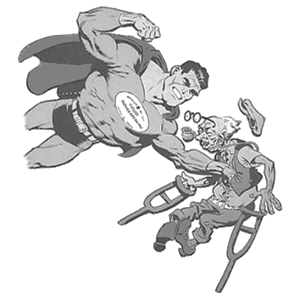
‘Superduperman‘ is a satirical story by cartoonists Harvey Kurtzman and Wally Wood that was published in the fourth issue of ‘Mad’ in 1953. Lampooning both Superman and Captain Marvel, it revolutionized the types of stories seen in ‘Mad,’ leading to greatly improved sales. Writers such as Alan Moore have cited this story as an influence.
The plot parallels the Superman scenario of the period: ‘Clark Bent’ is a lowly assistant to the copy boy at ‘The Daily Dirt’ newspaper, where he tries, unsuccessfully, to woo the narcissistic and indifferent ‘Lois Pain.’
read more »
Posted in Humor, Money |
1 Comment »
March 25, 2013

A tontine [ton-teen] is an investment plan for raising capital, devised in the 17th century and relatively widespread in the 18th and 19th. It combines features of a group annuity (recurring payments) and a lottery. Each subscriber pays an agreed sum into the fund, and thereafter receives an annuity. As members die, their shares devolve to the other participants, and so the value of each annuity increases. On the death of the last member, the scheme is wound up. In a variant, which has provided the plot device for most fictional versions, on the death of the penultimate member the capital passes to the last survivor.
The investment plan is named after Neapolitan banker Lorenzo de Tonti, who is credited with inventing it in France in 1653, although it has been suggested that he merely modified existing Italian investment schemes. Tonti put his proposal to the French royal government, but after consideration it was rejected by the Parlement de Paris. The first true tontine was therefore organized in the city of Kampen in the Netherlands in 1670. The French finally established a state tontine in 1689 (though it was not described by that name because Tonti had died in disgrace, about five years earlier).
read more »
Posted in Money, World |
Leave a Comment »
March 22, 2013
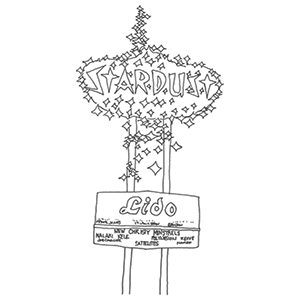
Robert Venturi (b. 1925) is an American architect, founding principal of the firm Venturi, Scott Brown and Associates, and one of the major architectural figures in the twentieth century. Together with his wife and partner, Denise Scott Brown, he helped to shape the way that architects, planners and students experience and think about architecture and the American built environment.
Their buildings, planning, theoretical writings and teaching have contributed to the expansion of discourse about architecture. He is also known for coining the maxim ‘Less is a bore’ a postmodern antidote to Mies van der Rohe’s famous modernist dictum ‘Less is more.’
read more »
Posted in Money, Technology |
Leave a Comment »
March 22, 2013
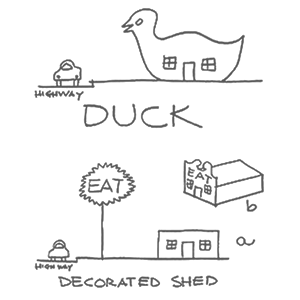
The Big Duck is a ferrocement (cement, sand, and steel mesh) building in the shape of a duck located in Flanders, New York, on Long Island. It was originally built in 1931 by duck farmer Martin Maurer in nearby Riverhead, and used as a shop to sell ducks and duck eggs.
The Big Duck is a prime example of literalism in advertising. The building measures 18 feet (5.5 m) wide, 30 feet (9.1 m) long and 20 feet (6.1 m) tall to the top of the head. The duck’s eyes are made from Ford Model T tail lights and the interior floor space is confined to 11 feet (3.4 m) by 15 feet (4.6 m).
read more »
Posted in Humor, Language, Money |
Leave a Comment »
March 22, 2013
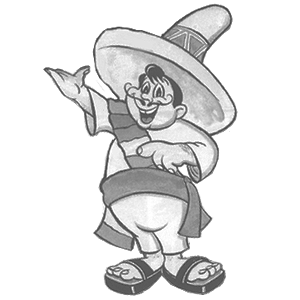
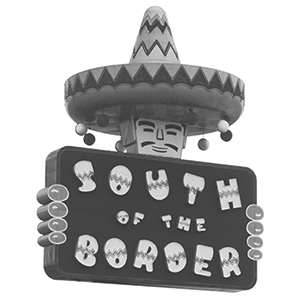
South of the Border is a roadside attraction on Interstate 95 south of the border between North and South Carolina, which serves as a rest stop for vacationers and tourists traveling to and from Florida. The rest area features not only restaurants, gas stations and a motel, but also a small amusement park, shopping (including, formerly, adult entertainment at the ‘Dirty Old Man Shop’), and, famously, fireworks. Its mascot is Pedro, an extravagantly stereotypical Mexican bandido.
It is known for being advertised by hundreds of billboards along surrounding highways, starting over 150 miles away. Federal Reserve Chairman Ben Bernanke, originally from nearby Dillon, South Carolina, worked for a summer as a poncho-wearing waiter at South of the Border to help pay his way through Harvard. South of the Border also hosted the bar/night club ‘Pedro’s’ from 1985-1998. This was a popular spot for revellers including many Lumbee Indians who visited the club from neighboring (and dry) Robeson County.
read more »
Posted in Humor, Money |
Leave a Comment »
March 21, 2013
Tourist trap is an establishment, or group of establishments, that has been created or re-purposed with the aim of attracting tourists and their money. Tourist traps will typically provide services, entertainment, souvenirs and other products for tourists to purchase.
While the term may have negative connotations for some, such establishments may be viewed by tourists as fun and interesting diversions. In some areas like Ishpeming, Michigan, Flush toilets may be a sufficient draw to entice tourists to stop as they are not readily available at many tourist facilities in Michigan’s Upper Peninsula. Wall Drug, in South Dakota, began its tourist trade simply by offering ice water.
Posted in Humor, Money |
Leave a Comment »
March 21, 2013

The treatment of animals in rodeo has been a source of concern for the industry, the public, and the law for decades. Protests were first raised in the 1870s, and, in the middle twentieth century, laws were enacted to curb events using animals. The American Humane Association (AHA) has worked with the rodeo industry (specifically, the PRCA, Professional Rodeo Cowboys Association) to establish rules improving animal treatment in rodeo and the treatment of rodeo animals. Today, animal cruelty complaints in rodeo are still very much alive, and continue to be a source of aggravation to the rodeo industry.
The PRCA (which governs about a third of the rodeos conducted in the United States annually) has provided rules for its members regarding animal welfare. Some locals have banned the use of certain rodeo tack (equipment worn by an animal) including flank straps (also called ‘bucking straps,’ irritants which encourage bucking) and certain events such as steer tripping (roping). Some charreada (amateur Mexican-American rodeo) events staged in the United States saw a crack down in the early years of the twenty-first century.
read more »
Posted in Games, Money, Politics |
1 Comment »
March 21, 2013

Consumerism is a social and economic order that encourages the purchase of goods and services in ever-greater amounts. The term is often associated with criticisms of consumption starting with American economist Thorstein Veblen. However, the term is also used to refer to the consumerists movement, consumer protection or consumer activism, which seeks to protect and inform consumers by requiring such practices as honest packaging and advertising, product guarantees, and improved safety standards.
In economics, consumerism refers to economic policies placing emphasis on consumption. In an abstract sense, it is the belief that the free choice of consumers should dictate the economic structure of a society. Consumerism has weak links with the Western world, but is in fact an international phenomenon. People purchasing goods and consuming materials in excess of their basic needs is as old as the first civilizations.
read more »
Posted in Money, Politics |
Leave a Comment »


 The Daily Omnivore