November 19, 2012
Long drive is a competitive sport where success is derived by hitting a golf ball the farthest by driving. A small but dedicated talent base of golfers populate the world of Long-Drive, with the top talent competing professionally in various events and exhibitions. Professional long drivers can average over 350 yards in competition, compared with 300 yard averages from the top PGA Tour drivers and 200 yards for an average amateur.
Some shots in competitions surpass 400 yards. The world record recognized by Guinness Records as the longest drive in a competition is 515 yards by 64 year old Mike Austin in 2002 at the US National Open Qualifier with a 43.5″ steel shafted persimmon wood driver. The current all-time record holder is Mike Dobbyn with 551 yards.
read more »
Posted in Games, Money |
Leave a Comment »
November 17, 2012

Feminist pornography is pornography produced by and with feminist women. It is a small but growing segment of the pornography industry. Since 2006, there has been a Feminist Porn Awards held annually in Toronto, sponsored by a local feminist sex toy shop, Good for Her.
They have three guiding criteria: A woman had a hand in the production, writing, direction, etc. of the work; It depicts genuine female pleasure; and It expands the boundaries of sexual representation on film and challenges stereotypes that are often found in mainstream porn.
read more »
Posted in Money, Politics, Sex |
Leave a Comment »
November 11, 2012


Appropriation [uh-proh-pree-ey-shuhn] in the arts is the use of pre-existing objects or images with little or no transformation applied to them. The use of appropriation has played a significant role in the history of the arts (literary, visual, and musical).
Appropriation can be understood as ‘the use of borrowed elements in the creation of a new work.’ In the visual arts, to appropriate means to properly adopt, borrow, recycle, or sample aspects (or the entire form) of man-made visual culture. Most notable in this respect are the ‘Readymades’ of Marcel Duchamp (are ordinary manufactured objects that the artist selected and modified, as an antidote to what he called ‘retinal art’).
read more »
Posted in Art, Money, Politics |
Leave a Comment »
November 10, 2012
Scène à faire (French for ‘scene to be made’ or ‘scene that must be done’) is a scene in a book or film which is almost obligatory for a genre of its type. In the U.S. it also refers to a principle in copyright law in which certain elements of a creative work are held to be not protected when they are mandated by or customary to the genre.
For example, a spy novel is expected to contain elements such as numbered Swiss bank accounts, a femme fatale, and various spy gadgets hidden in wristwatches, belts, shoes, and other personal effects. These elements are not protected by copyright, though specific sequences and compositions of them can be.
read more »
Posted in Art, Money, Politics |
Leave a Comment »
November 10, 2012

Fair use is a limitation and exception to the exclusive right granted by copyright law to the author of a creative work. Examples of fair use include commentary, search engines, criticism, news reporting, research, teaching, library archiving, and scholarship.
It provides for the legal, unlicensed citation or incorporation of copyrighted material in another author’s work under a four-factor balancing test (Purpose and character; Nature of the copied work; Amount and substantiality; and Effect upon work’s value). Along with Public Domain, Fair use is one of the ‘Traditional Safety Valves’ (techniques that balance the public’s interest in open access with the property interest of copyright owners)
read more »
Posted in Money, Politics, Technology |
Leave a Comment »
November 9, 2012
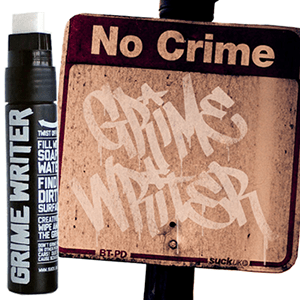
Reverse graffiti, also known as clean tagging or grime writing, is often done by removing dirt/dust with the fingertip(s) from windows or other dirty surfaces, such as writing ‘wash me’ on a dirty vehicle. Others, such as English artist Paul Curtis (aka Moose), use a cloth or a high power washer to remove dirt on a larger scale.
The first large scale reverse graffiti art piece was made by Alexandre Orion in 2006, the intervention ‘Ossario’ with over 1000 foot is washed by the municipality of São Paulo in the end of the video.
read more »
Posted in Art, Money, Politics |
Leave a Comment »
November 8, 2012
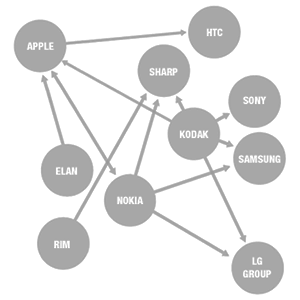
A patent thicket is ‘a dense web of overlapping intellectual property rights that a company must hack its way through in order to actually commercialize new technology,’ or, in other words, ‘an overlapping set of patent rights’ which require innovators to reach licensing deals for multiple patents from multiple sources.’ The expression may come from the ‘SCM Corp. v. Xerox Corp’ patent litigation case in the 1970s, wherein SCM’s central charge had been that Xerox constructed a ‘patent thicket’ to prevent competition. Patent thickets are used to defend against competitors designing around a single patent.
It has been suggested by some that this is particularly true in fields such as software or pharmaceuticals, but Sir Robin Jacob has pointed out that ‘every patentee of a major invention is likely to come up with improvements and alleged improvements to his invention’ and that ‘it is in the nature of the patent system itself that [patent thickets] should happen and it has always happened.’ Patent thickets are also sometimes called ‘patent floods,’ or ‘patent clusters.’
Posted in Money, Politics, Technology |
Leave a Comment »
November 8, 2012
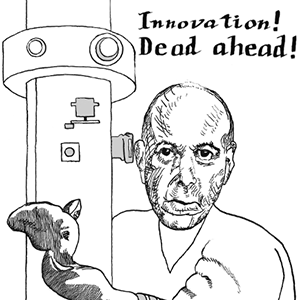
A submarine patent is a patent whose issuance and publication are intentionally delayed by the applicant for a long time, such as several years. This strategy requires a patent system where, first, patent applications are not published, and, second, patent term is measured from grant date, not from priority/filing date. In the United States, patent applications filed before November 2000 were not published and remained secret until they were granted. Analogous to a submarine, therefore, submarine patents could stay ‘under water’ for long periods until they ’emerged’ and surprised the relevant market. Persons or companies making use of submarine patents are sometimes referred to as patent pirates.
Submarine patent practice was possible previously under the United States patent law, but is no longer practical since the U.S. signed the TRIPS agreement of the WTO: since 1995, patent terms (20 years in the U.S.) are measured from the original filing or priority date, and not the date of issuance. A few potential submarine patents may result from pre-1995 filings that have yet to be granted and may remain unpublished until issuance. Submarine patents are considered by some, including the US Federal Courts, as a procedural laches (a delay in enforcing one’s rights, which may cause the rights to be lost).
Posted in Money, Politics, Technology |
Leave a Comment »
November 8, 2012

The Anti Security Movement (also written as antisec and anti-sec) is a movement opposed to the computer security industry. Antisec is against full disclosure of information relating to but not limited to: software vulnerabilities, exploits, exploitation techniques, hacking tools, attacking public outlets, and distribution points of that information. The general thought behind this is that the computer security industry uses full disclosure to profit and develop scare-tactics to convince people into buying their firewalls, anti-virus software, and auditing services. As recently as 2009, attacks against security communities such as ‘Astalavista’ and ‘milw0rm,’ as well as the popular image-host ‘ImageShack,’ have given the movement worldwide media attention.
The ‘anti-security movement” as it is understood today was coined a document which was initially an index on the anti.security.is website: ‘The purpose of this movement is to encourage a new policy of anti-disclosure among the computer and network security communities. The goal is not to ultimately discourage the publication of all security-related news and developments, but rather, to stop the disclosure of all unknown or non-public exploits and vulnerabilities. In essence, this would put a stop to the publication of all private materials that could allow script kiddies from compromising systems via unknown methods.’
Posted in Money, Politics, Technology |
Leave a Comment »
November 8, 2012


A grey hat in the hacking community refers to a skilled hacker whose activities fall somewhere between white hat (lawful) and black hat (unlawful) hackers on a variety of spectra.
They usually do not hack for personal gain or have malicious intentions, but may be prepared to technically commit crimes during the course of their technological exploits in order to achieve better security. Whereas white hat hackers will tend to advise companies of security exploits quietly, grey hat hackers are prone to ‘advise the hacker community as well as the vendors and then watch the fallout.’
read more »
Posted in Money, Politics, Technology |
Leave a Comment »
November 6, 2012

‘Poison pill’ is sometimes used more broadly to describe other types of takeover defenses that involve the target taking some action.
Although the broad category of takeover defenses (more commonly known as ‘shark repellents‘) includes the traditional shareholder rights plan poison pill. Other anti-takeover protections include: Limitations on the ability to call special meetings or take action by written consent; Supermajority vote requirements to approve mergers; and Supermajority vote requirements to remove directors.
read more »
Posted in Money, Politics |
Leave a Comment »
November 5, 2012
A shareholder rights plan, colloquially known as a ‘poison pill,’ is a type of defensive tactic used by a corporation’s board of directors against a takeover. There are a number of such tactics, referred to as ‘shark repellents’ generally. In the field of mergers and acquisitions, shareholder rights plans were devised in the early 1980s as a way for directors to prevent takeover bidders from negotiating a price for sale of shares directly with shareholders, and instead forcing the bidder to negotiate with the board.
Shareholder rights plans are unlawful without shareholder approval in many jurisdictions such as the United Kingdom, frowned upon in others such as throughout the European Union, and lawful if used ‘proportionately’ in others, including Delaware in the United States. They are controversial because they hinder an active market for corporate control. Further, giving directors the power to deter takeovers puts directors in a position to enrich themselves, as they may effectively ask to be compensated for the price of consenting to a takeover.
read more »
Posted in Games, Money, Politics |
Leave a Comment »


 The Daily Omnivore