December 12, 2012
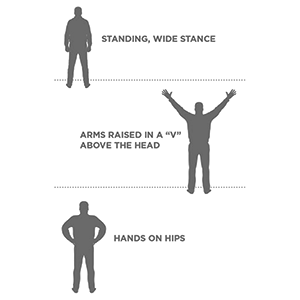
Amy Cuddy is an American social psychologist known for her studies of the relations between stereotyping and behavior. She is Associate Professor in the Negotiation, Organizations & Markets Unit at Harvard Business School. Cuddy studies the origins and outcomes of how people judge and influence each other.
She has conducted experimental and correlational research on stereotyping and discrimination against various groups (e.g., Asian Americans, elderly people, Latinos, working mothers), the causes and consequences of feeling ambivalent emotions (e.g., envy and pity), nonverbal behavior and communication, and hormonal responses to social stimuli. She is a sought-after speaker on the psychology of power, influence, nonverbal communication, and prejudice.
read more »
Posted in Education, Money, Science |
Leave a Comment »
December 11, 2012
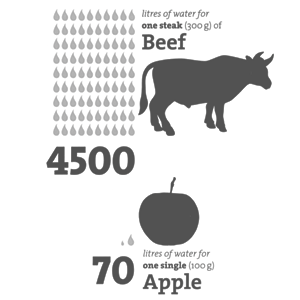
Virtual water (also known as embedded or embodied water) refers to the hidden flow of water if food or other commodities are traded from one place to another. For instance, it takes 1,600 cubic meters of water on average to produce one metric ton of wheat.
The precise volume can be more or less depending on climatic conditions and agricultural practice. Hoekstra and Chapagain have defined the virtual-water content of a product (a commodity, good or service) as ‘the volume of freshwater used to produce the product, measured at the place where the product was actually produced.’
read more »
Posted in Food, Money, Politics |
Leave a Comment »
December 11, 2012
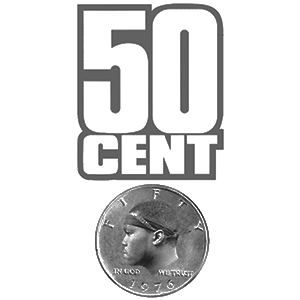
‘How to Rob‘ is a 1999 song by American hip hop recording artist 50 Cent. The song serves as his debut single and the lead single from his album ‘Power of the Dollar’ (officially unreleased but heavily bootlegged).
The album, which was originally set for a 2000 release, was supposed to be his debut with Columbia Records, but was cancelled after 50 Cent was dropped from the label when Columbia discovered that he had been shot. ‘How to Rob’ was produced by Tone & Poke of Trackmasters and features D-Dot, also known as The Madd Rapper. The song was also included on the soundtrack to the 1999 film ‘In Too Deep,’ staring LL Cool J and Omar Epps.
read more »
Posted in Art, Humor, Money |
Leave a Comment »
December 11, 2012

Jane Elliott (b. 1933) is an American anti-racism activist and educator (she is also a feminist and LGBT activist).
She created the famous ‘blue-eyed/brown-eyed’ exercise, first done with grade school children in the 1960s, and which later became the basis for her career in diversity training.
read more »
Posted in Education, Money, Politics |
Leave a Comment »
December 10, 2012
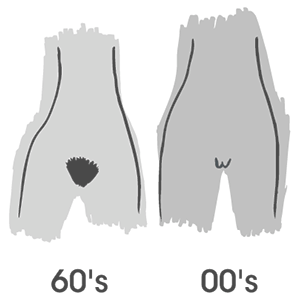
Pubic Wars, a pun on the Punic Wars, is the name given to the rivalry between the pornographic magazines Playboy and Penthouse during the 1960s and 1970s. Each magazine strove to show just a little bit more than the other, without getting too crude. The term was coined by ‘Playboy’ owner Hugh Hefner. In 1950s and 60s America it was generally agreed that nude photographs were not pornographic unless they showed pubic hair or, even worse, genitals.
‘Respectable’ photography was careful to come close to, but not cross over, this line. Consequently the depiction of pubic hair was de facto forbidden in U.S. pornographic magazines. ‘Penthouse’ originated in 1965 in Britain and was initially distributed in Europe. In 1969 it was launched in the U.S., bringing new competition to ‘Playboy.’ Due to more liberal European attitudes to nudity ‘Penthouse’ was already displaying pubic hair at the time of its U.S. launch. According to the magazine’s owner Bob Guccione, ‘We began to show pubic hair, which was a big breakthrough.’
read more »
Posted in Money, Politics, Sex |
1 Comment »
December 6, 2012

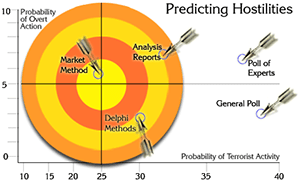
The Policy Analysis Market (PAM), part of the FutureMAP project, was a proposed futures exchange developed by the United States’ Defense Advanced Research Projects Agency (DARPA) and based on an idea first proposed by Net Exchange, a San Diego research firm specializing in the development of online prediction markets. PAM was to be ‘a market in the future of the Middle East,’ and would have allowed trading of futures contracts based on possible political developments in several Middle Eastern countries.
The theory behind such a market is that the monetary value of a futures contract on an event reflects the probability that that event will actually occur, since a market’s actors rationally bid a contract either up or down based on reliable information. One of the models for PAM was a political futures market run by the University of Iowa, which had predicted U.S. election outcomes more accurately than either opinion polls or political pundits. PAM was also inspired by the work of George Mason University economist Robin Hanson.
read more »
Posted in Death, Money, War |
1 Comment »
December 4, 2012
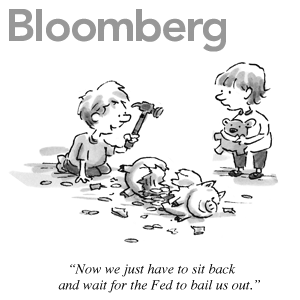
In economic theory, a moral hazard is a situation where the costs that could incur from a decision will not be felt by the party taking the risk. Knowing that the potential costs and/or burdens of taking such risk will be borne, in whole or in part, by others creates a moral hazard and invites high risk behavior.
For example, with respect to the originators of subprime loans, many may have suspected that the borrowers would not be able to maintain payments and that, for this reason, the loans were not, in the long run, going to be worth much. Still, because there were many buyers of these loans (or of pools of these loans) willing to take on that risk, the originators did not concern themselves with the potential long-term consequences of making these loans.
read more »
Posted in Money, Politics, World |
Leave a Comment »
December 4, 2012
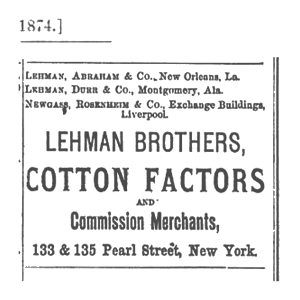
‘Too big to fail‘ describes financial institutions that are so large and so interconnected that their failure is widely held to be disastrous to the economy, and which therefore must be supported by government when they face difficulty. The term was popularized by Congressman Stewart McKinney in a 1984 hearing discussing the FDIC’s intervention with a failing bank, Continental Illinois.
Proponents of this theory believe that the importance of some institutions means they should become recipients of beneficial financial and economic policies from governments or central banks. One of the problems that arises is moral hazard (where costs that could incur will not be felt by the party taking the risk), in this case companies insulated by protective policies will seek to profit by it, and take positions that are high-risk high-return, as they are able to leverage these risks based on the policy preference they receive.
read more »
Posted in Money, Politics |
Leave a Comment »
December 4, 2012
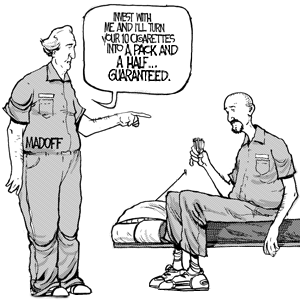
Commodity money is money whose value comes from a commodity of which it is made (e.g. precious metals, cigarettes). Unlike representative money (a certificate or token which can be exchanged for the underlying commodity) or fiat currency (money backed only by an assurance from the issuing government), commodity money consists of objects that have value in themselves as well as value in their use as money.
Examples of commodities that have been used as mediums of exchange include gold, silver, copper, peppercorns, Rai stones (large, circular stone disks carved out of limestone), decorated belts (wampum belts), shells, cigarettes, barley, laundry detergent, etc.
read more »
Posted in Money, Politics |
Leave a Comment »
November 30, 2012
David Rees (b. 1972) is a cartoonist and humorist whose best-known work combines bland clip art with outrageous ‘trash talk’ to incongruous effect. The comic strips have achieved wide popularity and some controversy.
Rees grew up in Chapel Hill, North Carolina and was an avid reader of ‘Rex Morgan, M.D.’ comics. He is a graduate of Oberlin College, and drew comics for the school’s newspaper. His office-cubicle humor is partly inspired by his experience working in a basement for Citicorp; he was later a part time fact-checker for ‘Maxim’ magazine and ‘Martha Stewart Weddings’ magazine, until he was laid off. Rees’s best-known and most controversial comic is ‘Get Your War On.’
read more »
Posted in Humor, Language, Money |
Leave a Comment »
November 30, 2012

The South Butt, LLC was a clothing and accessories company founded in 2007 by Jimmy Winkelmann, a then 16-year-old student at Chaminade College Preparatory School. The company dissolved in 2011.
Winkelmann claimed the company was a parody of the The North Face, an American outdoor product company.
read more »
Posted in Humor, Money, Politics |
Leave a Comment »
November 29, 2012
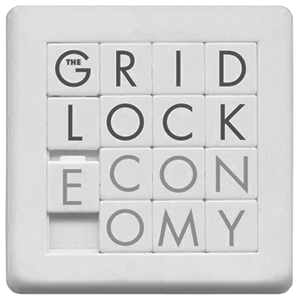
The tragedy of the anticommons is a type of coordination breakdown, in which a single resource has numerous rightsholders who prevent others from using it, frustrating what would be a socially desirable outcome. It is a mirror-image of the older concept of tragedy of the commons, in which numerous rightsholders’ combined use exceeds the capacity of a resource and depletes or destroys it.
The concept covers a range of coordination failures including patent thickets, submarine patents, and nail houses. Overcoming these breakdowns can be difficult, but there are assorted means, including eminent domain, laches, patent pools, or other licensing organizations.
read more »
Posted in Money, Politics, Technology |
Leave a Comment »



