October 17, 2012
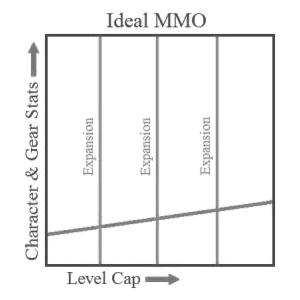
Mudflation, from MUD (multi-user dungeon) and inflation, is an economic issue that exists only in massively multiplayer online games. Mudflation occurs when future additions to (or even just continued operation of) a game causes previously acquired resources to decline in value. This can take many forms and have many causes, including new items introduced by an expansion pack, fundamental imbalances in the in-game economy, or even spread of information that allows a previously rare resource to be acquired more easily.
The term mudflation became popular during the height of the MMORPG EverQuest’s dominance, coming into common usage after the release of the ‘Ruins of Kunark’ (2000) expansion. The term originated many years prior with MUDs, the text based forerunner of MMORPGs, that also suffered from the same currency supply problems.
read more »
Posted in Games, Money, Technology |
1 Comment »
October 17, 2012
Gold farming is playing a massively multiplayer online game to acquire in-game currency that other players purchase in exchange for real-world money. People in China and in other developing nations have held full-time employment as gold farmers.
While most game operators expressly ban the practice of selling in-game currency for real-world cash, gold farming is lucrative because it takes advantage of economic inequality and the fact that much time is needed to earn in-game currency. Rich, developed country players, wishing to save many hours of playing time, may be willing to pay substantial sums to the developing country gold farmers. In 2009 the global market for gold farming was valued at around $3 billion annually.
read more »
Posted in Games, Money, Politics |
Leave a Comment »
October 17, 2012
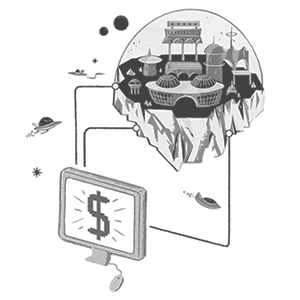
A virtual economy (or sometimes synthetic economy) is an emergent economy existing in a virtual persistent world, usually exchanging virtual goods in the context of an Internet game. People enter these virtual economies for recreation rather than necessity, which means that virtual economies lack the aspects of a real economy that are not considered to be ‘fun’ (for instance, players in a virtual economy often do not need to buy food in order to survive, and usually do not have any biological needs at all). However, some people do interact with virtual economies for ‘real’ economic benefit.
Virtual economies arise in numerous platforms. Multi-User Dungeons (MUDs) are text-based games that predate the World Wide Web. The largest virtual economies are in massively multi-player online role-playing games (MMORPGs). Virtual economies also exist in life simulation games which may have taken the most radical steps toward linking a virtual economy with the real world. For example, in ‘Second Life’ there is recognition of intellectual property rights for assets created ‘in-world’ by subscribers, and a laissez-faire policy on the buying and selling of ‘Linden Dollars’ (the world’s official currency) for real money on third party websites.
read more »
Posted in Games, Money, Technology |
Leave a Comment »
October 17, 2012

Virtual goods are non-physical objects purchased for use in online communities or online games. ‘Digital goods,’ on the other hand, may be a broader category including digital books, music, and movies.
Virtual goods have no intrinsic value and are intangible by definition. Including digital gifts and digital clothing for avatars, virtual goods may be classified as services instead of goods and are usually sold by companies that operate social networks, community sites, or online games. Sales of virtual goods are sometimes referred to as microtransactions, and the games that utilize this model are usually referred to as ‘freemium’ (free + premium) games.
read more »
Posted in Games, Money, Technology |
Leave a Comment »
October 16, 2012


Anti-nationalism denotes the sentiments associated with the opposition to nationalism, arguing that it is undesirable or dangerous. Some anti-nationalists are humanitarians or humanists who pursue an idealist form of world community, and self-identify as world citizens.
They reject chauvinism, jingoism, and militarism, and want humans to live in peace rather than perpetual conflict. They do not necessarily oppose the concepts of countries, nation states, national boundaries, cultural preservation or identity politics.
read more »
Posted in Money, Politics, World |
Leave a Comment »
October 14, 2012

The Kill A Watt is an electricity usage monitor marketed by P3 International. It features a large LCD display and it enables cost forecasting.
It measures the energy used by individual appliances plugged into the meter, as opposed to in-home energy use displays, which display the energy used by an entire household. The name is a play on the word kilowatt. The device can give an indication of the standby power used by appliances.
Posted in Money, Technology |
Leave a Comment »
October 12, 2012

Perfecto is a brand of ‘lancer fronted’ leather motorcycle jackets designed by Irving Schott and manufactured by American clothing company Schott NYC. The company was founded in 1913, and was the first company to put a zipper on a jacket. In 1928 Irving Schott designed and produced the first ever leather motorcycle jacket, he named it the ‘Perfecto’ after his favorite cigar.
The jackets were made out of horsehide, had a belted front, D-pocket, flap change pocket, zippered sleeve cuffs and shoulder epaulets This classic motorcycle jacket was a double riders jacket design which meant that one part of the front zipper was located a couple of inches in. When zipped up this created a seal where no air would pass through when riding a motorcycle.
read more »
Posted in Money |
Leave a Comment »
October 11, 2012
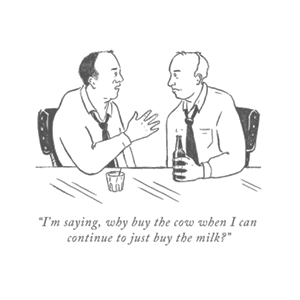
Sexual economy refers to the resources men offer to women in order to acquire sex. In this sense the heterosexual community is considered as a marketplace where sex is bought and sold. The marketplace is defined by gender roles, and in the sex economy men are the buyers, and women are the sellers.
Couples and their sexual activities are loosely interrelated by a marketplace; the decisions made regarding sex by each couple may be influenced by conditions in the market. As with all economic principles, price is determined by supply and demand, product variety, complicity among sellers, competition between sellers, as well as other factors. The price of sex is not limited to money, it has a wide conception of resources including, respect, love, time, gifts, affection, or commitment.
read more »
Posted in Love, Money, Sex |
1 Comment »
October 11, 2012

In Marxist theory, human society consists of two parts: the base and superstructure; the base comprehends the forces and relations of production — employer-employee work conditions, the technical division of labor and property relations — into which people enter to produce the necessities and amenities of life.
These relations determine society’s other relationships and ideas, which are described as its superstructure: its culture, institutions, political power structures, roles, rituals, and state. The base determines (conditions) the superstructure, yet their relation is not strictly causal, because the superstructure often influences the base; the influence of the base, however, predominates. In Orthodox Marxism, the base determines the superstructure in a one-way relationship. However, in more advanced forms and variations of Marxist thought their relationship is not strictly one-way, as some theories claim that just as the base influences the superstructure, the superstructure also influences the base.
read more »
Posted in Money, Politics |
Leave a Comment »
October 10, 2012

Rockism is a term referring to perceived biases in popular music criticism, coined by UK singer songwriter Pete Wylie in the early 1980s. The fundamental tenet of rockism is that some forms of popular music, and some musical artists, are more authentic than others. While there are many vague interpretations of it, rockism is essentially believed to treat rock music as normative.
From a rockist view, rock is the standard state of popular music. Interestingly, it is not entirely rockist to love rock, or to write about it. One may also care about R&B or norteño or bubblegum pop, but discuss them in a rockist way. The idea is built into the way people talk informally about what kinds of popular music interest them. Rockism is often suspicious of the use of computer-based production systems.
read more »
Posted in Art, Language, Money |
1 Comment »
October 10, 2012

The Adventures of Tintin: Breaking Free is an anarchist parody of the popular Tintin series of comics. An exercise in detournement (turning expressions of the capitalist system and its media culture against itself), the book was written under the pseudonym J. Daniels and published by Attack International in 1988. It has recently been re-printed by anarchist publishers Freedom Press which includes for the first time Tintin’s earlier adventures during the Wapping dispute as told in ‘The Scum,’ a 1986 pamphlet which was produced in solidarity with the printworkers.
The story features a number of characters based on those from the original series by Hergé, notably Tintin himself and Captain Haddock (referred to only as ‘the Captain’ and depicted here as being Tintin’s uncle), but not the original themes or plot. Snowy is featured on the cover – being especially visible on the first edition’s cover – but not in the narrative. The story tracks Tintin’s development from a disaffected, shoplifting youth to a revolutionary leader.
read more »
Posted in Humor, Money, Politics |
Leave a Comment »
October 10, 2012
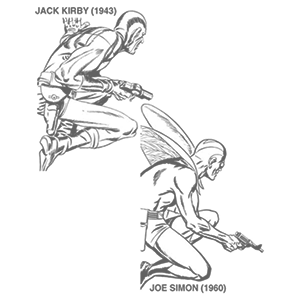
Swipe is a comics term that refers to the intentional copying of a cover, panel, or page from an earlier comic book or graphic novel without crediting the original artist.
Artists Jack Kirby, Neal Adams, Hergé, and Jim Lee are common targets of swipes (though even ‘The King’ is not above reproach: Kirby was known to have swiped from Hal Foster early in his career, as were many Golden Age artists — many of whom kept ‘swipe files’ of material to be copied as needed).
read more »
Posted in Art, Language, Money |
Leave a Comment »


 The Daily Omnivore