October 10, 2012

In music, sampling is the act of taking a portion, or sample, of one sound recording and reusing it as an instrument or a sound recording in a different song or piece. Sampling was originally developed by experimental musicians working with musique concrète and electroacoustic music, who physically manipulated tape loops or vinyl records on a phonograph.
In the late 1960s, the use of tape loop sampling influenced the development of minimalist music and the production of psychedelic rock and jazz fusion. In the 1970s, DJs manipulating vinyl on turntables gave birth to hip hop music, the first popular music genre based originally around the art of sampling.
read more »
Posted in Money, Politics, Technology |
Leave a Comment »
October 9, 2012
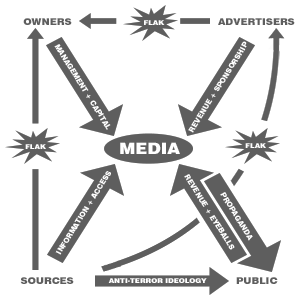
The propaganda model is a conceptual model in political economy advanced by Edward S. Herman and Noam Chomsky that states how propaganda, including systemic biases, function in mass media. The model seeks to explain how populations are manipulated and how consent for economic, social and political policies is ‘manufactured’ in the public mind due to this propaganda. The theory posits that the way in which news is structured (through advertising, media ownership, government sourcing and others) creates an inherent conflict of interest which acts as propaganda for undemocratic forces.
First presented in their 1988 book ‘Manufacturing Consent: The Political Economy of the Mass Media,’ the ‘propaganda model’ views the private media as businesses interested in the sale of a product—readers and audiences—to other businesses (advertisers) rather than that of quality news to the public. Describing the media’s ‘societal purpose,’ Chomsky writes, ‘… the study of institutions and how they function must be scrupulously ignored, apart from fringe elements or a relatively obscure scholarly literature.’
read more »
Posted in Language, Money, Politics |
3 Comments »
October 9, 2012
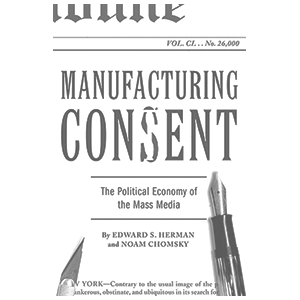
‘Manufacturing Consent: The Political Economy of the Mass Media’ (1988), by Edward S. Herman and Noam Chomsky, is an analysis of the news media, arguing that the mass media of the United States ‘are effective and powerful ideological institutions that carry out a system-supportive propaganda function by reliance on market forces, internalized assumptions, and self-censorship, and without overt coercion.’
The title derives from the phrase ‘the manufacture of consent’ that essayist–editor Walter Lippmann employed in the book ‘Public Opinion’ (1922). Chomsky has said that Australian social psychologist Alex Carey, to whom the book was dedicated, was in large part the impetus of his and Herman’s work. The book introduced the propaganda model of the media. A film, ‘Manufacturing Consent: Noam Chomsky and the Media,’ was later released based on the book.
read more »
Posted in Language, Money, Politics |
1 Comment »
October 9, 2012
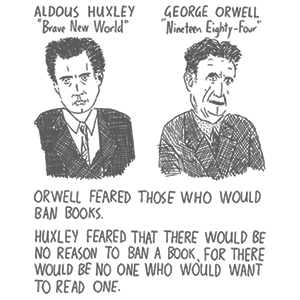
‘Amusing Ourselves to Death: Public Discourse in the Age of Show Business’ (1985) is a book by educator Neil Postman. The book’s origins lie in a talk Postman gave to the Frankfurt Book Fair in 1984. He was participating in a panel on Orwell’s ‘1984’ and the contemporary world. In the introduction to his book Postman said that the contemporary world was better reflected by Aldous Huxley’s ‘Brave New World,’ whose public was oppressed by their addiction to amusement, than by Orwell’s ‘Nineteen Eighty-Four,’ where they were oppressed by state control. It is regarded as one of the most important texts of media ecology (the study of how communication processes affect human perception).
Postman distinguishes the Orwellian vision of the future, in which totalitarian governments seize individual rights, from that offered by Aldous Huxley in ‘Brave New World,’ where people medicate themselves into bliss, thereby voluntarily sacrificing their rights. Drawing an analogy with the latter scenario, Postman sees television’s entertainment value as a present-day ‘soma,’ by means of which the consumers’ rights are exchanged for entertainment. (Note that there is no contradiction between an intentional ‘Orwellian’ conspiracy using ‘Huxleyan’ means)
read more »
Posted in Language, Money |
Leave a Comment »
October 9, 2012

Edupunk is an approach to teaching and learning practices that result from a do it yourself (DIY) attitude. ‘The New York Times’ called it ‘an approach to teaching that avoids mainstream tools like PowerPoint and Blackboard, and instead aims to bring the rebellious attitude and D.I.Y. ethos of ’70s bands like The Clash to the classroom.’
The term was first used in 2008 by Jim Groom in his blog, and covered less than a week later in the ‘Chronicle of Higher Education.’ Edupunk arose in objection to the efforts of government and corporate interests in reframing and bundling emerging technologies into cookie-cutter products with pre-defined application—somewhat similar to traditional punk ideologies.
Posted in Education, Money, Politics |
Leave a Comment »
October 8, 2012

The free culture movement is a social movement that promotes the freedom to distribute and modify creative works in the form of free content by using the Internet and other forms of media. The movement objects to overly-restrictive copyright laws. Many members of the movement argue that such laws hinder creativity. They call this system ‘permission culture.’ ‘Creative Commons’ is a well-known website which was started by legal activist Lawrence Lessig. It lists licenses that permit sharing under various conditions, and also offers an online search of various creative-commons-licensed productions.
The free culture movement, with its ethos of free exchange of ideas, is of a whole with the free software movement. Richard Stallman, the founder of the GNU project (a free UNIX competitor, and free software activist, advocates free sharing of information. He famously stated that free software means free as in ‘free speech,’ not ‘free beer.’ Today, the term stands for many other movements, including hacker computing, the access to knowledge movement, and the copyleft movement. The term ‘free culture’ was originally the title of a 2004 book by Lawrence Lessig, a founding father of the free culture movement.
read more »
Posted in Money, Politics, Technology |
2 Comments »
October 8, 2012

Information wants to be free is a slogan of technology activists invoked against limiting access to information. According to criticism of intellectual property rights, the system of governmental control of exclusivity is in conflict with the development of a public domain of information. The iconic phrase is attributed to American writer Stewart Brand who, in the late 1960s, founded the ‘Whole Earth Catalog’ and argued that technology could be liberating rather than oppressing.
The earliest recorded occurrence of the expression was at the first ‘Hackers’ Conference’ in 1984. Brand told Steve Wozniak: ‘On the one hand information wants to be expensive, because it’s so valuable. The right information in the right place just changes your life. On the other hand, information wants to be free, because the cost of getting it out is getting lower and lower all the time. So you have these two fighting against each other.’
read more »
Posted in Money, Politics, Technology |
Leave a Comment »
October 8, 2012
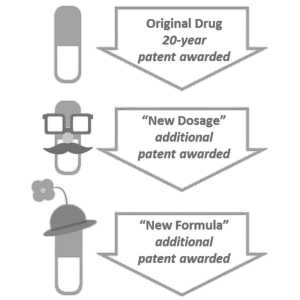
Evergreening refers to a variety of legal and business strategies by which technology producers with patents over products that are about to expire retain rent from them by either taking out new patents or by buying out or frustrating competitors, for longer periods of time than would normally be permissible under the law.
Evergreening is not a formal concept of patent law; it is best understood as a social idea used to refer to the myriad ways in which pharmaceutical patent owners use the law and related regulatory processes to extend their high rent-earning intellectual property rights, otherwise known as intellectual monopoly privileges, particularly over highly profitable ‘blockbuster’ drugs.
read more »
Posted in Drugs, Money, Politics |
Leave a Comment »
October 8, 2012
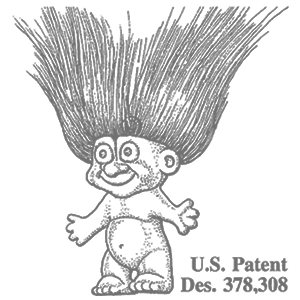
Patent troll is a pejorative term used for a person or company who enforces patents against one or more alleged infringers in a manner considered aggressive or opportunistic with no intention to manufacture or market the patented invention.
The Patent Troll was originally depicted in ‘The Patents Video,’ which was released in 1994 and sold to corporations, universities, and governmental entities. The metaphor was popularized in 2001 by Peter Detkin, former assistant general counsel of Intel, who chose the term from among a number of suggestions during a discussion with Anne Gundelfinger, Vice President and Associate General Counsel at Intel.
read more »
Posted in Money, Politics, Technology |
Leave a Comment »
October 8, 2012
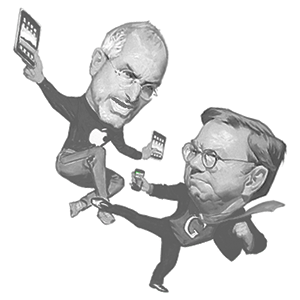
A patent war is a ‘battle’ between corporations or individuals to secure patents for litigation, whether offensively or defensively. There are ongoing patent wars between the world’s largest technology and software corporations. Patent wars are not a new phenomenon. The Wright brothers, attributed with the invention of the airplane, sought to prevent competitors from manufacturing airplanes through litigation, stifling the development of the American airline industry. Alexander Graham Bell, credited with inventing the telephone, was dragged into a patent war against his rivals, which involved, in just 11 years, 600 lawsuits.
One notable case was Bell’s lawsuit against Western Union, a telegraph company backed by Elisha Gray (also credited with inventing the telephone). In the digital age, the rapid pace of innovation makes much of the patent system obsolete. In the 1980s, technology corporations in the United States and Japan engaged in a patent war, creating a scenario where companies were forced to ‘fight patent with patent.’ This bilateral patent war, partly exaggerated by the media, subsided by the mid 1990s.
read more »
Posted in Money, Politics, Technology |
3 Comments »
October 7, 2012
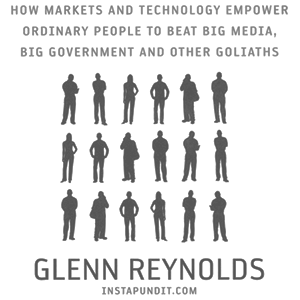
‘An Army of Davids: How Markets and Technology Empower Ordinary People to Beat Big Media, Big Government, and Other Goliaths’ is a2006 book by Glenn Reynolds, a law professor at the University of Tennessee also known as the blogger ‘Instapundit’.
The book looks at modern American society through the lens of individuals versus social institutions, and Reynolds concludes that technological change has allowed more freedom of action for people in contrast to the ‘big’ establishment organizations that used to function as gatekeepers. Thus, he argues that the balance of power between individuals and institutions is ‘flatting out,’ which involves numerous decentralized networks rising up. Reynolds divides the book into two distinct sections. The first focuses on trends currently taking place. The latter describes upcoming trends.
read more »
Posted in Money, Politics, Technology |
Leave a Comment »
October 5, 2012
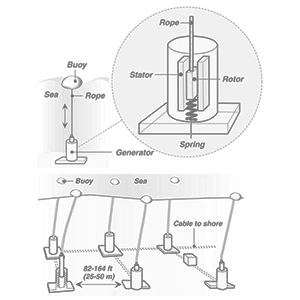
Wave power is the transport of energy by ocean surface waves, and the capture of that energy to do useful work – for example, electricity generation, water desalination, or the pumping of water (into reservoirs). Machinery able to exploit wave power is generally known as a wave energy converter (WEC). Wave power is distinct from tidal power and the steady gyre of ocean currents.
In 2008, the first experimental wave farm was opened in Portugal, at the Aguçadoura Wave Park. Waves are generated by wind passing over the surface of the sea. As long as the waves propagate slower than the wind speed just above the waves, there is an energy transfer from the wind to the waves. Both air pressure differences between the upwind and the lee side (the side sheltered from the wind) of a wave crest, as well as friction on the water surface by the wind, making the water to go into the shear stress causes the growth of the waves.
read more »
Posted in Money, Technology |
Leave a Comment »


 The Daily Omnivore
