October 8, 2012

Information wants to be free is a slogan of technology activists invoked against limiting access to information. According to criticism of intellectual property rights, the system of governmental control of exclusivity is in conflict with the development of a public domain of information. The iconic phrase is attributed to American writer Stewart Brand who, in the late 1960s, founded the ‘Whole Earth Catalog’ and argued that technology could be liberating rather than oppressing.
The earliest recorded occurrence of the expression was at the first ‘Hackers’ Conference’ in 1984. Brand told Steve Wozniak: ‘On the one hand information wants to be expensive, because it’s so valuable. The right information in the right place just changes your life. On the other hand, information wants to be free, because the cost of getting it out is getting lower and lower all the time. So you have these two fighting against each other.’
read more »
Posted in Money, Politics, Technology |
Leave a Comment »
October 8, 2012
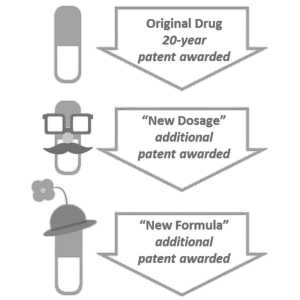
Evergreening refers to a variety of legal and business strategies by which technology producers with patents over products that are about to expire retain rent from them by either taking out new patents or by buying out or frustrating competitors, for longer periods of time than would normally be permissible under the law.
Evergreening is not a formal concept of patent law; it is best understood as a social idea used to refer to the myriad ways in which pharmaceutical patent owners use the law and related regulatory processes to extend their high rent-earning intellectual property rights, otherwise known as intellectual monopoly privileges, particularly over highly profitable ‘blockbuster’ drugs.
read more »
Posted in Drugs, Money, Politics |
Leave a Comment »
October 8, 2012
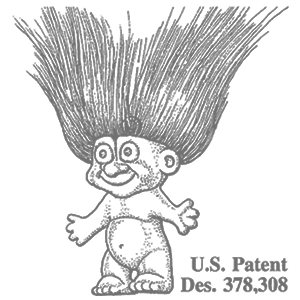
Patent troll is a pejorative term used for a person or company who enforces patents against one or more alleged infringers in a manner considered aggressive or opportunistic with no intention to manufacture or market the patented invention.
The Patent Troll was originally depicted in ‘The Patents Video,’ which was released in 1994 and sold to corporations, universities, and governmental entities. The metaphor was popularized in 2001 by Peter Detkin, former assistant general counsel of Intel, who chose the term from among a number of suggestions during a discussion with Anne Gundelfinger, Vice President and Associate General Counsel at Intel.
read more »
Posted in Money, Politics, Technology |
Leave a Comment »
October 8, 2012
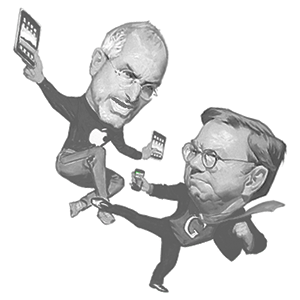
A patent war is a ‘battle’ between corporations or individuals to secure patents for litigation, whether offensively or defensively. There are ongoing patent wars between the world’s largest technology and software corporations. Patent wars are not a new phenomenon. The Wright brothers, attributed with the invention of the airplane, sought to prevent competitors from manufacturing airplanes through litigation, stifling the development of the American airline industry. Alexander Graham Bell, credited with inventing the telephone, was dragged into a patent war against his rivals, which involved, in just 11 years, 600 lawsuits.
One notable case was Bell’s lawsuit against Western Union, a telegraph company backed by Elisha Gray (also credited with inventing the telephone). In the digital age, the rapid pace of innovation makes much of the patent system obsolete. In the 1980s, technology corporations in the United States and Japan engaged in a patent war, creating a scenario where companies were forced to ‘fight patent with patent.’ This bilateral patent war, partly exaggerated by the media, subsided by the mid 1990s.
read more »
Posted in Money, Politics, Technology |
3 Comments »
October 7, 2012
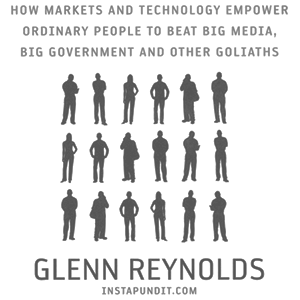
‘An Army of Davids: How Markets and Technology Empower Ordinary People to Beat Big Media, Big Government, and Other Goliaths’ is a2006 book by Glenn Reynolds, a law professor at the University of Tennessee also known as the blogger ‘Instapundit’.
The book looks at modern American society through the lens of individuals versus social institutions, and Reynolds concludes that technological change has allowed more freedom of action for people in contrast to the ‘big’ establishment organizations that used to function as gatekeepers. Thus, he argues that the balance of power between individuals and institutions is ‘flatting out,’ which involves numerous decentralized networks rising up. Reynolds divides the book into two distinct sections. The first focuses on trends currently taking place. The latter describes upcoming trends.
read more »
Posted in Money, Politics, Technology |
Leave a Comment »
October 5, 2012
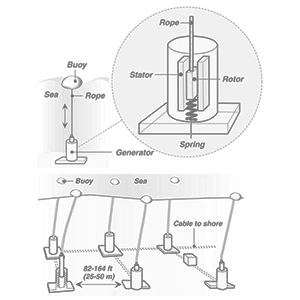
Wave power is the transport of energy by ocean surface waves, and the capture of that energy to do useful work – for example, electricity generation, water desalination, or the pumping of water (into reservoirs). Machinery able to exploit wave power is generally known as a wave energy converter (WEC). Wave power is distinct from tidal power and the steady gyre of ocean currents.
In 2008, the first experimental wave farm was opened in Portugal, at the Aguçadoura Wave Park. Waves are generated by wind passing over the surface of the sea. As long as the waves propagate slower than the wind speed just above the waves, there is an energy transfer from the wind to the waves. Both air pressure differences between the upwind and the lee side (the side sheltered from the wind) of a wave crest, as well as friction on the water surface by the wind, making the water to go into the shear stress causes the growth of the waves.
read more »
Posted in Money, Technology |
Leave a Comment »
October 5, 2012
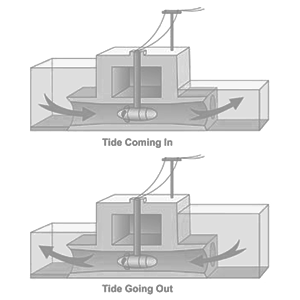
Tidal power, also called tidal energy, is a form of hydropower that converts the energy of tides into useful forms of power – mainly electricity. Although not yet widely used, tidal power has potential for future electricity generation. Tides are more predictable than wind energy and solar power. Among sources of renewable energy, tidal power has traditionally suffered from relatively high cost and limited availability of sites with sufficiently high tidal ranges or flow velocities, thus constricting its total availability.
However, many recent technological developments and improvements, both in design (e.g. dynamic tidal power, tidal lagoons) and turbine technology (e.g. new axial turbines, cross flow turbines), indicate that the total availability of tidal power may be much higher than previously assumed, and that economic and environmental costs may be brought down to competitive levels.
read more »
Posted in Money, Technology |
Leave a Comment »
October 4, 2012

In the United States, clean coal is any technology that may reduce emissions of carbon dioxide and other greenhouse gasses that arise from the burning of coal for electrical power. Typically, the term clean coal is used by coal companies in reference to carbon capture and storage (CCS), which pumps and stores emissions underground, and to plants using an Integrated gasification combined cycle (IGCC), which is technology that turns coal and other carbon based fuels into synthesis gas (‘syngas,’ which can be used to produce diesel, or converted into methane or other fuels).
Historically, the term has been used to refer to technologies for reducing emissions of ash, sulfur, and heavy metals from coal combustion. Carbon capture and storage technologies are being developed primarily in response to regulations by the EPA—most notably the ‘Clean Air Act’—and in anticipation of legislation that seeks to mitigate climate change. Currently, the electricity sector of the United States is responsible for about 41% of the nation’s carbon dioxide emissions, and half of the sector’s production comes from coal-fired power plants.
read more »
Posted in Money, Politics, Technology |
Leave a Comment »
October 4, 2012
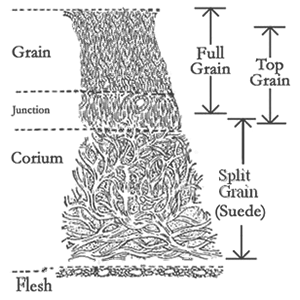
Leather is a durable and flexible material created by tanning animal rawhide and skin, often cattle hide. Traditionally, tanning used tannin, an acidic chemical compound from which the process draws its name (tannin is in turn named for an old German word for oak or fir trees, which supplied it).
Rawhide is made by removing the flesh and fat and then the hair (leather with the hair still attached is called ‘hair-on’) by use of an aqueous solution (this process is called ‘liming’ when using lime or ‘bucking’ when using lye), then scraping over a beam with a somewhat dull knife, and then drying (often while stretched). Liming or bucking also cleans the fiber network of the skin to encourage penetration of the tanning agent.
read more »
Posted in Art, Money, Technology |
Leave a Comment »
October 3, 2012


In Broadcast programming, counterprogramming is the practice of offering television programs to attract an audience from another television station airing a major event. The Super Bowl is among the most-viewed programs on American television. Thus, counterprogramming focuses on the pre-game period and the halftime show.
However, it is a common gentlemen’s agreement that the broadcast networks who carry the league’s game coverage (and in turn, other cable networks owned by the broadcasters) never counterprogram the Super Bowl, yielding to the game and airing either low profile reruns of their series or a middling film in the timeslot instead.
read more »
Posted in Games, Money |
Leave a Comment »
October 3, 2012

The term box office bomb or flop generally refers to a film that is viewed as highly unsuccessful or unprofitable during its theatrical run, sometimes preceding hype regarding its production, cost, or marketing efforts.
Not all films that fail to earn back their estimated costs during their theatrical runs are bombs, and the label is generally applied to films that miss earnings projections by a wide margin, particularly when they are very expensive to produce, and sometimes in conjunction with middling or poor reviews (though critical reception has nothing to do with box office performance). A film can be box office bomb, even though international distribution, sales to television syndication, and home video releases often mean some films that are considered flops in North America eventually make a profit for their studios.
read more »
Posted in Art, Money |
Leave a Comment »
October 2, 2012

‘The End of Work: The Decline of the Global Labor Force and the Dawn of the Post-Market Era’ is a non-fiction book by American economist Jeremy Rifkin, published in 1995.
Rifkin contended that worldwide unemployment would increase as information technology eliminated tens of millions of jobs in the manufacturing, agricultural, and service sectors. He predicted devastating impact of automation on blue-collar, retail and wholesale employees.
read more »
Posted in Language, Money, Technology |
Leave a Comment »



