July 30, 2012

Tough Mudder is an adventure sports company that hosts 10-12 mile endurance event obstacle courses designed by British Special Forces to test all around strength, stamina, mental grit, and camaraderie that are billed as ‘probably the toughest event on the planet’ and regularly attract 15-20,000 participants over a two day weekend.
Tough Mudder events are a new type of team endurance challenge. According to ‘The New York Times,’ the events are ‘more convivial than marathons and triathlons, but more grueling than shorter runs or novelty events (for example, ‘Warrior Dash’ courses are 3-4 miles). Contestants are not timed and organizers encourage ‘mudders’ to demonstrate teamwork by helping fellow participants over difficult obstacles to complete the course. The prize for completing a Tough Mudder challenge is an official orange sweatband and a free beer. It is estimated that 15-20% of participants do not finish. Each event is designed to be unique and incorporates challenges and obstacles that utilize the local terrain.
read more »
Posted in Games, Money, War |
Leave a Comment »
July 30, 2012

Po Bronson (b. 1964) is an American journalist and author who lives in San Francisco. After attending Lakeside School in Seattle, he graduated from Stanford University in 1986 and briefly worked as an assistant bond salesman in San Francisco.
He abandoned finance to pursue writing, publishing short stories and eventually a comedic novel based upon his bond trading experiences. ‘Bombardiers’ was an international best seller in 1995.
read more »
Posted in Language, Money, Technology |
Leave a Comment »
July 30, 2012

Machine-to-machine (M2M) refers to technologies that allow both wireless and wired systems to communicate with other devices of the same ability. M2M uses a device (such as a sensor or meter) to capture an event (such as temperature, inventory level, etc.), which is relayed through a network (wireless, wired, or hybrid) to an application (software program), that translates the captured event into meaningful information (for example, ‘items need to be restocked’).
Such communication was originally accomplished by having a remote network of machines relay information back to a central hub for analysis, which would then be rerouted into a system like a personal computer. However, modern M2M communication has expanded beyond a one-to-one connection and changed into a system of networks that transmits data to personal appliances.
read more »
Posted in Money, Technology |
Leave a Comment »
July 27, 2012

Participatory culture is a neologism in reference of, but opposite to a Consumer culture — in other words a culture in which private persons (the public) do not act as consumers only, but also as contributors or producers (‘prosumers’). The term is most often applied to the production or creation of some type of published media.
This new culture as it relates to the Internet has been described as ‘Web 2.0.’ In participatory culture ‘young people creatively respond to a plethora of electronic signals and cultural commodities in ways that surprise their makers, finding meanings and identities never meant to be there and defying simple nostrums that bewail the manipulation or passivity of ‘consumers.”
read more »
Posted in Money, Technology, World |
Leave a Comment »
July 27, 2012

Counter-economics is a term originally used by libertarian activists Samuel Edward Konkin III and J. Neil Schulman, defined as ‘the study and/or practice of all peaceful human action which is forbidden by the State.’ The term is short for ‘counter-establishment economics.’
Counter-economics was integrated by Schulman into Konkin’s doctrine of agorism (a philosophy that advocates the goal of the bringing about of a society in which all relations between people are voluntary exchanges). The first book to portray counter-economics as a strategy for achieving a libertarian society was Schulman’s novel ‘Alongside Night’ (1979).
read more »
Posted in Money, Philosophy, Politics |
Leave a Comment »
July 26, 2012
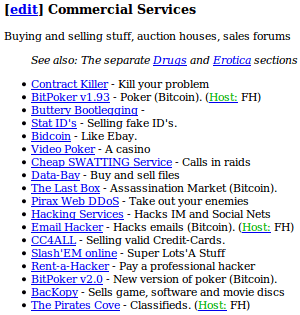
The Hidden Wiki is a website that uses hidden services available through the Tor network. The use of Tor to provide anonymity allows the site to advertise links to a range of other sites, including ones offering illegal drugs and child pornography. The site provides a range of links in a wiki format to other hidden services and sites on the clearnet (sites that can be accessed in a standard browser).
These include links to child pornography sites, sites selling drugs and other contraband such as the Silk Road. Scot Terban, an independent security researcher, commented: ‘It’s kind of like any black market operation except this one was in cyberspace and pretty much completely anonymous. Because it was anonymous, people felt free to trade openly in illegal things, mess around by putting up ads for services like hired assassins, and in the end, became a haven for pedophiles and their content.’
read more »
Posted in Money, Politics, Technology |
Leave a Comment »
July 26, 2012
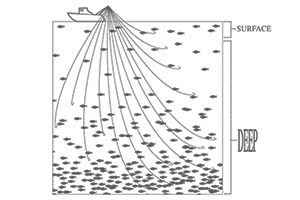

Silk Road is an online marketplace that its operators run as a Tor hidden service (anonymous and encrypted). Visitors must use Tor software to access the marketplace. The majority of products that sellers list on Silk Road qualify as contraband in most jurisdictions. ‘NPR’ has referred to the site as the ‘Amazon.com of illegal drugs.’ Buyers and sellers conduct all transactions with bitcoins (an encrypted digital currency).
Although the bitcoin’s exchange rate may fluctuate greatly in short periods of time, most of the prices on Silk Road are bound to United States dollar to prevent too drastic inflation or deflation. Buyers can register on Silk Road for free, but sellers must purchase new accounts through auctions to mitigate the possibility of malicious individuals distributing tainted goods.
read more »
Posted in Drugs, Money, Technology |
Leave a Comment »
July 25, 2012

Joke thievery is the act of performing and taking credit for comic material written by another person without their consent. This is a form of plagiarism and sometimes can be copyright infringement. A common epithet for a joke thief is ‘hack,’ which is derived from the term, ‘hackneyed’ (over used and thus cheapened, or trite).
From the music hall and vaudeville beginnings of stand-up comedy, joke thievery was common as there were few chances that a performer from one area would meet one from another and a single twenty-minute set could sustain a comic for a decade. Most jokes at the time were one-liners and there was little in the way of proof of a joke’s origin, but the value of each joke was immeasurable to a comedian. Milton Berle and Bob Hope had a long-standing feud due to Hope’s accusation that Berle had stolen some of his jokes. Berle never refuted the claim, but instead embraced the title ‘The Thief of Bad Gag.’
read more »
Posted in Humor, Language, Money |
Leave a Comment »
July 25, 2012


Ambient awareness is a term used by social scientists to describe a new form of peripheral social awareness. This awareness is propagated from relatively constant contact with one’s friends and colleagues via social networking platforms on the Internet. Marketing professor Andreas Kaplan defines ambient awareness as ‘awareness created through regular and constant reception, and/or exchange of information fragments through social media.’
The term essentially defines the sort of omnipresent knowledge one experiences by being a regular user of media outlets that allow a constant connection with one’s social circle. According to Clive Thompson of ‘The New York Times,’ ambient awareness is ‘very much like being physically near someone and picking up on mood through the little things; body language, sighs, stray comments…’ Therefore, in effect two friends who regularly follow one another’s digital information can already be aware of each other’s lives without actually being physically present to have a conversation.
read more »
Posted in Language, Money, Technology |
Leave a Comment »
July 24, 2012

Late modernity (or liquid modernity) is a term that has been used to describe the condition or state of some highly developed present day societies. It regards their state as a continuation or development of modernity, rather than as a distinct new state, post-modernity.
‘Late modernity is defined by complex, global capitalist economies and a shift from state support and welfare to the privatization of services…a process fuelled by the information revolution, the capacity to move capital and information around the world instantaneously.’ Social theorists, ‘criticize adherents of postmodernity that presume the ending of the modernization process and the dawning of a new era. Contemporary modernity, they argue, rather involves a continuation or even a radicalization of the modernization process.’
read more »
Posted in Money, Politics, World |
Leave a Comment »
July 23, 2012


Rhythm game refers to a genre of music-themed action video games. Games in the genre typically focus on dance or the simulated performance of musical instruments, and require players to press buttons in a sequence dictated on the screen. Doing so causes the game’s protagonist or avatar to dance or to play their instrument correctly, which increases the player’s score.
Many rhythm games include multiplayer modes in which players compete for the highest score or cooperate as a simulated musical ensemble. While conventional control pads may be used as input devices, rhythm games often feature novel game controllers that emulate musical instruments. Certain dance-based games require the player to physically dance on a mat, with pressure-sensitive pads acting as the input device.
read more »
Posted in Games, Money, Technology |
Leave a Comment »
July 19, 2012

US energy independence relates to the goal of reducing the US imports of oil and other foreign sources of energy. If total energy is looked at, the US is over 70% self-sufficient. Energy independence is espoused by those who want to leave America unaffected by global energy supply disruptions, and to restrict a reliance upon politically unstable states for its energy purposes.
Energy independence is highly concerned with oil, being perhaps the most important imported energy sources for purposes of both transportation and electricity. The United States is the world’s third largest producer of oil, but it also relies on imported oil. More oil is imported from Canada than any other country. 19% of imported oil comes from the Middle East. Such resources are finite and decreasing, despite an increase in demand. World-wide demand for oil is projected to grow 60% over the next two decades.
read more »
Posted in Money, Politics, World |
Leave a Comment »


 The Daily Omnivore