May 24, 2012

Frame rate is the frequency (rate) at which an imaging device produces unique consecutive images called frames. The term applies equally well to computer graphics, video cameras, film cameras, and motion capture systems. Frame rate is most often expressed in frames per second (FPS), and is also expressed in progressive scan monitors as hertz (Hz).
The human visual system can process 10 to 12 separate images per second, perceiving them individually. The visual cortex holds onto one image for about one-fifteenth of a second, so if another image is received during that period an illusion of continuity is created, allowing a sequence of still images to give the impression of motion.
read more »
Posted in Art, Money, Technology |
Leave a Comment »
May 24, 2012
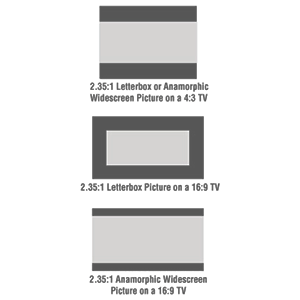
Letterboxing is the practice of transferring film shot in a widescreen aspect ratio to standard-width video formats while preserving the film’s original aspect ratio. The resulting videographic image has mattes (black bars) above and below it; these mattes are part of the image (i.e., of each frame of the video signal). LTBX is the identifying abbreviation for films and images so formatted. The term refers to the shape of a letter box, a slot in a wall or door through which mail is delivered, being rectangular and wider than it is high.
Letterboxing is used as an alternative to a full-screen, pan-and-scan transfer of a widescreen film, in which the original image is cropped to the narrower aspect ratio of the destination format, usually the 1.33:1 (4:3) ratio of the standard television screen, whereas letterboxing preserves the film’s original image composition as seen in the cinema. Letterboxing was developed for use in 4:3 television displays before widescreen television screens were available, but it is also necessary to represent on a 16:9 widescreen display the unaltered original composition of a film with a wider aspect ratio, such as Panavision’s 2.35:1 ratio.
read more »
Posted in Art, Money, Technology |
5 Comments »
May 23, 2012

A retronym [re-truh-nim] is a type of neologism that provides a new name for something to differentiate the original version from a more recent one. The original name is most often augmented with an adjective (rather than being completely displaced) to account for later developments of the object or concept itself. Much retronymy is driven by advances in technology.
Examples of retronyms are ‘acoustic guitar’ (coined when electric guitars appeared), and ‘analog watch’ to distinguish from a digital watch. In the entertainment industry, this can manifest itself as calling a movie ‘Part 1’ once sequels are released or by slightly altering the title (e.g. ‘Star Wars: A New Hope’ or ‘Indiana Jones and the Raiders of the Lost Ark’) to emphasize its connection with the sequel(s), or by referring to a television series as ‘the original,’ as in ‘Star Trek: The Original Series.’
read more »
Posted in Language, Money, Technology |
Leave a Comment »
May 21, 2012

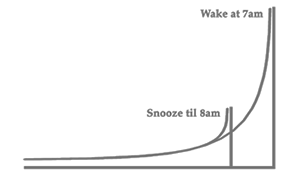
In economics, hyperbolic discounting is a time-inconsistent model of discounting. Given two similar rewards, humans show a preference for one that arrives sooner rather than later. Humans are said to discount the value of the later reward, by a factor that increases with the length of the delay. This process is traditionally modeled in form of exponential discounting, a time-consistent model of discounting.
A large number of studies have since demonstrated that the constant discount rate assumed in exponential discounting is systematically being violated. Hyperbolic discounting is a particular mathematical model devised as an improvement over exponential discounting. Hyperbolic discounting has been observed in humans and animals.
read more »
Posted in Money, Science |
1 Comment »
May 17, 2012
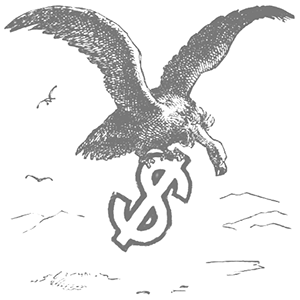
A vulture fund is a private equity or hedge fund that invests in debt issued by an entity that is considered to be very weak or dying, or whose debt is in imminent default. The name is a metaphor comparing these investors to vultures patiently circling, waiting to pick over the remains of a rapidly weakening company or, in the case of sovereign debt, debtor country. Market practitioners refer to them as distressed debt or special situations funds.
Vulture funds have sometimes had success in bringing actions against sovereign debtor governments, usually settling with them before forced sales. Settlements typically are made at a discount in hard or local currency or in the form of new debt issuance. A related term is ‘vulture investing,’ where certain stocks in near bankrupt companies are purchased upon anticipation of asset divestiture or successful reorganization. A prime example in the US is K-Mart, where the real estate held by the company was the anticipated payout for investors who bought stock during their bankruptcy proceedings.
Posted in Money, Politics, World |
Leave a Comment »
May 17, 2012

The Glock is a series of semi-automatic pistols designed and produced in Austria. The company’s founder, engineer Gaston Glock, had no experience with firearm design or manufacture at the time their first pistol, the Glock 17, was being prototyped in 1982.
Glock did, however, have extensive experience in advanced synthetic polymers, knowledge of which was instrumental in the company’s design of the first successful line of pistols with a polymer frame. Glock introduced ferritic nitrocarburizing, a form of case hardening, into the firearms industry as an anti-corrosion surface treatment for metal gun parts.
read more »
Posted in Money, Technology, War |
Leave a Comment »
May 16, 2012

Verner Panton (1926 – 1998) is considered one of Denmark’s most influential 20th-century furniture and interior designers. During his career, he created innovative, funky and futuristic designs in a variety of materials, especially plastics, and in vibrant and exotic colors.
His style was very ‘1960s’ but regained popularity at the end of the 20th century; as of 2004, Panton’s most well-known furniture models are still in production (at Vitra, among others).
read more »
Posted in Art, Money, Technology |
Leave a Comment »
May 16, 2012

Mars to Stay missions propose astronauts sent to Mars for the first time should intend to stay, with their unused emergency return vehicles recycled into settlement construction as soon as the habitability of Mars becomes evident to the initial pioneers. Mars to Stay missions are advocated both to reduce cost and to ensure permanent settlement of Mars.
Among many notable Mars to Stay advocates, former Apollo astronaut Buzz Aldrin has been particularly outspoken, suggesting in numerous forums ‘Forget the Moon, Let’s Head to Mars!’ The Mars Underground, Mars Homestead Foundation, and Mars Artists Community have also adopted Mars to Stay policy initiatives. The earliest formal outline of a Mars to Stay mission architecture was given at the ‘Case for Mars VI Workshop’ in 1990, during a presentation by George Herbert titled ‘One Way to Mars.’
read more »
Posted in Money, Technology, World |
1 Comment »
May 16, 2012

Max Headroom is a fictional British artificial intelligence, known for his wit and stuttering, distorted, electronically sampled voice. It was introduced in early 1984. The character was created by George Stone, Annabel Jankel, and Rocky Morton, and portrayed by Matt Frewer as ‘The World’s first computer generated TV host’ although the computer generated appearance was achieved with prosthetic make up. The classic look for the character was a shiny dark suit – which was actually a fibreglass mould – often paired with Ray-Ban Wayfarer sunglasses.
Only his head and shoulders were depicted, usually against a ‘computer generated’ backdrop of a slowly rotating wire-frame cube interior, which was also initially generated by analogue means – in this case traditional cel animation, though later actual computer graphics were employed for the backdrop. Another distinguishing trademark of Max was his chaotic speech patterns – his voice would seemingly randomly pitch up or down, or occasionally get stuck in a loop. These modulations also appeared when the character was performed live.
read more »
Posted in Humor, Money, Technology |
Leave a Comment »
May 16, 2012
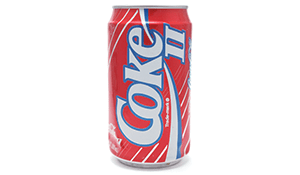

New Coke was the reformulation of Coca-Cola introduced in 1985; it originally had no separate name of its own, and was simply known as ‘the new taste of Coca-Cola’ until 1992 when it was renamed Coca-Cola II. The American public’s reaction to the change was negative and the new cola was a major marketing failure.
The subsequent reintroduction of Coke’s original formula, re-branded as ‘Coca-Cola Classic,’ resulted in a significant gain in sales, leading to speculation that the introduction of the New Coke formula was just a marketing ploy.
read more »
Posted in Food, Humor, Money |
Leave a Comment »
May 16, 2012


Crystal Pepsi was a caffeine-free soft drink made by PepsiCo from 1992 to 1993 in the United States, Canada, and for a short time in Australia. Crystal Pepsi was sold for a longer time in Europe.
In the early 1990s, a marketing fad equating clarity with purity began with the remake of Ivory soap from its classic milky solution; the idea spread to many companies, including PepsiCo. Its marketing slogan was ‘You’ve never seen a taste like this.’ A large marketing campaign was launched, for which the company invented the world’s first photo-realistic, computer-generated bus wrap printing. A series of television advertisements featuring Van Halen’s hit song ‘Right Now’ during Super Bowl XXVII.
read more »
Posted in Food, Humor, Money |
1 Comment »
May 14, 2012

Shigeru Miyamoto [she-gay-roo mee-yah-moe-toe] (b. 1952) is a Japanese game designer and creator of ‘Donkey Kong,’ ‘Mario,’ and ‘The Legend of Zelda’ series for Nintendo. He is one of the most famous game designers in the world and is often called the father of modern video gaming.
His games give players many ways to play and explore, which was unique at the time. Miyamoto started working with Nintendo in 1977 as an artist when it was still a toy and playing-card company. In 1980, he designed ‘Donkey Kong,’ which was a big success. Miyamoto was born and raised in Kyoto Prefecture; the natural surroundings of Kyoto inspired much of his later work. His other creations for Nintendo include ‘Star Fox,’ ‘F-Zero,’ and ‘Pikmin.’
read more »
Posted in Games, Money, World |
Leave a Comment »


 The Daily Omnivore