May 13, 2012

Gauche [gohsh] caviar [kav-ee-ahr] (‘Caviar left’) is a pejorative French term to describe someone who claims to be a socialist while living in a way that contradicts socialist values. The expression is a political neologism dating from the 1980s and implies a degree of hypocrisy. It is broadly similar to the English ‘champagne socialist,’ the American ‘Limousine liberal,’ the German ‘Salonkommunist,’ the Italian ‘Radical Chic,’ and the Danish ‘Kystbanesocialist’ (referring to well-off coastal neighborhoods north of Copenhagen). French encyclopedia ‘Petit Larousse’ defines ‘left caviar’ as a pejorative expression for a, ‘Progressivism combined with a taste for society life and its accoutrements.’
The term was once prevalent in Parisian circles, applied deprecatingly to those who professed allegiance to the Socialist Party, but who maintained a far from proletariat lifestyle that distinguished them from the working-class base of the French Socialist Party. It was often employed by detractors of former French President François Mitterrand. In early 2007, French politician Ségolène Royal was identified with the ‘gauche caviar’ when it was revealed that she had been avoiding paying taxes. The description damaged her campaign for the French presidency. The weekly French news magazine, ‘Le Nouvel Observateur,’ has been described as the ‘quasi-official organ of France’s ‘gauche caviar.”
Posted in Food, Money, Politics |
Leave a Comment »
May 11, 2012

Jennifer Government is a 2003 novel written by Max Barry, set in a dystopian alternate reality in which most nations (now controlled by the United States) are dominated by for-profit corporate entities while the government’s political power is extremely limited. Some readers consider it similar in satiric intent to Orwell’s ‘1984,’ but of a world with too little political power as opposed to too much.
Consequently, some readers see the novel as a criticism of libertarianism. Many readers also see it as a criticism of globalization, although Barry claims he is not an anti-globalizationist.
read more »
Posted in Language, Money, Politics |
Leave a Comment »
May 8, 2012

The Khan Academy is a non-profit educational organization, created in 2006 by American educator Salman Khan (who has three degrees from MIT (a BS in mathematics, a BS in electrical engineering and computer science, and an MS in electrical engineering and computer science), and an MBA from Harvard Business School.
With the stated mission of ‘providing a high quality education to anyone, anywhere,’ the website supplies a free online collection of more than 3,100 micro lectures via video tutorials stored on YouTube teaching mathematics, history, healthcare and medicine, finance, physics, chemistry, biology, astronomy, economics, cosmology, organic chemistry, American civics, art history, microeconomics, and computer science.
read more »
Posted in Education, Language, Money, Technology |
1 Comment »
May 8, 2012

The exorbitant privilege is a term coined in the 1960s by Valéry Giscard d’Estaing, then the French Minister of Finance. This quote is generally misattributed to Charles de Gaulle, who is said to have had somewhat similar views. The term refers to the benefit the United States had in its Dollar being the international reserve currency: the US would not face a balance of payments crisis, because it purchased imports in its own currency.
‘Exorbitant privilege’ as a concept cannot refer to currencies that have a regional reserve currency role, only global reserve currencies. Recent McKinsey Global Institute research questions whether the benefit that the US enjoys is really that exorbitant, highlighting the countervailing loss of trade competitiveness from the high dollar (that typically results from its reserve status, all else equal). The phrase became the title of a 2010 book by economist Barry Eichengreen, examining the future prospects for the US Dollar’s dominance in international trade.
Posted in Money, Politics, World |
Leave a Comment »
May 8, 2012
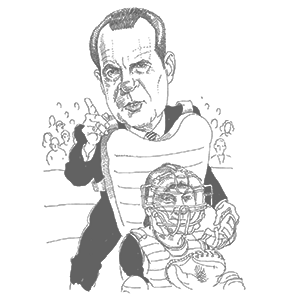
The Nixon Shock was a series of economic measures taken by U.S. President Richard Nixon in 1971 including unilaterally cancelling the direct convertibility of the United States dollar to gold that essentially ended the existing Bretton Woods system of international financial exchange.
The return to a gold standard is supported by followers of the Austrian School, largely because they object to the role of the government in issuing fiat currency through central banks. A number of gold standard advocates also call for a mandated end to fractional reserve banking.
read more »
Posted in Money, Politics, World |
1 Comment »
May 5, 2012


A non-apology apology is a statement in the form of an apology but that is not in fact an apology at all. It is common in both politics and public relations. It most commonly entails the speaker saying that he or she is sorry not for a behavior, statement or misdeed, but rather is sorry only because a person who has been aggrieved is requesting the apology, expressing a grievance, or is threatening some form of retribution or retaliation.
An example of a non-apology apology would be saying ‘I’m sorry that you felt insulted’ to someone who has been offended by a statement. This apology does not admit that there was anything wrong with the remarks made, and additionally, it may be taken as insinuating that the person taking offense was excessively thin-skinned or irrational in taking offense at the remarks in the first place.
read more »
Posted in Language, Money, Politics |
Leave a Comment »
May 4, 2012
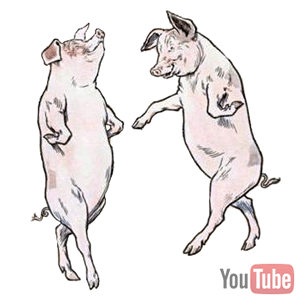
In computer security, the dancing pigs problem (also known as the dancing bunnies problem) is a statement on user attitudes to computer security: that users primarily desire features without considering security, and so security must be designed in without the computer having to ask a technically ignorant user.
The term has its origin in a remark by computer scientists Edward Felten and Gary McGraw: ‘Given a choice between dancing pigs and security, users will pick dancing pigs every time.’
read more »
Posted in Humor, Money, Technology |
Leave a Comment »
May 3, 2012

The Culture is a fictional interstellar anarchist, socialist, and utopian society created by the Scottish writer Iain M. Banks which features in a number of science fiction novels and works of short fiction by him, collectively called the Culture series.
The Culture is characterized by being a post-scarcity society (meaning that its advanced technologies provide practically limitless material wealth and comforts for everyone for free, having all but abolished the concept of possessions), by having overcome almost all physical constraints on life (including disease and death) and by being an almost totally egalitarian, stable society without the use of any form of force or compulsion, except where necessary to protect others.
read more »
Posted in Money, Politics, Technology |
Leave a Comment »
May 3, 2012
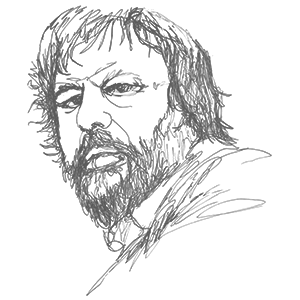
Slavoj Žižek [slah-voy zhee-zhek] (b. 1949) is a Slovenian philosopher and cultural critic working. He has made contributions to political theory, film theory and theoretical psychoanalysis. Žižek is a senior researcher at the Institute of Sociology University of Ljubljana.
Žižek uses examples from popular culture to explain the theory of Jacques Lacan and uses Lacanian psychoanalysis, Hegelian philosophy, and Marxist economic criticism to interpret and speak extensively on immediately current social phenomena, including the current ongoing global financial crisis.
read more »
Posted in Money, Philosophy, Politics |
1 Comment »
May 1, 2012

James Jean is a Taiwanese-American visual artist, known for both his commercial and fine art gallery work. He is also known in the American comics industry as a cover artist for various books published by DC Comics, as well as for his work for Prada, ESPN, and Atlantic Records. His work, which has been collected in numerous volumes, has been compared to Maxfield Parrish (known for his distinctive saturated hues and idealized neo-classical imagery). Jean was born in Taiwan and was raised in Parsippany-Troy Hills, New Jersey. He illustrated covers for the comic book series ‘Fables’ and ‘The Umbrella Academy.’ In 2008, Jean retired from illustration and commercial projects to focus on painting.
In 2007, Jean created a mural for the Prada Epicenter stores in New York and Los Angeles. He also created a backdrop for Prada’s Spring/Summer 2008 show in Milan. Aspects of the Epicenter mural and the Milan wallpaper were transformed into clothing, handbags, shoes, and packaging. Prada undertook a global campaign that featured Jean’s work in advertising environments, animation, and special events. Jean developed an animated short based on the theme titled ‘Trembled Blossoms,’ taken from the poem ‘Ode to Psyche,’ by John Keats (one of his darker and more experimental odes). In 2010, Jean was commissioned by fashion designer Phillip Lim to paint a series of portraits featuring Los Angeles-based actors, musicians, and tastemakers, including Rachel Bilson, Selma Blair, and Devendra Banhart.
Posted in Art, Money |
2 Comments »
April 29, 2012

In marketing terminology, a killer application (commonly shortened to killer app) is any computer program that is so necessary or desirable that it proves the core value of some larger technology, such as computer hardware, gaming console, software, or an operating system. One of the first examples of a killer application is generally agreed to be the ‘VisiCalc’ spreadsheet for the Apple II. The machine was purchased in the thousands by finance workers on the strength of this program.
The definition of ‘killer app’ came up during Bill Gates’s questioning in the ‘United States v. Microsoft’ antitrust suit. Gates had written an email in which he described ‘Internet Explorer’ as a killer app. In the questioning, he said that the term meant ‘a very popular application,’ and did not connote an application that would fuel sales of a larger product or one that would supplant its competition.
Posted in Money, Politics, Technology |
2 Comments »
April 28, 2012


A disruptive innovation creates a new market and value network, and eventually goes on to disrupt an existing market and value network (over a few years or decades), displacing an earlier technology. The term is used in business and technology literature to describe innovations that improve a product or service in ways that the market does not expect, typically first by designing for a different set of consumers in the new market and later by lowering prices in the existing market.
By contrast, a ‘sustaining innovation’ does not create new markets or value networks but rather only evolves existing ones with better value, allowing the firms within to compete against each other’s sustaining improvements; they may be either ‘discontinuous’ (i.e. ‘transformational’ or ‘revolutionary’) or ‘continuous’ (i.e. ‘evolutionary’).
read more »
Posted in Money, Technology |
Leave a Comment »



 The Daily Omnivore