April 9, 2012


Food faddism refers to idiosyncratic diets and eating patterns that promote short-term weight loss, usually with no concern for long-term weight maintenance, which enjoy temporary popularity. The term ‘food fad’ may also be used with a neutral connotation to describe the short term popularity among restaurants and consumers of an ingredient, dish, or preparation technique.
‘Fad diet’ is a term of popular media, not science. Some so-called fad diets may make pseudo-scientific claims, but others labeled ‘fad’ are based on science. According to one definition, fad diets claim to be scientific but do not follow the scientific method in establishing their validity. Among the scientific shortcomings of the claims made in support of fad diets: not being open to revisions, whereas real science is; and observations that prompt explanations are used as evidence of the validity of the explanation.
read more »
Posted in Food, Health, Money |
Leave a Comment »
April 9, 2012


Tarsem Singh Dhandwar (b. 1961), known professionally as Tarsem, is an Indian film director. He began his career directing music videos, including those of ‘Hold On’ by En Vogue, ‘Sweet Lullaby’ by Deep Forest, and R.E.M.’s smash hit ‘Losing My Religion,’ the latter of which won Best Video of the Year at the 1991 MTV Video Music Awards. He has directed dozens of commercials for brands such as Nike and Coca-Cola.
Tarsem’s feature film directorial debut was ‘The Cell’ (2000), starring Jennifer Lopez. His second film, ‘The Fall,’ debuted at the 2006 Toronto International Film Festival and was released theatrically in the United States in 2008. His third film was 2011’s ‘Immortals.’ He directed an adaptation of the Brothers Grimm story of Snow White, called ‘Mirror Mirror’ in 2012.
Posted in Art, Money |
Leave a Comment »
April 9, 2012

‘On Writing: A Memoir of the Craft’ by Stephen King, published in 2000, is a memoir of the prolific author’s experiences as a writer, and also serves as a guide book for those who choose to enter the craft. The first section of the book is an Autobiography mainly about King’s early exposure to writing, and his childhood attempts at writing. King talks about his early attempts to get published, and his first novel ‘Carrie.’ He also talks about his fame as a writer, and what it took to get there. This includes his relationship with his wife, the death of his mother and his history of drug and alcohol abuse.
The second section is practical advice on writing, including tips on grammar and ideas about developing plot and character. King himself describes it as a guide for how ‘a competent writer can become a good one.’ This includes his beliefs that a writer should edit out unnecessary details and avoid the use of unnecessary adverbs. He also uses quotes from other books and authors to illustrate his points. The third section is also autobiographical, in which he discusses the 1999 automobile accident in which he was struck by a vehicle while walking down an isolated country road. He describes serious injuries, his painful recovery and his struggle to start writing again.
Posted in Art, Language, Money |
1 Comment »
April 6, 2012

Artists and repertoire (A&R) is the division of a record label that is responsible for talent scouting and overseeing the artistic development of recording artists. It also acts as a liaison between artists and the record label; every activity involving artists to the point of album release is generally considered under the purview of, and responsibility of, A&R. The A&R division is responsible for discovering new recording artists and bringing them to the record company.
They are expected to understand the current tastes of the market and to be able to find artists that will be commercially successful. For this reason, A&R people are often young and many are musicians, music journalists or record producers. An A&R executive is authorized to offer a record contract, often in the form of a ‘deal memo’: a short informal document that establishes a business relationship between the recording artist and the record company. The actual contract negotiations will typically be carried out by rival entertainment lawyers hired by the musician’s manager and the record company.
read more »
Posted in Art, Money |
Leave a Comment »
April 6, 2012
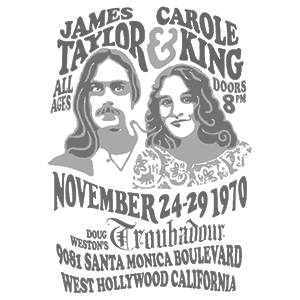
The Troubadour is a nightclub located in West Hollywood, founded in 1957 by Doug Weston. It was a major center for folk music in the 1960s, and subsequently for singer-songwriters and rock.
The Troubadour played an important role in the careers of Elton John, Linda Ronstadt, Hoyt Axton, the Eagles, The Byrds, Joni Mitchell, James Taylor, Carole King, Bonnie Raitt, J.D. Souther, Jackson Browne, Van Morrison, Buffalo Springfield and other prominent and successful performers, who played performances there establishing their future fame.
read more »
Posted in Art, Humor, Money |
Leave a Comment »
April 4, 2012

The Male Gaze is a feminist theory that was first developed by British feminist film theorist Laura Muvley in 1975. The male gaze occurs when the audience, or viewer, is put into the perspective of a heterosexual man. Mulvey stressed that the dominant male gaze in mainstream Hollywood films reflects and satisfies the male unconscious: most filmmakers are male, thus the voyeuristic gaze of the camera is male. Male characters in the film’s narratives make women the objects of their gaze.
When feminism characterizes the ‘male gaze’ certain themes appear such as, voyeurism, objectification, fetishism, scopophilia (pleasure from looking), and women as the object of male pleasure. Mary Anne Doane at Brown University gives an example of how voyeurism can be seen in the male gaze: ‘The early silent cinema, through its insistent inscription of scenarios of voyeurism, conceives of its spectator’s viewing pleasure in terms of the peeping tom, behind the screen, reduplicating the spectator’s position in relation to the woman on the screen.’
read more »
Posted in Money, Politics, Sex |
2 Comments »
April 4, 2012
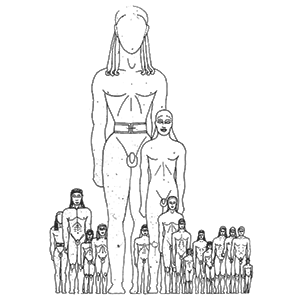
The Getty kouros [koor-os] is an over-life-sized statue in the form of a late archaic Greek kouros (representations of male youths). The dolomitic marble sculpture was bought by the J. Paul Getty Museum, Malibu, California, in 1985 for $7 million. Despite initial favorable scientific analysis of the patina and aging of the marble, a question of its authenticity has persisted from the start.
Subsequent demonstration of an artificial means of creating the de-dolomitization observed on the stone has prompted a number of art historians to revise their opinions of the work. If genuine, it is one of only twelve complete kouroi still extant. If fake, it exhibits a high degree of technical and artistic sophistication by an as-yet unidentified forger. Its status remains undetermined: today the museum’s label reads ‘Greek, about 530 B.C., or modern forgery.’
read more »
Posted in Art, Money, Science |
1 Comment »
April 3, 2012

Estuary English is a dialect of English widely spoken in South East England, especially along the River Thames and its estuary. Phonetician John C. Wells defines Estuary English as ‘Standard English spoken with the accent of the southeast of England.’
Some people adopt the accent as a means of ‘blending in,’ appearing to be more working class, or in an attempt to appear to be ‘a common man’ – sometimes this affectation of the accent is derisively referred to as ‘Mockney.’ A move away from traditional Received Pronunciation accents is almost universal among middle class young people.
read more »
Posted in Language, Money, World |
1 Comment »
April 3, 2012

Mockney (a portmanteau of ‘mock’ and ‘Cockney’) is an affected accent and form of speech in imitation of Cockney or working class London speech, or a person with such an accent. A stereotypical Mockney comes from a middle or upper-middle class background in England’s Home Counties (the counties encircling London).
Mockney is distinct from Estuary English by being the deliberate affectation of the working-class London (Cockney) accent. A person speaking with a Mockney accent might adopt Cockney pronunciation but retain standard grammatical forms where the Cockney would use non-standard forms (e.g. negative concord / double negative). The first published use of the word according to the Oxford English Dictionary was in 1989.
read more »
Posted in Language, Money, Politics |
Leave a Comment »
April 3, 2012

U and non-U English usage, with U standing for upper class, and non-U representing the aspiring middle classes, were part of the terminology of popular discourse of social dialects (sociolects) in 1950s Britain and New England. The debate did not concern itself with the speech of the working classes, which in many instances used the same words as the upper class.
For this reason, the vocabulary list can often appear quite counter-intuitive: the middle class prefers ‘fancy’ or fashionable words (even neologisms), often euphemisms, in an attempt to make themselves sound more refined, while the upper class in many cases sticks to the same plain and traditional words that the working classes also use, as they have no need to make themselves sound more refined, conscious of their status.
read more »
Posted in Language, Money, Politics |
Leave a Comment »
April 3, 2012


The Deep Web (also called the Invisible Net, the Deep Web, Undernet, or the hidden Web) refers to World Wide Web content that is not part of the Surface Web, which is indexable by standard search engines. It should not be confused with the ‘dark Internet,’ the computers that can no longer be reached via Internet, or with the distributed filesharing network ‘Darknet,’ which could be classified as a smaller part of the Deep Web.
Mike Bergman, founder of ‘BrightPlanet,’ credited with coining the phrase, has said that searching on the Internet today can be compared to dragging a net across the surface of the ocean: a great deal may be caught in the net, but there is a wealth of information that is deep and therefore missed. Most of the Web’s information is buried far down on dynamically generated sites, and standard search engines do not find it. Traditional search engines cannot ‘see’ or retrieve content in the deep Web—those pages do not exist until they are created dynamically as the result of a specific search. The deep Web is several orders of magnitude larger than the surface Web.
read more »
Posted in Money, Technology, World |
1 Comment »
April 2, 2012
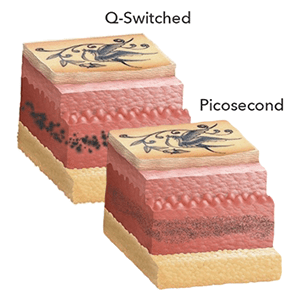
InfinitInk is a tattoo ink, which allows for easier tattoo removal, with removal up to three times faster than conventional inks. It is produced by Freedom2, Inc., and is available as of 2009 in limited release in the United States. It is currently only available in black and red, with other colors planned. The initial ink formulation consisted of inert plastic beads, containing bioremovable dyes. Laser application ruptures the beads, allowing the ink to leak out and be removed by the body.
The concept for this ink arose initially from potential medical uses, such as in reconstructive surgery and in radiation oncology. However, it was clear that a permanent and safe, yet more removable ink would also find use by some artists for decorative tattooing.
Posted in Money, Technology |
Leave a Comment »


 The Daily Omnivore