March 21, 2012

The Principality of Sealand is an unrecognized micronation, located on HM Fort Roughs, a former World War II Maunsell Sea Fort in the North Sea 10 km (six miles) off the coast of Suffolk, England. Since 1967, the facility has been occupied by the former British Major Paddy Roy Bates; his associates and family claim that it is an independent sovereign state.
While it has been described as the world’s smallest nation, or a micronation, Sealand is not currently officially recognized by any established sovereign state. Although Roy Bates claims it is de facto recognized by Germany as they have sent a diplomat to the micronation, and by the UK after an English court ruled it did not have jurisdiction over Sealand, neither action constitutes de jure recognition as far as the respective countries are concerned.
read more »
Posted in Money, Politics, World |
1 Comment »
March 20, 2012
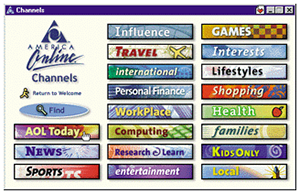

A walled garden is an analogy used in various senses in information technology. In the telecommunications and media industries, a ‘walled garden’ refers to a carrier or service provider’s control over applications, content, and media on platforms (such as mobile devices) and restriction of convenient access to non-approved applications or content. For example, in telecommunications, the services and applications accessible on any device on a given wireless network were historically tightly controlled by the mobile operators. The mobile operators determined which applications from which developers were available on a device’s home portal or home page. This has long been a central issue constraining the telecommunications sector, as developers face huge hurdles in getting their applications onto devices and into the hands of end-users.
More generally, a ‘walled garden’ refers to a closed or exclusive set of information services provided for users. This is in contrast to giving consumers unrestricted access to applications and content. Similar to a ‘real’ walled garden, a user in a walled garden is unable to escape this area unless it is through the designated entry/exit points or the walled garden is removed. Removing the walled garden is typically done by complying with the terms of removal, such as updating firmware, registering an account, or cleaning machine from infected files.
Posted in Money, Technology |
Leave a Comment »
March 20, 2012

The SynthAxe is a fretted, guitar-like MIDI controller, created by Bill Aitken, Mike Dixon, and Tony Sedivy and manufactured in England in the 1980s. It uses electronic synthesizers to produce sound and is controlled through the use of an arm resembling the neck of a guitar in form and in use.
The neck of the instrument is angled upwards from the body, and there are two independent sets of strings. The fretboard is continuously scanned and sends signals to synthesizers which produce the sound. The left set determine the pitch played, through contact with the frets on the neck and by sensing the side-to-side bending of the string. The right set of strings are velocity sensitive; these strings can be plucked, strummed or damped in the same manner as a guitar’s. A keyboard made up of nine keys can also be used to trigger notes instead of the strings. An electronic tremolo bar can be used for standard whammy bar effects, or can be redefined to produce different MIDI output (e.g., filter cutoffs, volume, etc).
Posted in Art, Money, Technology |
Leave a Comment »
March 20, 2012
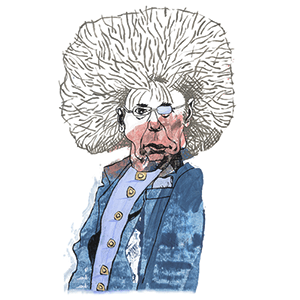
The Wrecking Crew was a nickname coined by the drummer Hal Blaine for a group of elite session musicians in Los Angeles, who earned wide acclaim in the 1960s. They backed dozens of popular singers, and were one of the most successful groups of studio musicians in music history. The Wrecking Crew’s members typically had backgrounds in jazz or classical music, but were highly versatile.
The talents of this group of ‘first call’ players were used on almost every style of recording, including television theme songs, film scores, advertising jingles, and almost every genre of American popular music, from The Monkees to Bing Crosby. Notable artists employing the Wrecking Crew’s talents included Nancy Sinatra, The Partridge Family, The Mamas & the Papas, The Carpenters, John Denver, The Beach Boys, Simon & Garfunkel, and Nat King Cole.
Posted in Art, Money |
1 Comment »
March 20, 2012

Phil Spector (b. 1939) is an American musician (piano, guitar), songwriter and record producer. He was co-owner of Philles Records (with then-business partner Lester Sill), and later owner of Phil Spector Records. In 2009 he was found guilty of second degree murder. Spector’s signature style was called the Wall of Sound. He used large amounts of echo, doubling and multiplying of musical instruments and the parts to be played, and overdubbing of recorded parts. The built-up effect gave his records an operatic, theatrical quality. The music sounded ‘bigger than life.’
The effect carried over especially well on AM radio, which was how most music was broadcast in the 1950s and 1960s. Spector said the Wall of Sound made ‘…little symphonies for kids…’ The recording artists who worked with Spector over the years included The Crystals (‘Then He Kissed Me’), The Ronettes (‘Be My Baby’), The Righteous Brothers (‘You’ve Lost That Lovin’ Feelin’,’ Gene Pitney (‘Every Breath I Take’), Darlene Love (‘(Today I Met) The Boy I’m Gonna Marry’), and Tina Turner (‘River Deep, Mountain High’). Sonny Bono and Cher were among his backup singers. He married Veronica (Ronnie) Bennett of the Ronettes, who took the name Ronnie Spector.
read more »
Posted in Art, Death, Money |
Leave a Comment »
March 20, 2012
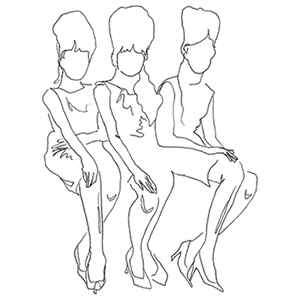
The Wall of Sound is a music production technique for pop and rock music recordings developed by record producer Phil Spector at Gold Star Studios in Los Angeles during the early 1960s. Working with such audio engineers as Larry Levine and the session musicians who became known as The Wrecking Crew, Spector created a dense, layered, reverberant sound that came across well on AM radio and jukeboxes popular in the era. He created this sound by having a number of electric and acoustic guitarists perform the same parts in unison, adding musical arrangements for large groups of musicians up to the size of orchestras, then recording the sound using an echo chamber.
To attain Spector’s signature sound, his arrangements called for large ensembles (including some instruments not generally used for ensemble playing, such as electric and acoustic guitars), with multiple instruments doubling many of the parts to create a fuller, richer sound. Spector also included orchestral instruments – strings, woodwind, brass and percussion – not previously associated with youth-oriented pop music. Spector himself called his technique ‘a Wagnerian approach to rock & roll: little symphonies for the kids.’
read more »
Posted in Art, Money, Technology |
Leave a Comment »
March 20, 2012

Auto-Tune is an audio processor created by Antares Audio Technologies, which uses proprietary software to alter pitch in vocal and instrumental performances. It was originally intended to disguise off-key inaccuracies, allowing vocal tracks to be perfectly tuned despite originally being slightly off-key. The processor slightly blends pitches to the nearest true semitone (to the exact pitch of the nearest tone in traditional equal temperament). Auto-Tune can also be used as an effect to distort the human voice when pitch is raised or lowered significantly. The overall effect to the discerning ear can be described as hearing the voice leap from note to note stepwise, like a synthesizer.
Auto-Tune was initially created by Andy Hildebrand, an engineer working for Exxon. Hildebrand developed methods for interpreting seismic data and subsequently realized that the technology could be used to detect, analyze, and modify pitch. Auto-Tune was used to produce the prominent altered vocal effect on Cher’s ‘Believe.’ Recorded in 1998, ‘Believe’ was the first commercial recording to use the software for this purpose. In an early interview, the producers claimed that they had used a Digitech Talker FX pedal, in an attempt to preserve a trade secret. After the success of the single, the technique became known as the ‘Cher Effect.’ The use of Auto-Tune as a musical effect was revived in the late-2000s by R&B singer T-Pain, who elaborated on the effect and made active use of Auto-Tune in his songs.
Posted in Art, Money, Technology |
Leave a Comment »
March 20, 2012
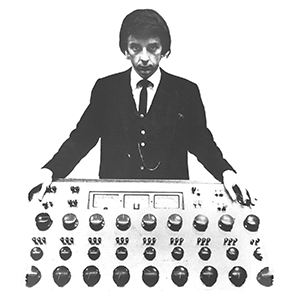
Overproduction is the excessive use of audio effects, layering, or digital manipulation in music production. Common traits include: audio processing effects such as reverb, delay, or dynamic range compression; heavy layering or multi-tracking (in the context of pop and rock music, this may refer to the addition of elements such as chorused vocals or backing strings).
Other modifications include pitch correction, time correction, and quantization (correcting to perfect notes). Records are sometimes overseen by a producer who ‘imposes’ his or her own distinctive ‘sound’ or techniques on a band or artist (producers frequently accused of this kind of ‘overproduction’ include Phil Spector and Mutt Lange). The term ‘overproduction’ implies that a producer or mastering engineer has made ‘unnecessary’ additions or changes to a record in the production process, and in doing so has decreased the quality or enjoyability of the music.
Posted in Art, Money, Technology |
Leave a Comment »
March 20, 2012
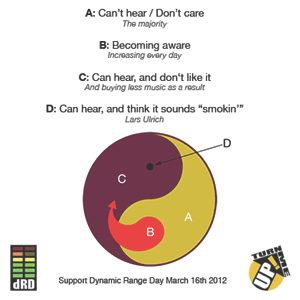
The loudness war is a pejorative term for the apparent competition to digitally master and release recordings with increasing loudness. Older music typically has a very diverse dynamic, that is, there are quiet parts of the track and much louder parts. For example, acoustic interludes leading up to the body of a song might be produced at a very quiet level, with some of the loudest sounds being snare drums and other kinds of percussion.
While the rationale for the loudness war is often described as an attempt to make the quieter parts of music more accessible to a listener, the overall effect is that that dynamic between sounds becomes leveled out, with no sound standing out from the track as a much louder sound. This results in a loss of clarity, where it’s no longer possible to experience music as a distinct interplay of louder and quieter parts.
read more »
Posted in Art, Money, Technology |
Leave a Comment »
March 19, 2012
The Centurion Card, known informally as the ‘black card,’ is a charge card first issued by American Express in 1999. The card was initially only available to select users of the Platinum Card. Cardholders are required to pay an annual fee, and in some countries also an initiation fee. In addition to a variety of exclusive benefits, the card itself is made of anodized titanium (although the plastic version is still available in some markets).
American Express created the card line amid rumors and urban legends in the 1980s that it produced an ultra-exclusive black card for elite users who could purchase anything with it.
read more »
Posted in Money |
1 Comment »
March 19, 2012


Kleptocracy (‘rule by thieves’) is a form of political and government corruption where the government exists to increase the personal wealth and political power of its officials and the ruling class at the expense of the wider population, often without pretense of honest service. This type of government corruption is often achieved by the embezzlement of state funds.
Kleptocracy is most common in third world countries where the economy (often as a legacy of colonialism) is dominated by resource extraction. Such incomes constitute a form of economic rent and are therefore easier to siphon off without causing the income itself to decrease (for example, due to capital flight as investors pull out to escape the high taxes levied by the kleptocrats).
read more »
Posted in Money, Politics, World |
1 Comment »
March 19, 2012

The Banana Wars were a series of occupations, police actions, and interventions involving the United States in Central America and the Caribbean. This period started with the Spanish-American War in 1898 and the subsequent Treaty of Paris, which gave the United States control of Cuba and Puerto Rico. Between the time of the war with Spain and 1934, the US conducted military operations and occupations in Panama, Honduras, Nicaragua, Mexico, Haiti, and the Dominican Republic. The series of conflicts ended with the withdrawal of troops from Haiti and President Franklin D. Roosevelt’s Good Neighbor Policy in 1934. Reasons for these conflicts were varied but were largely economic in nature.
The term ‘Banana Wars’ arises from the connections between these interventions and the preservation of American commercial interests in the region. Most prominently, the United Fruit Company had significant financial stakes in production of bananas, tobacco, sugar cane, and various other products throughout the Caribbean, Central America and Northern South America. The U.S. was also advancing its political interests, maintaining a sphere of influence and controlling the Panama Canal which it had recently built, critically important to global trade and naval power.
read more »
Posted in Money, Politics, War |
Leave a Comment »



