November 29, 2011
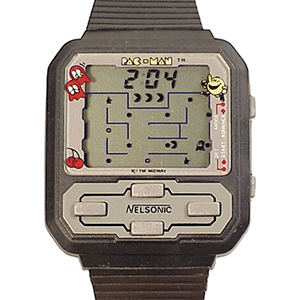
Nelsonic Industries is the name of an electronics manufacturing and development company that operated from Queens, NY in the early 1980s and throughout the 1990s when it was acquired by the watch-manufacturer, M.Z. Berger. Nelsonic produced numerous toy-themed wrist-watches during their existence, often targeting younger audiences with likenesses of characters from popular franchises such as Barbie, the Ghostbusters, and Mario. Nelsonic became notable during the early mid-1980s for being the first electronics company in the United States to produce game-watches (multi-purpose electronic devices capable of functioning as both a time-piece and as a typically electronic game). Today the original Nelsonic Game Watch line has entered the secondary market and individual Game Watches have become highly sought-after collectibles that often fetch high prices on online auction websites.
Throughout its existence, Nelsonic produced pop-culture-themed wrist-watches for children and young adults. The chronograph digital watches, typically made of molded plastic, invariably featured an alarm and utilized LCD display-screens to display the time for their wearers. In time the company began manufacturing multi-purpose units that used the LCD screen to combine time display functions with simple video game functions. These simple video games were variations on the theme of the Calculator watch.
Posted in Games, Money, Technology |
Leave a Comment »
November 29, 2011

A calculator watch is a watch with a calculator built into it. Calculator watches first appeared in the Mid 1970s introduced by Pulsar and Hewlett Packard. Several watch manufacturers have made calculator watches over the years, but the Japanese electronics company Casio produced the largest variety of models. In the mid-1980s, Casio created the Data Bank calculator watch, which not only performed calculator functions, but also stored appointments, names, addresses, and phone numbers. The modern eData version of its Data Bank watch has greater memory and the ability to store computer passwords.
When mass produced calculator watches appeared in the early 1980s (with the most being produced in the middle of the decade), the high-tech community’s demand created a ‘feature war’ of one-up-manship between watch manufacturers. However, as the novelty of this new electronic fad watch wore off, they became, much like pocket protectors and thick glasses, associated with nerds and today are no longer considered to be in vogue. Recently, they have come back in style and are worn ‘ironically’ by hipsters.
Posted in Humor, Money, Technology |
Leave a Comment »
November 29, 2011
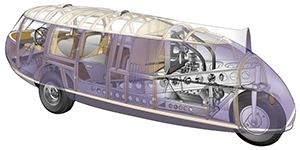

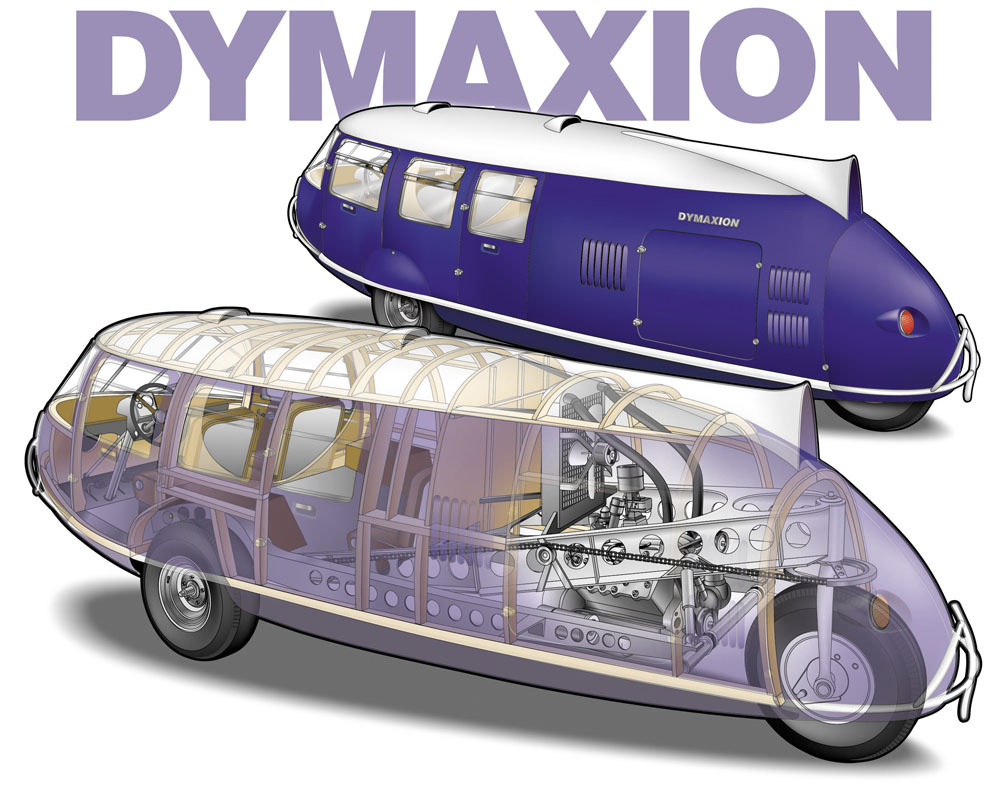
The Dymaxion [dahy-mak-see-uhn] car was a concept car designed by U.S. inventor and architect Buckminster Fuller in 1933. The word Dymaxion is a brand name that Fuller gave to several of his inventions, to emphasize that he considered them part of a more general project to improve humanity’s living conditions. The car had a fuel efficiency of 30 mpg, and could transport 11 passengers.
While Fuller claimed it could reach speeds of 120 miles per hour, the fastest documented speed was 90 miles per hour. Japanese American artist Isamu Noguchi was involved with the development of the Dymaxion car, creating plaster wind tunnel models that were a factor in determining its shape, and during 1934 drove it for an extended road trip through Connecticut with congresswoman Clare Boothe Luce and actress Dorothy Hale.
read more »
Posted in Money, Technology |
1 Comment »
November 29, 2011

A jalopy [juh-lop-ee] (also clunker or hooptie or beater) is a decrepit car, often old and in a barely functional state. A jalopy is not a well kept antique car, but a car which is mostly rundown or beaten up.
As a slang term in American English, ‘jalopy’ was noted in 1924 but is now slightly passé. The term was used extensively in the book ‘On the Road’ by Jack Kerouac, first published in 1957, although written from 1947. The equivalent English term is old banger, often shortened to banger, a reference to older poorly maintained vehicles’ tendency to backfire.
read more »
Posted in Language, Money, Technology |
1 Comment »
November 28, 2011

Rat bikes are motorcycles that have fallen apart over time but been kept on the road and maintained for little or no cost by employing kludge (ad hoc) fixes. The concept of keeping a motorcycle in at least minimally operational condition without consideration for appearance has probably characterized motorcycle ownership since its earliest days. The essence of a rat bike is keeping a motorbike on the road for the maximum amount of time while spending as little as possible on it. This calls for adaptation of parts that were not designed to fit the model of bike in question. Most Rat bikes are painted matte black but this is not a requirement.
‘Survival bikes’ are bikes that may appear to be rat bikes, but are not. They are influenced by the ‘Mad Max’ films. The term survival bike itself originated in the British motorcycle press particularly ‘Back Street Heroes,’ and the now-defunct AWoL in the late 1980s and early 1990s.
Posted in Money, Technology |
Leave a Comment »
November 28, 2011


A rat rod is a style of hot rod or custom car that, in most cases, imitates (or exaggerates) the early hot rods of the 40s, 50s, and 60s. It is not to be confused with the somewhat closely related ‘traditional’ hot rod, which is an accurate re-creation or period-correct restoration of a hot rod from the same era.
Most rat rods appear ‘unfinished’ (whether they actually are or not), with just the bare essentials to be driven. The rat rod is the visualization of the idea of function over form. Rat rods are meant to be driven, not shown off. Sometimes the customization will include using spare parts, or parts from another car altogether.
read more »
Posted in Games, Money, Technology |
Leave a Comment »
November 28, 2011

Novelty architecture is a type of architecture in which buildings and other structures are given unusual shapes as a novelty, such as advertising, notoriety as a landmark, or simple eccentricity of the owner or architect. Many examples of novelty architecture take the form of buildings that resemble the products sold inside to attract drive-by customers.
Others are attractions all by themselves, such as giant animals, fruits, and vegetables, or replicas of famous buildings. And others are merely unusual shapes or made of unusual building materials.
read more »
Posted in Art, Humor, Money |
1 Comment »
November 25, 2011

Junk food news is a sardonic term for news stories that deliver ‘sensationalized, personalized, and homogenized inconsequential trivia,’ especially when such stories appear at the expense of serious investigative journalism.
It implies a criticism of the mass media for disseminating news that, while not very nourishing, is ‘cheap to produce and profitable for media proprietors.’
read more »
Posted in Language, Money, Politics |
1 Comment »
November 25, 2011

Deviancy amplification spiral is a media hype phenomenon defined by media critics as a cycle of increasing numbers of reports on a category of antisocial behavior or some other ‘undesirable’ event, leading to a moral panic. The term was coined in 1972 by Stanley Cohen in his book, ‘Folk Devils and Moral Panics.’ According to Cohen the spiral starts with some ‘deviant’ act. Usually the deviance is criminal, but it can also involve lawful acts considered morally repugnant by a large segment of society.
With the new focus on the issue, hidden or borderline examples that would not themselves have been newsworthy are reported, confirming the ‘pattern.’ Reported cases of such ‘deviance’ are often presented as just ‘the ones we know about’ or the ‘tip of the iceberg,’ an assertion that is nearly impossible to disprove immediately. For a variety of reasons, the less sensational aspects of the spiraling story that would help the public keep a rational perspective (such as statistics showing that the behavior or event is actually less common or less harmful than generally believed) tends to be ignored by the press.
read more »
Posted in Language, Money, Politics |
Leave a Comment »
November 25, 2011


Dieter Rams (b. 1932) is a German industrial designer closely associated with the consumer products company Braun and the Functionalist school of industrial design. Rams studied architecture at the Werkkunstschule Wiesbaden as well as learning carpentry from 1943 to 1957. After working for the architect Otto Apel between 1953 and 1955 he joined the electronic devices manufacturer Braun where he became chief of design in 1961, a position he kept until 1995.
Rams once explained his design approach in the phrase ‘Weniger, aber besser’ which freely translates as ‘Less, but better.’ Rams and his staff designed many memorable products for Braun including the famous SK-4 record player and the high-quality ‘D’-series (D45, D46) of 35 mm film slide projectors. He is also known for designing the 606 Universal Shelving System by Vitsœ in 1960. Many of his designs — coffee makers, calculators, radios, audio/visual equipment, consumer appliances and office products — have found a permanent home at many museums over the world, including MoMA in New York. He continues to be highly regarded in design circles and currently has a major retrospective of his work on tour around the world.
read more »
Posted in Art, Money, Technology |
1 Comment »
November 25, 2011

In the jargon of the media-industry, ‘development hell‘ is a period during which a film or other project is trapped in development. A film, television program screenplay, computer program, concept, or idea stranded in development hell takes an especially long time to start production, or never does.
The film industry buys rights to many popular novels, video games, and comics, but it may take years for such properties to be successfully brought to the cinema, and often with considerable changes to the plot, characters, and general tone.
read more »
Posted in Art, Language, Money |
1 Comment »
November 24, 2011

‘The Mythical Man-Month: Essays on Software Engineering’ is a book on software engineering and project management by Fred Brooks, whose central theme is that ‘adding manpower to a late software project makes it later.’ This idea is known as Brooks’ law, and is presented along with the second-system effect (the tendency of small, elegant, and successful systems to have elephantine, feature-laden monstrosities as their successors) and advocacy of prototyping.
Brooks’ observations are based on his experiences at IBM while managing the development of OS/360. He had mistakenly added more workers to a project falling behind schedule. He also made the mistake of asserting that one project — writing an Algol compiler — would require six months, regardless of the number of workers involved (it required longer). The tendency for managers to repeat such errors in project development led Brooks to quip that his book is called ‘The Bible of Software Engineering,’ because ‘everybody quotes it, some people read it, and a few people go by it.’ The book is widely regarded as a classic on the human elements of software engineering. The work was first published in 1975
read more »
Posted in Language, Money, Technology |
Leave a Comment »






 The Daily Omnivore