November 28, 2011


A rat rod is a style of hot rod or custom car that, in most cases, imitates (or exaggerates) the early hot rods of the 40s, 50s, and 60s. It is not to be confused with the somewhat closely related ‘traditional’ hot rod, which is an accurate re-creation or period-correct restoration of a hot rod from the same era.
Most rat rods appear ‘unfinished’ (whether they actually are or not), with just the bare essentials to be driven. The rat rod is the visualization of the idea of function over form. Rat rods are meant to be driven, not shown off. Sometimes the customization will include using spare parts, or parts from another car altogether.
read more »
Posted in Games, Money, Technology |
Leave a Comment »
November 28, 2011

Novelty architecture is a type of architecture in which buildings and other structures are given unusual shapes as a novelty, such as advertising, notoriety as a landmark, or simple eccentricity of the owner or architect. Many examples of novelty architecture take the form of buildings that resemble the products sold inside to attract drive-by customers.
Others are attractions all by themselves, such as giant animals, fruits, and vegetables, or replicas of famous buildings. And others are merely unusual shapes or made of unusual building materials.
read more »
Posted in Art, Humor, Money |
1 Comment »
November 25, 2011

Junk food news is a sardonic term for news stories that deliver ‘sensationalized, personalized, and homogenized inconsequential trivia,’ especially when such stories appear at the expense of serious investigative journalism.
It implies a criticism of the mass media for disseminating news that, while not very nourishing, is ‘cheap to produce and profitable for media proprietors.’
read more »
Posted in Language, Money, Politics |
1 Comment »
November 25, 2011

Deviancy amplification spiral is a media hype phenomenon defined by media critics as a cycle of increasing numbers of reports on a category of antisocial behavior or some other ‘undesirable’ event, leading to a moral panic. The term was coined in 1972 by Stanley Cohen in his book, ‘Folk Devils and Moral Panics.’ According to Cohen the spiral starts with some ‘deviant’ act. Usually the deviance is criminal, but it can also involve lawful acts considered morally repugnant by a large segment of society.
With the new focus on the issue, hidden or borderline examples that would not themselves have been newsworthy are reported, confirming the ‘pattern.’ Reported cases of such ‘deviance’ are often presented as just ‘the ones we know about’ or the ‘tip of the iceberg,’ an assertion that is nearly impossible to disprove immediately. For a variety of reasons, the less sensational aspects of the spiraling story that would help the public keep a rational perspective (such as statistics showing that the behavior or event is actually less common or less harmful than generally believed) tends to be ignored by the press.
read more »
Posted in Language, Money, Politics |
Leave a Comment »
November 25, 2011


Dieter Rams (b. 1932) is a German industrial designer closely associated with the consumer products company Braun and the Functionalist school of industrial design. Rams studied architecture at the Werkkunstschule Wiesbaden as well as learning carpentry from 1943 to 1957. After working for the architect Otto Apel between 1953 and 1955 he joined the electronic devices manufacturer Braun where he became chief of design in 1961, a position he kept until 1995.
Rams once explained his design approach in the phrase ‘Weniger, aber besser’ which freely translates as ‘Less, but better.’ Rams and his staff designed many memorable products for Braun including the famous SK-4 record player and the high-quality ‘D’-series (D45, D46) of 35 mm film slide projectors. He is also known for designing the 606 Universal Shelving System by Vitsœ in 1960. Many of his designs — coffee makers, calculators, radios, audio/visual equipment, consumer appliances and office products — have found a permanent home at many museums over the world, including MoMA in New York. He continues to be highly regarded in design circles and currently has a major retrospective of his work on tour around the world.
read more »
Posted in Art, Money, Technology |
1 Comment »
November 25, 2011

In the jargon of the media-industry, ‘development hell‘ is a period during which a film or other project is trapped in development. A film, television program screenplay, computer program, concept, or idea stranded in development hell takes an especially long time to start production, or never does.
The film industry buys rights to many popular novels, video games, and comics, but it may take years for such properties to be successfully brought to the cinema, and often with considerable changes to the plot, characters, and general tone.
read more »
Posted in Art, Language, Money |
1 Comment »
November 24, 2011

‘The Mythical Man-Month: Essays on Software Engineering’ is a book on software engineering and project management by Fred Brooks, whose central theme is that ‘adding manpower to a late software project makes it later.’ This idea is known as Brooks’ law, and is presented along with the second-system effect (the tendency of small, elegant, and successful systems to have elephantine, feature-laden monstrosities as their successors) and advocacy of prototyping.
Brooks’ observations are based on his experiences at IBM while managing the development of OS/360. He had mistakenly added more workers to a project falling behind schedule. He also made the mistake of asserting that one project — writing an Algol compiler — would require six months, regardless of the number of workers involved (it required longer). The tendency for managers to repeat such errors in project development led Brooks to quip that his book is called ‘The Bible of Software Engineering,’ because ‘everybody quotes it, some people read it, and a few people go by it.’ The book is widely regarded as a classic on the human elements of software engineering. The work was first published in 1975
read more »
Posted in Language, Money, Technology |
Leave a Comment »
November 24, 2011


Overengineering is when a product is more robust or complicated than necessary for its application, either (charitably) to ensure sufficient factor of safety, sufficient functionality, or due to design errors.
Overengineering is desirable when safety or performance on a particular criterion is critical, or when extremely broad functionality is required, but it is generally criticized from the point of view of value engineering as wasteful. As a design philosophy, such overcomplexity is the opposite of the minimalist school of thought.
read more »
Posted in Money, Technology |
Leave a Comment »
November 24, 2011

Software bloat is a process whereby successive versions of a computer program include an increasing proportion of unnecessary features that are not used by end users, or generally use more system resources than necessary, while offering little or no benefit to its users.
Software developers in the 1970s had severe limitations on disk space and memory. Every byte and clock cycle counted, and much work went into fitting the programs into available resources. Achieving this efficiency was one of the highest values of computer programmers, and the best programs were often called ‘elegant’; —seen as a form of high art.
read more »
Posted in Money, Technology |
Leave a Comment »
November 24, 2011

Shovelware is a derogatory computer jargon term that refers to software noted more for the quantity of what is included than for the quality or usefulness. The term is also used to refer to software that is ported from one computer platform or storage medium to another with little thought given to adapting it for use on the destination platform or medium, resulting in poor quality. The metaphor implies that the creators showed little care for the original software, as if the new compilation or version had been indiscriminately created / ported with a shovel, without any care shown for the condition of the software on the newly created product. The term ‘shovelware’ is coined with semantic analogy to phrases like shareware and freeware, which describe methods of software distribution.
Shovelware was often used to refer to conversions in the manner floppy disc collections were aggregated onto CD-ROMs. Today there is potential for similar shovelware in converting PC websites into mobile websites with little thought to optimizing for the new platform or the conversion of console games to PC games. The practice of shovelware has largely decreased due to the wide availability of high speed networking and software downloading and the limited capacity of removable media in modern computers compared to the growing massive file sizes of newer software packages. It continues in some cases with bundled or pre-installed software, where many extra programs of dubious quality and usefulness are included with a piece of hardware, often called derisively ‘crapware.’
Posted in Games, Money, Technology |
Leave a Comment »
November 23, 2011

Myachi [mee-ah-chee] is the brand name of a type of hand sack. It is a small rectangular bag approximately 1.5 by 3.5 inches (40 by 90 mm) that players use to perform a variety of tricks using every part of the body except the palm of the hand. Myachi can be played alone or in groups. There are a number of different games played with the Myachi including big air, best trick and MYACH, but it is most commonly used for freestyle.
Myachi is based on a popular college game in which lighters, keys or coins are tossed from person to person using only the back of the hand. Myachi founder Steven Ochs was introduced to this game while studying at Vanderbilt University and saw marketing potential in this simple hobby. Headquartered in Nashville, Tennessee, the company began in 1998 when Ochs quit his job as a Wall Street Broker. Starting in the back of an RV, he hand-stitched the first ten thousand Myachis and traveled the country selling his concept at concerts, festivals and street fairs. Today Myachi is a top selling toy.
Posted in Games, Money |
Leave a Comment »
November 23, 2011
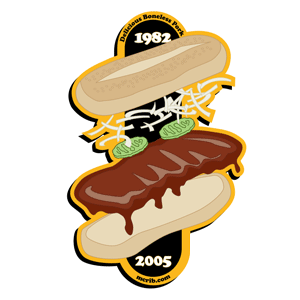
The McRib is a barbecue pork sandwich periodically sold by the international fast-food restaurant chain McDonald’s. It was first introduced to the McDonald’s menu in 1981. After poor sales it was removed from the menu in 1985. It was reintroduced in 1989, staying on the menu until 2005. From 2006 onward, it was made available for a short time each year. The McRib consists of a pork patty, barbecue sauce, onions, and pickles served on a roll. Despite its name, it is primarily composed of pork shoulder meat, according to McDonalds. The patty is also composed of restructured meat products such as tripe, heart, and stomach and blended with salt and water to extract salt-soluble proteins, which act as a ‘glue’ that helps bind the reshaped meat together. The McRib has 70 ingredients, 34 of which are contained in the bun.
It was developed by McDonald’s first Executive Chef Rene Arend, who had fathered Chicken McNuggets in 1979. ‘The McNuggets were so well received that every franchise wanted them,’ said Arend in a 2009 interview. ‘There wasn’t a system to supply enough chicken. We had to come up with something to give the other franchises as a new product. So the McRib came about because of the shortage of chickens.’ It was his inspiration to shape the McRib patty ‘like a slab of ribs,’ despite the fact that a round patty would have been cheaper to manufacture and serve on standard hamburger buns.
Posted in Food, Money |
Leave a Comment »