November 24, 2011


Overengineering is when a product is more robust or complicated than necessary for its application, either (charitably) to ensure sufficient factor of safety, sufficient functionality, or due to design errors.
Overengineering is desirable when safety or performance on a particular criterion is critical, or when extremely broad functionality is required, but it is generally criticized from the point of view of value engineering as wasteful. As a design philosophy, such overcomplexity is the opposite of the minimalist school of thought.
read more »
Posted in Money, Technology |
Leave a Comment »
November 24, 2011

Software bloat is a process whereby successive versions of a computer program include an increasing proportion of unnecessary features that are not used by end users, or generally use more system resources than necessary, while offering little or no benefit to its users.
Software developers in the 1970s had severe limitations on disk space and memory. Every byte and clock cycle counted, and much work went into fitting the programs into available resources. Achieving this efficiency was one of the highest values of computer programmers, and the best programs were often called ‘elegant’; —seen as a form of high art.
read more »
Posted in Money, Technology |
Leave a Comment »
November 24, 2011

Shovelware is a derogatory computer jargon term that refers to software noted more for the quantity of what is included than for the quality or usefulness. The term is also used to refer to software that is ported from one computer platform or storage medium to another with little thought given to adapting it for use on the destination platform or medium, resulting in poor quality. The metaphor implies that the creators showed little care for the original software, as if the new compilation or version had been indiscriminately created / ported with a shovel, without any care shown for the condition of the software on the newly created product. The term ‘shovelware’ is coined with semantic analogy to phrases like shareware and freeware, which describe methods of software distribution.
Shovelware was often used to refer to conversions in the manner floppy disc collections were aggregated onto CD-ROMs. Today there is potential for similar shovelware in converting PC websites into mobile websites with little thought to optimizing for the new platform or the conversion of console games to PC games. The practice of shovelware has largely decreased due to the wide availability of high speed networking and software downloading and the limited capacity of removable media in modern computers compared to the growing massive file sizes of newer software packages. It continues in some cases with bundled or pre-installed software, where many extra programs of dubious quality and usefulness are included with a piece of hardware, often called derisively ‘crapware.’
Posted in Games, Money, Technology |
Leave a Comment »
November 23, 2011

Myachi [mee-ah-chee] is the brand name of a type of hand sack. It is a small rectangular bag approximately 1.5 by 3.5 inches (40 by 90 mm) that players use to perform a variety of tricks using every part of the body except the palm of the hand. Myachi can be played alone or in groups. There are a number of different games played with the Myachi including big air, best trick and MYACH, but it is most commonly used for freestyle.
Myachi is based on a popular college game in which lighters, keys or coins are tossed from person to person using only the back of the hand. Myachi founder Steven Ochs was introduced to this game while studying at Vanderbilt University and saw marketing potential in this simple hobby. Headquartered in Nashville, Tennessee, the company began in 1998 when Ochs quit his job as a Wall Street Broker. Starting in the back of an RV, he hand-stitched the first ten thousand Myachis and traveled the country selling his concept at concerts, festivals and street fairs. Today Myachi is a top selling toy.
Posted in Games, Money |
Leave a Comment »
November 23, 2011
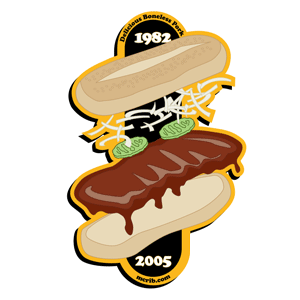
The McRib is a barbecue pork sandwich periodically sold by the international fast-food restaurant chain McDonald’s. It was first introduced to the McDonald’s menu in 1981. After poor sales it was removed from the menu in 1985. It was reintroduced in 1989, staying on the menu until 2005. From 2006 onward, it was made available for a short time each year. The McRib consists of a pork patty, barbecue sauce, onions, and pickles served on a roll. Despite its name, it is primarily composed of pork shoulder meat, according to McDonalds. The patty is also composed of restructured meat products such as tripe, heart, and stomach and blended with salt and water to extract salt-soluble proteins, which act as a ‘glue’ that helps bind the reshaped meat together. The McRib has 70 ingredients, 34 of which are contained in the bun.
It was developed by McDonald’s first Executive Chef Rene Arend, who had fathered Chicken McNuggets in 1979. ‘The McNuggets were so well received that every franchise wanted them,’ said Arend in a 2009 interview. ‘There wasn’t a system to supply enough chicken. We had to come up with something to give the other franchises as a new product. So the McRib came about because of the shortage of chickens.’ It was his inspiration to shape the McRib patty ‘like a slab of ribs,’ despite the fact that a round patty would have been cheaper to manufacture and serve on standard hamburger buns.
Posted in Food, Money |
Leave a Comment »
November 23, 2011
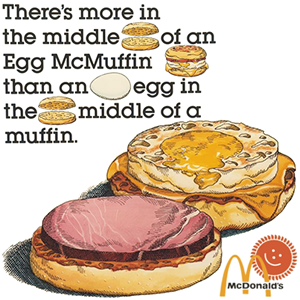
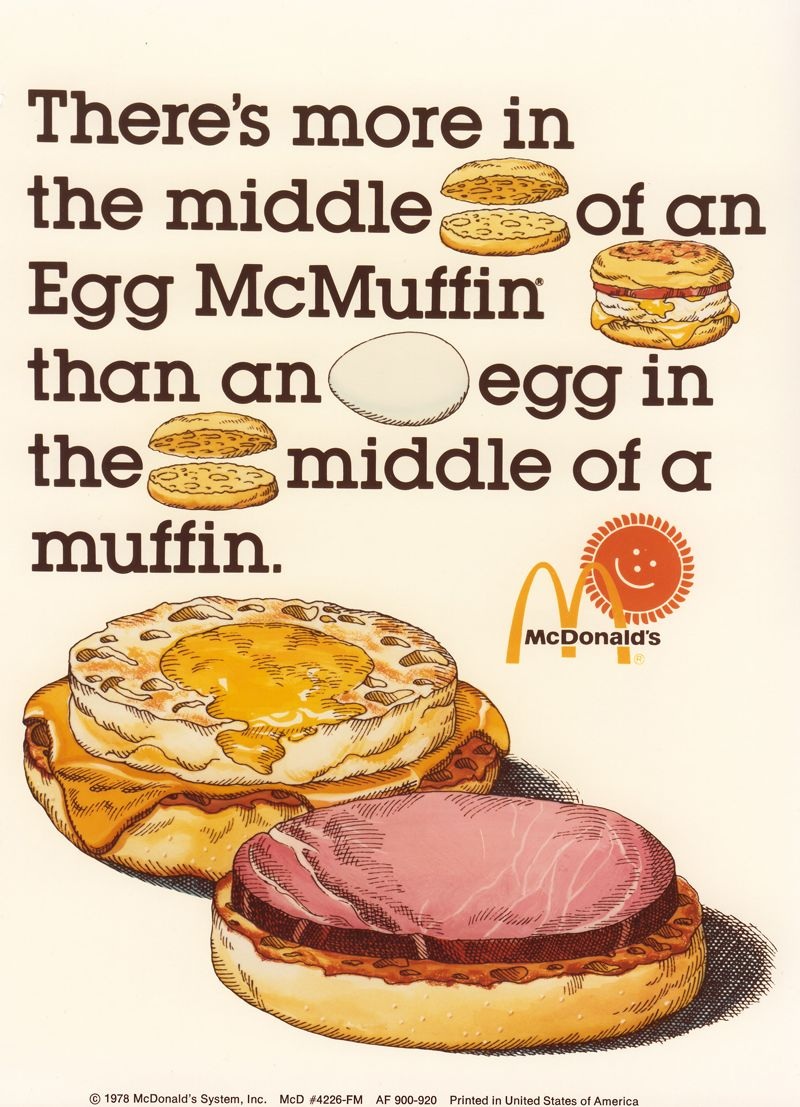
The McMuffin is a family of breakfast sandwiches in various sizes and configurations, sold by the fast-food restaurant chain McDonald’s. It was invented by the late McDonald’s franchisee Herb Peterson in the late 1960s and was introduced nationwide in 1972. In the US and Canada the standard McMuffin consists of a slice of Canadian bacon, a griddle-fried egg, and a slice of American cheese on a toasted and buttered English muffin. The round shape of the egg is made by cooking it in a teflon coated ring. Peterson first presented the Egg McMuffin at a Santa Barbara franchise without the knowledge of McDonald’s Corporate, which at the time served only lunch and dinner at all their locations.
When Corporate discovered Mr. Peterson’s unauthorized breakfast offerings, it initially reprimanded him and threatened him with a number of penalties for breaking the franchise agreement. Today, several countries like Hong Kong serve Egg McMuffins around the clock, due to the prominent use of the egg in meals other than breakfast in those regions. US restaurants usually restrict the item to the breakfast menu. This is due mainly because the grill temperature for the beef patties and the eggs are significantly different from each other.
Posted in Food, Money |
Leave a Comment »
November 22, 2011

Terry Richardson (b. 1965) is an American fashion photographer. Richardson was born in New York City, the son of Bob Richardson, a fashion photographer who struggled with schizophrenia and drug abuse. Richardson was raised in Hollywood. He was shy as a teenager and at some times deemed ‘completely lacking in social skills.’ He played bass guitar in the punk rock band The Invisible Government for 5 years. Richardson began photography when the band broke up and his mother introduced him to Tony Kent, a photographer who hired him as an assistant.
Richardson’s photographs often contain graphic sexual subject matter. Richardson has shot advertisements for fashion designers and editorial photographs. His alleged attitude towards models has been criticized by Danish model and filmmaker Rie Rasmussen and others, who have accused Richardson of exploiting and sexually abusing the models he photographs.
Posted in Art, Money, Sex |
Leave a Comment »
November 22, 2011

Glamorama is a novel by American writer Bret Easton Ellis, published in 1998. Unlike Ellis’ previous novels, Glamorama is set in and satirizes the 1990s, specifically celebrity culture and consumerism. Ellis wanted to write a Stephen King-style ghost story novel (which would eventually become ‘Lunar Park’); finding it difficult at the time, he began work on the other novel which he had in mind, a Robert Ludlum-style thriller, with the intention of using one of his own vapid characters who lack insight as the narrator. The novel is a satire of modern celebrity culture, featuring models-turned-terrorists.
A character remarks, ‘basically, everyone was a sociopath…and all the girls’ hair was chignoned.’ (A chignon is an arrangement of long hair in a roll or knot at the back of the head). The novel plays upon the conspiracy thriller conceit of someone ‘behind all the awful events,’ to dramatize the revelation of a world of random horror. The lack of resolution contributes to Ellis’ artistic effect. The obsession with beauty is reflected in consistent namedropping; this satirizes Victor’s obsession with looks, and perhaps is indicative of the author’s own attraction to glamor.
read more »
Posted in Art, Language, Money |
Leave a Comment »
November 22, 2011

A motivational poster (or affirmation poster or inspirational poster) is a type of poster commonly designed for use in schools and offices. The intent of motivational posters is to make people achieve more, or to think differently about the things that they may be learning or doing. Motivational posters can have behavioral effects. For example, the University of Glasgow found in one study that their placement of a motivational poster that promotes stair use in front of an escalator and a parallel staircase, in an underground station, doubled the amount of stair use.
This kind of poster has been repeatedly parodied, and parody motivational posters have become an Internet meme. One famous motivational poster features a kitten hanging from a tree branch along with the phrase ‘Hang in There, Baby!’ This has been the target of various reproductions and parodies, such as an appearance on ‘The Simpsons’ episode ‘The Twisted World of Marge Simpson’ where Marge Simpson notices the copyright date (1968) and comments, ‘…determined or not, that cat must be long dead. That’s kind of a downer.’ Despair, Inc. has made a business out of such parody and cynical posters, with ‘demotivational posters’ ranging from a picture of a tree bent over by wind with the caption ‘ADVERSITY: That which does not kill me postpones the inevitable.’ to a picture of a sinking ship with the caption ‘MISTAKES: It could be that the purpose of your life is only to serve as a warning to others.’
Posted in Humor, Language, Money |
Leave a Comment »
November 21, 2011
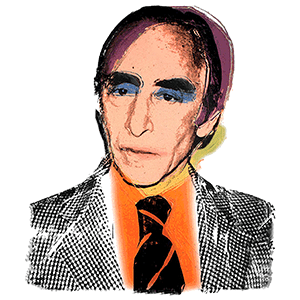
Leo Castelli (1907 – 1999), born Leo Krausz, was an American art dealer whose gallery showcased cutting edge Contemporary art for five decades. Castelli showed Surrealism, Abstract Expressionism, Neo-Dada, Pop Art, Op Art, Color field painting, Hard-edge painting, Lyrical Abstraction, Minimal Art, Conceptual Art, and Neo-expressionism, among other movements. Leo Castelli was born at Trieste, of Italian and Austro-Hungarian Jewish origin. Castelli’s first American curatorial effort was the famous Ninth Street Show of 1951, a seminal event of Abstract Expressionism.
In 1957, he opened the Leo Castelli Gallery in a townhouse on 77th Street between Madison and Fifth Avenues. Initially the gallery showcased European Surrealism, Wassily Kandinsky, and other European artists. However the gallery also exhibited American Abstract Expressionism. Jackson Pollock and Willem de Kooning were some artists who were included in group shows. In 1958, Robert Rauschenberg and Jasper Johns joined the gallery, signaling a turning away from Abstract Expressionism, towards Pop Art, Minimalism and Conceptual Art. From the early 1960s through the late 70s, Frank Stella, Roy Lichtenstein, Andy Warhol, and Ed Ruscha joined the stable of Castelli artists.
Posted in Art, Money |
Leave a Comment »
November 20, 2011

Famous for being famous, in popular culture terminology, refers to someone who attains celebrity status for no particular identifiable reason, or who achieves fame through association with a celebrity. The term is a pejorative, suggesting that the individual has no particular talents or abilities. Even when their fame arises from a particular talent or action on their part, the term will sometimes still apply if their fame is perceived as disproportionate to what they earned through their own talent or work.
The term originates from an analysis of the media dominated world called ‘The Image: A Guide to Pseudo-events in America’ (1961), by historian and social theorist Daniel J. Boorstin. In it, he defined the celebrity as ‘a person who is known for his well-knownness.’ He further argued that the graphic revolution in journalism and other forms of communication had severed fame from greatness, and that this severance hastened the decay of fame into mere notoriety. Over the years, the phrase has been glossed as ‘a celebrity is someone who is famous for being famous’.
read more »
Posted in Humor, Language, Money |
1 Comment »
November 19, 2011

The term shunpiking comes from the word shun, meaning ‘to avoid,’ and pike, a term referring to turnpikes, which are roads that require payment of a toll to travel on them. People who often avoid toll roads sometimes call themselves shunpikers. Shunpiking has also come to mean an avoidance of major highways (regardless of tolls) in preference for bucolic and scenic interludes along lightly traveled country roads.
The word ‘shunpike’ may have its origins in post-colonial New Hampshire: When the ‘Turnpike’ was built, around 1810 or so, by the Hampton Causeway Turnpike Corporation, a toll was charged to cross it at Taylor’s River. Not content with the payment of a toll, some of the residents got together and built a slight bridge called the ‘Shunpike’ across the River, some distance west of the Turnpike bridge, where travelers and teamsters could cross without charge. This continued on until 1826, when the toll on the Turnpike was discontinued and has remained a free road to this day
read more »
Posted in Language, Money, World |
Leave a Comment »





 The Daily Omnivore