July 25, 2013
YOLO is an acronym for ‘you only live once.’ Similar to ‘carpe diem’ (‘seize the day’) or ‘memento mori’ (‘remember that you will die’), it implies that one should enjoy life, even if that entails taking risks. The expression’ is commonly attributed to Golden Age film star Mae West, but variations of the phrase have been in use for over 100 years, including as far back as (the German equivalent of) ‘one lives but once in the world’ by Johann Wolfgang von Goethe in his 1774 play ‘Clavigo’ and as the title of a waltz, ‘Man lebt nur einmal!’ (‘You Only Live Once!’) by Johann Strauss II in 1855.
The acronym is in youth culture and music, and was popularized by the 2011 song ‘The Motto’ by Canadian rapper Drake (who later claimed to want royalties due to the proliferation of merchandise bearing the phrase). Actor Zac Efron has a tattoo with the acronym. The expression has been criticized for its use in conjunction with reckless behavior, most notably in a Twitter post by aspiring rapper Ervin McKinness just prior to his death: ‘Drunk af going 120 drifting corners #FuckIt YOLO.’
Posted in Humor, Language, Philosophy |
Leave a Comment »
July 25, 2013
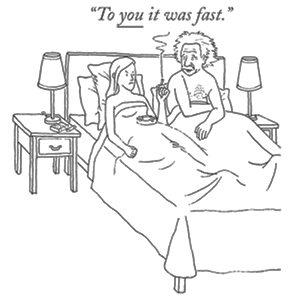
Relativism [rel-uh-tuh-viz-uhm] is the concept that points of view have no absolute truth or validity, having only relative, subjective value according to differences in perception and consideration. The term is often used to refer to the context of moral principle, where in a relativistic mode of thought, principles and ethics are regarded as applicable in only limited context.
There are many forms of relativism which vary in their degree of controversy. The term often refers to ‘truth relativism,’ which is the doctrine that there are no absolute truths, i.e., that truth is always relative to some particular frame of reference, such as a language or a culture (cultural relativism). Another widespread and contentious form is moral relativism (which argues that morality is context-bound, not objective).
read more »
Posted in Philosophy |
Leave a Comment »
July 23, 2013

Technological determinism [dih-tur-muh-niz-uhm] is a reductionist theory that presumes that a society’s technology drives the development of its social structure and cultural values. The term is believed to have been coined by American economist and sociologist Thorstein Veblen (1857–1929). The most radical technological determinist in the United States in the twentieth century was most likely economist Clarence Ayres who was a follower of Veblen and American philosopher and psychologist John Dewey. Sociologist William Ogburn was also known for espousing theories of radical technological determinism.
Veblen’s contemporary, popular historian Charles A. Beard, said of the concept: ‘Technology marches in seven-league boots from one ruthless, revolutionary conquest to another, tearing down old factories and industries, flinging up new processes with terrifying rapidity.’
read more »
Posted in Philosophy, Politics, Technology |
1 Comment »
July 16, 2013

‘Testament‘ was an American comic book series written by media theorist Douglas Rushkoff with art and covers by Liam Sharp. It was published from February 2006 to March 2008 under DC Comics’ Vertigo imprint.
The story takes place simultaneously in the near future and the biblical past to illustrate the most prominent theme: that history repeats itself. This is done by juxtaposing the two timelines, the purpose of which seems to be to illustrate that religion is a continually evolving, living story that is being written by how people, and specifically the protagonists, live their daily lives. Other themes include increasing numbers of fascist governments, human rights, technology, and information economics in the form of a global currency, manna.
read more »
Posted in Art, Language, Philosophy |
Leave a Comment »
July 13, 2013

In historical analysis, biblical criticism and comparative mythology parallelomania [par-uh-lel-uh-mey-nee-uh] refers to a phenomenon where authors perceive apparent similarities and construct parallels and analogies without historical basis.
The concept was introduced to scholarly circles in 1961 by Rabbi Samuel Sandmel of the Hebrew Union College in a paper of the same title, where he stated that he had first encountered the term in a French book of 1830, but did not recall the author or the title. Sandmel stated that the simple observations of similarity between historical events are often less than valid, but at times lead to a phenomenon where authors first notice a supposed similarity, overdose on analogy, and then, ‘proceeds to describe source and derivation as if implying a literary connection flowing in an inevitable or predetermined direction.’
read more »
Posted in Education, Language, Philosophy |
Leave a Comment »
July 11, 2013

Sympathetic magic, also known as ‘imitative magic,’ is a type of magic based on imitation or correspondence.
It has been said that the theory of sympathetic magic was first popularized in 1889 by Scottish anthropologist Sir James George Frazer in ‘The Golden Bough’ (a comparative study of mythology and religion); German geographer and ethnographer Richard Andree, however, anticipates Frazer, writing of ‘Sympathie-Zauber’ in his 1878 ‘Ethnographische Parallelen und Vergleiche’ (‘Ethnographic Parallels and Comparisons). Frazer further subcategorized sympathetic magic into two varieties: that relying on similarity, and that relying on contact or ‘contagion.’
read more »
Posted in Health, Philosophy |
Leave a Comment »
June 27, 2013

Pseudorationalism [soo-doh-rash-uh-nl-iz-uhm] was the label given by economist and philosopher Otto Neurath to a school of thought that he was heavily critical of, throughout many of his writings but primarily in his 1913 paper ‘The lost wanderers of Descartes and the auxiliary motive’ and later to a lesser extent in his 1935 ‘Pseudorationalismus der Falsifikation,’ a review of and attack on philosopher of science Karl Popper’s first book, ‘Logik der Forschung’ (‘The Logic of Scientific Discovery’), contrasting this approach with his own view of what rationalism should properly be.
Neurath aimed his criticism at a Cartesian belief that all actions can be subject to rational analysis, saying that: ‘Once reason has gained a certain influence, people generally show a tendency to regard all their actions as reasonable. Ways of action which depend on dark instincts receive reinterpretation or obfuscation.’
read more »
Posted in Money, Philosophy, Science |
Leave a Comment »
June 26, 2013
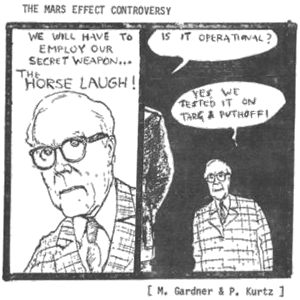
Pseudoskepticism [soo-doh-skep-tuh-siz-uhm] refers to a philosophical or scientific position which appears to be that of skepticism or scientific skepticism but which in reality fails to be so, for whatever reason.
The term is usually used pejoratively.
read more »
Posted in Language, Philosophy, Science |
Leave a Comment »
June 20, 2013
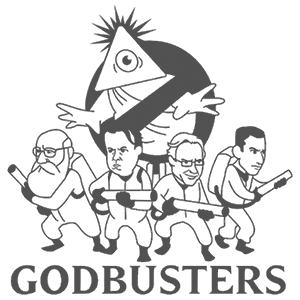
New Atheism is a social and political movement that began in the early 2000s by a collection of modern atheist writers who have advocated the view that ‘religion should not simply be tolerated but should be countered, criticized, and exposed by rational argument wherever its influence arises.’ During ‘The God Debate’ in 2010 featuring Christopher Hitchens and Dinesh D’Souza four outspoken atheists (Richard Dawkins, Christopher Hitchens, Sam Harris, and Daniel Dennett) were referred to as the ‘Four Horsemen of the Non-Apocalypse,’ a cheeky counterpart to the figures in the Book of Revelation.
Harris is a neuroscientist and the author of, ‘The End of Faith,’ ‘Letter to a Christian Nation,’ and ‘The Moral Landscape.’ Biologist Richard Dawkins is the author of ‘The God Delusion,’ which was preceded by a British television documentary titled ‘The Root of all Evil?’ Philosopher Daniel Dennett, author of ‘Darwin’s Dangerous Idea,’ ‘Breaking the Spell,’ and many others, has also been a vocal supporter of ‘The Clergy Project,’ an organization which provides support for clergy in the US who no longer believe in God, and cannot fully participate in their communities any longer. Journalist Christopher Hitchens was the author of ‘God Is Not Great’ and served on the advisory board of the Secular Coalition for America.
Posted in Humor, Philosophy |
1 Comment »
June 19, 2013
The Committee for Skeptical Inquiry (CSI), formerly known as the Committee for the Scientific Investigation of Claims of the Paranormal (CSICOP), is a program within the U.S. non-profit organization Center for Inquiry (CFI), whose stated purpose is to ‘encourage the critical investigation of paranormal and fringe-science claims from a responsible, scientific point of view and disseminate factual information about the results of such inquiries to the scientific community and the public.’
CSI was founded in 1976 by skeptic and secular humanist Paul Kurtz to counter what he regarded as an uncritical acceptance of, and support for, paranormal claims by both the media and society in general. Its philosophical position is one of scientific skepticism. CSI’s fellows have included many notable scientists, Nobel laureates, philosophers, educators, authors, and celebrities. It is headquartered in Amherst, New York.
read more »
Posted in Education, Philosophy, Science |
Leave a Comment »
June 10, 2013

There are a number of disputes relating to the Church of Scientology’s efforts to suppress material critical of Scientology on the Internet through the use of lawsuits and legal threats. In late 1994, the Church of Scientology began using various legal tactics to stop distribution of unpublished documents written by L. Ron Hubbard.
The Church of Scientology is often accused of barratry (litigation for the purpose of harassment or profit) through the filing of SLAPP suits (lawsuits intended to censor, intimidate, and silence critics by burdening them with the cost of a legal defense until they abandon their criticism or opposition). The official church response is that its litigious nature is solely to protect its copyrighted works and the unpublished status of certain documents.
read more »
Posted in Philosophy, Politics, Technology |
Leave a Comment »
June 10, 2013

‘Going Clear: Scientology, Hollywood, and the Prison of Belief’ is a 2013 non-fiction book about Scientology written by American journalist Lawrence Wright. The book contains interviews from current and former Scientologists, the history of founder L. Ron Hubbard and current leader David Miscavige, and analysis of the relationships of Tom Cruise and John Travolta to the organization.
In an interview with the ‘New York Times’ Wright said that ‘There are a lot of people out there who were very high up in the church and know a lot about it who have become outspoken…I’m very lucky to come along at a time when a lot of these people are ready to talk.’ Wright also disclosed that he has received ‘innumerable’ letters threatening legal action from lawyers representing the church and celebrities who belong to it.
read more »
Posted in Language, Money, Philosophy |
Leave a Comment »


 The Daily Omnivore