January 24, 2026

The Highest Court in the Land is the basketball court located on the fifth floor of the United States Supreme Court Building. The Supreme Court of the United States is nicknamed the ‘highest court in the land’ because it is the highest court in the federal judiciary of the United States, and the basketball court is located on a higher floor than the courtroom where the Supreme Court meets, hence the basketball court’s nickname.
While Supreme Court law clerks regularly play on the court, it is less common for the justices to do so. The first justice to play basketball on the court was Byron White, according to fellow justice Sandra Day O’Connor.
read more »
Posted in Games, Politics |
1 Comment »
January 10, 2026

A pig-butchering scam is a type of online fraud where the victim is encouraged to make increasing financial contributions over a long period, usually in the form of cryptocurrency. The term compares the initial phase of gaining the victims’ trust to the fattening of pigs before slaughtering them. Such scams are commonplace on social media and dating apps, and often involve elements of catfishing (using false identities), investment fraud, and romance scams.
The scammer builds trust with the victim through online communication, subsequently persuading them to invest in a fraudulent cryptocurrency scheme. Perpetrators are typically victims of a fraud factory, where they are lured to travel internationally under false pretenses, trafficked to another location, and forced to commit the fraud by organised crime gangs.
read more »
Posted in Money, Politics |
Leave a Comment »
January 1, 2026

A Witness Tree is a tree that was present during a grand historical or cultural event of America. Witness trees are centuries old and are known to be of great importance to the U.S. nation’s history. It is unclear how many witness trees there are, but the ones documented are archived in the Library of Congress through the Witness Tree Protection Program, which was founded in 2006.
The program was initially created to document and identify two dozen historically significant trees in the Washington DC area. The creation of the program came from the discovery of Yoshino cherry trees from the year 1910.
read more »
Posted in Politics, War |
1 Comment »
December 23, 2025

Since 2018, the health effects of consuming certain processed vegetable oils, or seed oils have been subject to misinformation in popular and social media. The trend grew in 2020 after podcaster and comedian Joe Rogan interviewed fad diet proponent Paul Saladino about the carnivore diet. Saladino made several claims about the health effects of vegetable fats.
The theme of the misinformation is that seed oils are the root cause of most diseases of affluence, including heart disease, cancer, diabetes, and liver spots. These claims are not based on evidence, but have nevertheless become popular on the political right. Critics cite a specific ‘hateful eight’ oils that constitute seed oils: canola, corn, cottonseed, soy, sunflower, safflower, grapeseed, and rice bran.
read more »
Posted in Food, Health, Politics |
1 Comment »
October 6, 2025

Mar-a-Lago face is a plastic surgery and fashion trend among American conservative and Republican individuals such as excessive makeup, fake tans, fake eyelashes, dark smokey eyes, and full lips.
The trend has been described as a status symbol among Donald Trump’s inner circle, purportedly signaling wealth, privilege, and alignment with Trumpism. Some commentators and surgeons have described the look as engineered and overdone, and have linked it to the aesthetics and aspects of Trump-era politics. One cosmetic surgeon listed facial surgery, fillers, and cosmetic dental work among the procedures constituting the look.
read more »
Posted in Politics |
Leave a Comment »
September 13, 2025

The Groypers, sometimes called the Groyper Army, are a group of alt-right, white nationalist, and Christian nationalist activists led by Nick Fuentes. Members of the group have attempted to introduce alt-right politics into mainstream conservatism in the United States and participated in the January 6 United States Capitol attack and the protests leading up to it. They have targeted other conservative groups and individuals whose agendas they view as too moderate and insufficiently nationalist.
The Groyper movement has been described as white nationalist, homophobic, nativist, fascist, sexist, antisemitic, and an attempt to rebrand the declining alt-right movement. Groypers are a loosely defined group of Fuentes’s followers and fans. After him, there is no clear second in the Groyper hierarchy. Groypers are named after a cartoon amphibian named ‘Groyper,’ a variant of the Internet meme Pepe the Frog.
read more »
Posted in Politics |
Leave a Comment »
August 28, 2025


A data broker is an individual or company that specializes in collecting personal data (such as income, ethnicity, political beliefs, or geolocation data) or data about people, mostly from public records but sometimes sourced privately, and selling or licensing such information to third parties for a variety of uses.
Sources, usually Internet-based since the 1990s, may include census and electoral roll records, social networking sites, court reports and purchase histories. The information from data brokers may be used in background checks used by employers and housing.
read more »
Posted in Money, Politics, Technology |
Leave a Comment »
May 13, 2025

Zersetzung [zer-set-zung] (German for ‘decomposition’ and ‘disruption’) was a psychological warfare technique used by the Ministry for State Security (Stasi) to repress political opponents in East Germany during the 1970s and 1980s. Zersetzung served to combat alleged and actual dissidents through covert means, using secret methods of abusive control and psychological manipulation to prevent anti-government activities.
Among the defining features of it was the widespread use of offensive counterespionage methods as a means of repression. People were commonly targeted on a preemptive and preventive basis, to limit or stop activities of political dissent and cultural incorrectness that they may have gone on to perform, and not on the basis of crimes they had actually committed. Zersetzung methods were designed to break down, undermine, and paralyze people behind ‘a facade of social normality’ in a form of ‘silent repression.’
read more »
Posted in Politics, World |
1 Comment »
March 31, 2025

Steganography [steg-uh-nog-ruh-fee] is the practice of representing information within another message or physical object, in such a manner that the presence of the concealed information would not be evident to an unsuspecting person’s examination.
The word steganography comes from Greek words steganós (‘covered or concealed’) and graphia (‘writing’). The first recorded use of the term was in 1499 by German Benedictine abbot Johannes Trithemius in his Steganographia, a treatise on cryptography and steganography, disguised as a book on magic.
read more »
Posted in Politics, Science, Technology |
Leave a Comment »
March 19, 2025
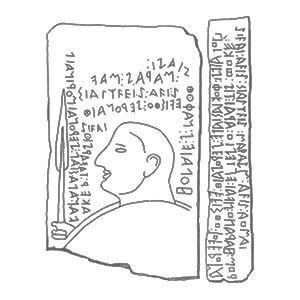
A stele [stee-lee] or stela [stee-lah] is a stone or wooden slab, generally taller than it is wide, erected in the ancient world as a monument. The surface of the stele often has text, ornamentation, or both. These may be inscribed, carved in relief, or painted.
Steles have also been used to publish laws and decrees, to record a ruler’s exploits and honors, to mark sacred territories or mortgaged properties, as territorial markers, as the boundary steles of Akhenaton at Amarna, or to commemorate military victories. They were widely used in the ancient Near East, Mesopotamia, Greece, Egypt, Somalia, Eritrea, Ethiopia, and, most likely independently, in China and elsewhere in the Far East, and, independently, by Mesoamerican civilizations, notably the Olmec and Maya.
read more »
Posted in Philosophy, Politics, World |
Leave a Comment »
February 3, 2025

The phantom time conspiracy theory is a pseudohistorical conspiracy theory first asserted by Heribert Illig in 1991. It hypothesizes a conspiracy by the Holy Roman Emperor Otto III, Pope Sylvester II, and possibly the Byzantine Emperor Constantine VII, to fabricate the Anno Domini dating system retroactively, in order to place them at the special year of AD 1000, and to rewrite history to legitimize Otto’s claim to the Holy Roman Empire.
Illig suggested this was achieved through the alteration, misrepresentation and forgery of documentary and physical evidence. According to this scenario, the entire Carolingian period, including the figure of Charlemagne, is a fabrication, with a ‘phantom time’ of 297 years (614–911) added to the Early Middle Ages. Substantial evidence contradicts the hypothesis and it failed to gain the support of historians, and calendars in other European countries, most of Asia and parts of pre-Columbian America contradict this.
read more »
Posted in Politics |
Leave a Comment »
January 7, 2025

The Outrage Industrial Complex (OIC) is a combination of forces including media outlets, social media influencers, political fundraising messaging, and individuals in media, political leadership or advocacy that in the late 20th and early 21st centuries exploited differences of opinion and what was termed a culture of contempt drawn along political and social lines, increasing distrust of institutions and society, to advance their own desires for fame, wealth, higher office, or for geopolitical reasons.
The OIC creates and distributes outrage media, digital or print content specifically intended to provoke anger or outrage among its consumers to increase engagement. The complex includes media outlets, social media influencers, political fundraising messaging, and individuals in media, political leadership or advocacy who call out ‘outrages,’ hoping to generate what Richard Thompson Ford, writing for ‘The American Interest,’ calls a sense of ‘righteous indignation’ and rage borne of frustration in their readers or listeners, often for their own purposes of attracting advertisers or fame or to intentionally cause social disruption in a country or region.
read more »
Posted in Money, Politics |
1 Comment »


 The Daily Omnivore