January 26, 2011
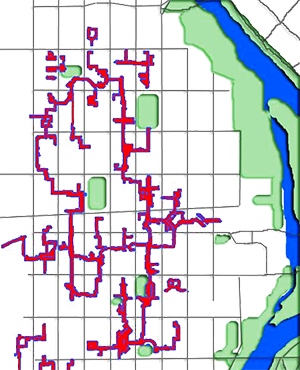
The Plus 15 or +15 Skyway network in Calgary, Alberta, Canada, is the world’s most extensive pedestrian skywalk system with a total length of 16 kilometers (10 mi) and 59 bridges. The system is so named because the skywalks are approximately 15 feet (approximately 4.5 metres) above street level. (Some Plus 15 skywalks are multi-level, with higher levels being referred to as +30’s and +45’s.)
Opening in 1970, the +15 network has expanded to include dozens of downtown Calgary buildings. The central core of the system is a series of enclosed shopping centers, and the city’s flagship department stores. Although there are currently no plans to remove bridges or to discontinue building new ones, the system has been subject to criticism in recent years. It has been identified with a decline in street life in the Downtown Commercial Core. Street life is instead concentrated on streets (such as Stephen Avenue) or in neighbourhoods where there are no bridges (such as Eau Claire and the Beltline).
Posted in Money, Politics, Technology |
Leave a Comment »
January 26, 2011
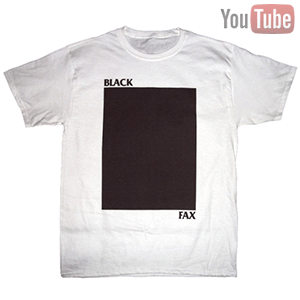
The term black fax refers to a prank fax transmission, consisting of one or more pages entirely filled with a uniform black tone and often made into a loop the sending machine will transmit endlessly. The sender’s intention is typically to consume as much of the recipient’s fax ink, toner or thermal paper or disk space as possible, thus costing the recipient money and/or denying the recipient the use of their machine (this is similar to computer-based denial of service attacks).
Black faxes can be particularly effective as the fax algorithm compresses the solid black image very well, so a very short fax call can produce many pages. They have been used to harass large institutions or government departments, to retaliate against the senders of junk faxes, or merely as simple pranks. In a black fax attack, one or more sheets are fed halfway through the sender’s fax machine and taped end to end, forming an endless loop that cycles through the machine. Not only can solid black be used, but also images which will repeat endlessly on the receiver’s machine until his or her toner runs out.
Posted in Humor, Politics, Technology |
Leave a Comment »
January 25, 2011


Prole drift, short for proletarian drift, is a trend in which products, styles or other aspects of culture previously considered to be upscale or upper class become popular among working class people. Prole drift can also go the other way, as when things that were once the purview of the working class become fashionable in the middle or upper classes. The term was coined by, American literary historian, Paul Fussell in 1983 to describe the phenomenon of most aspects of high culture eventually joining the lowest common denominator.
Examples include sales of premium coffee, Burberry clothing or Coach Inc. handbags to working class people. Examples of reverse prole drift include Mockney, the skinhead and punk subcultures, hip hop, rockabilly, dressing down, slumming it (e.g. going to a working class bar) and NASCAR. BMW cars (particularly the 3 series) have also suffered from this phenomenon, in some instances the 3 series outselling more mainstream cars such as the Ford Mondeo and Vauxhall Vectra.
Posted in Language, Money, Politics |
Leave a Comment »
January 25, 2011

A fad, sometimes called a trend, meme or a craze, is any form of behavior that develops among a large population and is collectively followed with enthusiasm for some period, generally as a result of the behavior’s being perceived as novel in some way.
A fad is said to ‘catch on’ when the number of people adopting it begins to increase rapidly, but they fade quickly once the perception of novelty is gone. Though the term trend may be used interchangeably with fad, a fad is generally considered a fleeting behavior whereas a trend is considered to be a behavior that evolves into a relatively permanent change.
read more »
Posted in Language, Money, Politics |
Leave a Comment »
January 25, 2011

A robot jockey is commonly used on camels in camel racing. Early designs confused or frightened the camels, so the robots were modified to include more human-like features, including a mannequin-like face, sunglasses, hats, racing silks and even traditional perfumes used by human jockeys. Developed since 2004, the robotic jockeys are slowly phasing out the use of human jockeys, which, in the case of camel racing in the Middle East, often employs small children who reportedly suffer repeated systemic human rights abuses. In response to international condemnation of such abuses, the nations of Qatar and the UAE have banned the use of human jockeys in favor of robots.
Camel racing has been around for thousands of years. ‘The Sport of Sheiks’ almost exclusively utilized small children, usually boys around the age of four, to ride and direct the camels. Often, the boys would be starved to be as light as possible. Many of the boys used for the races were often sold to race organizers or camel owners, and there was an active child slave trade for camel jockeys, involving victims of kidnapping or the children of destitute families who sold them into servitude.
Posted in Politics, Technology, World |
Leave a Comment »
January 24, 2011

A straw man argument is an informal fallacy based on misrepresentation of an opponent’s position. To ‘attack a straw man’ is to create the illusion of having refuted a proposition by substituting it with a superficially similar yet not equivalent proposition (the ‘straw man’), and refuting it, without ever having actually refuted the original position.
The origins of the term are unclear; one common (folk) etymology given is that it originated with men who stood outside courthouses with a straw in their shoe in order to indicate their willingness to be a false witness, but the practice is of questionable authority. Another more popular origin is a human figure made of straw, such as practice dummies used in military training. Such a dummy is supposed to represent the enemy, but it is considerably easier to attack because it neither moves, nor fights back.
Posted in Language, Politics |
Leave a Comment »
January 24, 2011
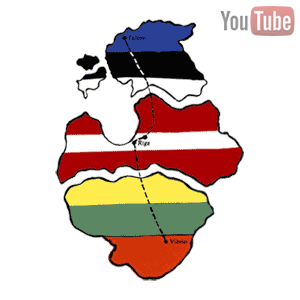
The Baltic Way was a peaceful political demonstration that occurred on August 23, 1989. Approximately two million people joined their hands to form a human chain spanning over 600 kilometres (370 mi) across the three Baltic states – Estonian SSR, Latvian SSR, and Lithuanian SSR, republics of the Soviet Union. It marked the 50th anniversary of the Molotov–Ribbentrop Pact between the Soviet Union and Nazi Germany. The pact and its secret protocols divided Eastern Europe into spheres of influence and led to the occupation of the Baltic states in 1940.
The event was organised by Baltic pro-independence movements: Rahvarinne of Estonia, Popular Front of Latvia, and Sąjūdis of Lithuania. The protest was designed to draw global attention by demonstrating a popular desire for independence for each of the entities. It also illustrated solidarity among the three nations. Within six months from the protest, Lithuania became the first of the Republics of the Soviet Union to declare independence.
Posted in Politics, World |
Leave a Comment »
January 24, 2011

Helicopter parent is a colloquial, early 21st-century term for a parent who pays extremely close attention to his or her child’s or children’s experiences and problems, particularly at educational institutions. The term was originally coined by Foster W. Cline, M.D. and Jim Fay in their 1990 book ‘Parenting with Love and Logic.’
Helicopter parents are so named because, like helicopters, they hover closely overhead, rarely out of reach, whether their children need them or not. They try to resolve their child’s problems, and try to stop them coming to harm by keeping them out of dangerous situations.
read more »
Posted in Education, Language, Politics |
2 Comments »
January 20, 2011

K Foundation Burn a Million Quid was a performance art/ political exercise that took place in 1994, in which the K Foundation (an art duo consisting of Bill Drummond and Jimmy Cauty) burned cash in the amount of one million pounds sterling on the Scottish island of Jura. A single house brick that was manufactured from the fire’s ashes. This money represented the bulk of the K Foundation’s funds, earned by Drummond and Cauty as The KLF, one of the United Kingdom’s most successful pop groups of the early 1990s.
The incineration was recorded on a Hi-8 video camera by K Foundation collaborator Gimpo. In 1995, the film was toured around the UK, with Drummond and Cauty engaging each audience in debate about the burning and its meaning. Later that year, the duo pledged to dissolve the K Foundation and to refrain from public discussion of the burning for a period of 23 years. Despite this Drummond has spoken about the burning in 2000 and 2004. At first he was unrepentant but in 2004, he admitted to the BBC that he regretted burning the money.
Posted in Art, Money, Politics |
Leave a Comment »
January 20, 2011

A mashup is a song or composition created by blending two or more pre-recorded songs, usually by overlaying the vocal track of one song seamlessly over the instrumental track of another. To the extent that such works are ‘transformative’ of original content, they may find protection from copyright claims under the ‘fair use’ doctrine. Though the term ‘bastard pop’ first became popular in 2001, the practice of assembling new songs from purloined elements of other tracks stretches back to the beginnings of recorded music.
If one extends the definition beyond the realm of pop, precursors can be found in Musique concrète, as well as the classical practice of (re-)arranging traditional folk material and the jazz tradition of reinterpreting standards. In addition, many elements of bastard pop culture have antecedents in hip hop and the DIY ethic of punk.
Posted in Art, Money, Politics |
Leave a Comment »
January 19, 2011

OK Soda was a soft drink created by Coca-Cola in 1993 that aggressively courted the Generation X demographic with unusual advertising tactics, including endorsements and even outright negative publicity. It did not sell well in select test markets and was officially declared out of production in 1995 before reaching nation-wide distribution.
The drink’s slogan was ‘Things are going to be OK.’ The project was cancelled by Coca-Cola just seven months after its kickoff, and the soft drink was never widely released to the public.
read more »
Posted in Food, Money, Politics |
1 Comment »
January 19, 2011

A pin-up girl is a model whose mass-produced pictures see wide appeal as popular culture. Pin-ups are intended for informal display, e.g. meant to be ‘pinned-up’ on a wall. Pin-up girls may be glamour models, fashion models, or actresses. The term pin-up may also refer to drawings, paintings, and other illustrations done in emulation of these photos.
The term was first attested to in English in 1941; however, the practice is documented back at least to the 1890s. The pin-up images could be cut out of magazines or newspapers, or be from postcard or chromo-lithographs, and so on. Such photos often appear on calendars, which are meant to be pinned up anyway. Pin-ups are also referred to as ‘cheesecakes’ the male counterpart being ‘beefcake.’
read more »
Posted in Money, Politics, Sex |
Leave a Comment »



 The Daily Omnivore